





 Portuguese
  English
  Spanish
  6 min of reading
  0 comments


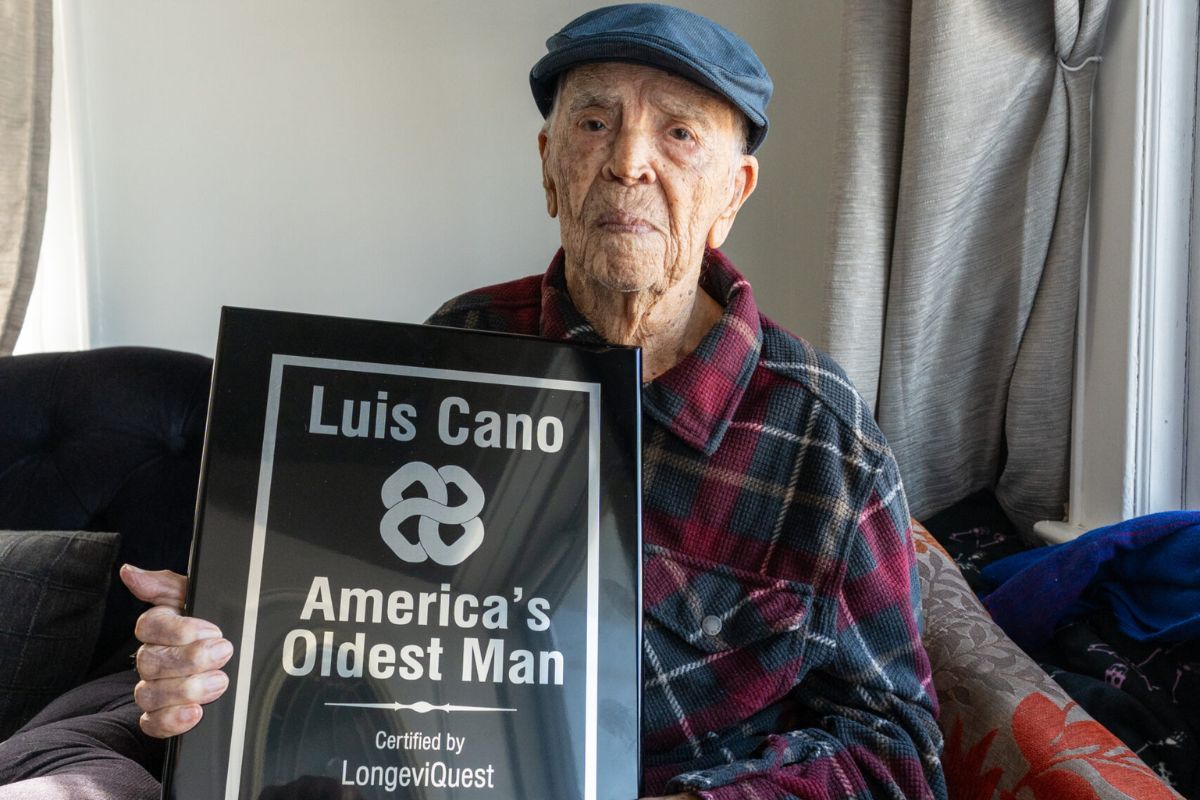
At 111 Years Old, Luis Cano, Colombian Residing in Linden, New Jersey, Had His Age Validated by LongeviQuest in December 2025 and Became Recognized as the Oldest Man in the United States, as Well as Being Among the Oldest in the World, Surrounded by Family and Local Tributes Today
Luis Cano, at 111 years old, has been recognized as the oldest man in the United States after having his age validated by LongeviQuest in December 2025. Born in Colombia and living in New Jersey, he also appears as the 12th oldest man in the world, a fact that places his name at the center of a very rare group of supercentenarians.
The scene accompanying this recognition is less solemn than many might imagine: in Linden, an industrial suburb near New York, Cano spends much of the day in his favorite armchair by the window, observing the street activity and commenting on daily life with his family, who affectionately call him “chismoso,” the “gossip” in Spanish.
Who Is Luis Cano

Luis Cano is a supercentenarian, a term used for people who reach 110 years or more, and is now officially associated with the label of oldest man in the United States based on validation released by LongeviQuest. In practice, this validation serves as a “seal” of credibility that distinguishes longevity stories told in families from records recognized by institutions dedicated to tracking these extreme ages.
-
Meteorologists warn of a storm with heavy rain and winds of up to 110 km per hour in the North of the continent, leaving thousands without power, causing flooding, and serving as a warning for Brazil after an increase in extreme weather events.

-
Kakebo, a Japanese technique created in 1904, teaches how to save money through simple notes and monthly tracking.

-
More than 500 Bronze Age objects, including pieces never seen in Western Europe, have emerged from a treasure buried 3,000 years ago in Scotland, intriguing archaeologists.

-
Luxurious mansion in Rio valued at up to R$ 40 million has already impressed international celebrities and belongs to a well-known Globo presenter.


Even when the public only sees the number, the process behind it is often what sustains the recognition. The idea of validated age exists to reduce doubts and turn an extraordinary narrative into a reliable record, especially when the person begins to be included in global lists, like the one that ranks Cano as the 12th oldest man in the world.
From the Mountains of Colombia to the Army: A Life Shaped by Effort and Discipline

Born in 1914 in the mountainous rural area of Colombia, Cano grew up in a physically intense work environment with little structure and no formal education. This beginning, described as being linked to rigorous activities, helps to understand why his biography is told by his family as a sequence of resistance, adaptation, and routine.
In 1937, he joined the Colombian Army and quickly gained a reputation as a sharpshooter, finishing second in target shooting training in his battalion. When asked, at 111 years old, if he could still shoot well, he confidently replied that he could. It’s not a statement about weapons, but about identity: he sees himself as capable, even at the limit of age.
The Bus Entrepreneur and the Mental Math That Became a Survival Tool
After his military period, Cano followed a path that also demands discipline: he became the owner and operator of a fleet of buses that transported passengers between underserved rural villages. It’s a detail that reveals two layers of the story: the precarious infrastructure that depended on transportation and his ability to manage something complex without a formal education.
As a businessman, he became so proficient in math that he performed calculations mentally. This skill, more than curiosity, suggests a life of quick decisions and constant attention, something that many family members associate with the fact that he remains awake and alert for much of the day, even currently.
A Giant Family Spread Across Countries That Keeps Daily Life Moving
Cano was one of ten children in his childhood and, with his wife Alicia, had ten children. In 1990, he moved to the United States, and today much of the family is spread across the New York metropolitan area, forming a network of children, grandchildren, great-grandchildren, and other relatives that helps to keep his days active and interesting.
His granddaughter Leidy Gomez, for example, makes a trip of approximately one hour by car to see him every week or two and often takes him for long walks around the city. She summarizes the impact of this simply: “Seeing him enjoy the outing makes me very happy.” It’s a portrait of longevity that doesn’t depend solely on the body but on connection and presence.
Linden, New Jersey: An Unlikely Place That Adopted Its Oldest Resident
At first glance, Linden seems a setting not commonly associated with longevity: an industrial suburb near New York, with a landscape marked by refineries, highways, and rows of houses. Still, it is in this urban routine, with noise and constant flow, that Cano found a particular “observation post,” from his chair by the window, watching passersby and neighborhood events.
The local community also participates in the recognition. The family says that people passing by the street honk or wave upon seeing “Happy Birthday” signs in front of the house, always with the age already in three digits.
The Role of the Mayor and the Symbolism of Tributes on a Memorable Weekend
The frequent visits from Linden’s mayor, Derek Armstead, have become part of the narrative surrounding Cano. On one of these occasions, he brought a newly issued proclamation in tribute to the resident, relating his life in detail that caught the family’s attention, and took time to talk with Cano and his relatives.
The meeting occurred just hours before the arrival of an impending snowstorm, a curious contrast between climatic urgency and accumulated human time.
When a city formalizes a tribute, it recognizes more than just a number: it acknowledges a whole life as local heritage, something rare for someone who arrived in the U.S. decades after being born in another country.
Routine, Nutrition, and Habits That He Associates with His Own Longevity
When it comes to the “secret,” Cano offers a practical response: healthy and entirely natural food, with a special emphasis on avocado.
He also advocates a healthy lifestyle in the most classical sense, stating that he has never smoked and never drank alcohol, in addition to maintaining a high level of physical activity even well after the age of 100.
Before contracting coronavirus in 2020, he spent most summer days tending to the garden. The family showed a video of him at 104 years old, rejecting his son’s pleas to rest, angrily raking the soil as if he wanted to prove his vitality. It’s not a “romanticized” image of old age: it’s effort, stubbornness, purpose, and routine. Even now, he remains awake and alert for much of the day, although he values a regular nap.
What Cano’s Story Provokes: Curiosity, Comparison, and Inevitable Questions
The recognition of the oldest man in the United States almost always brings comparisons: how does someone live through more than a century, change countries, raise a large family, maintain contact via FaceTime with relatives in Colombia, Spain, and the United Kingdom, and still show happiness in daily life?
In Cano’s case, the answer appears less in formulas and more in a set of factors: family bonds, a habit of staying active, pride in his past, and a routine that remains structured.
There is also a silent aspect: the validation in December 2025 places Cano under public scrutiny that blends admiration and scrutiny, as age records evoke both fascination and mistrust simultaneously.
Credibility in this kind of story depends as much on records as on biographical coherence, and his journey, from rural Colombia to the industrial neighborhood of Linden, offers precisely that continuous line of lived life.
Surrounded by family, honored by local authorities, and comfortable in his armchair with a view of the street, Luis Cano has become a concrete symbol of what it means to reach 111 years and be recognized as the oldest man in the United States.
In the end, what remains is a simple yet powerful combination: close relationships, a routine that didn’t stop too early, and the sense of belonging, even in a place that at first glance doesn’t seem made for “longevity stories.”
If you live with someone very elderly, what do you notice makes the most difference in day-to-day life: company, routine, nutrition, or movement?
And looking at Cano’s life, which habit do you think is most realistic to adopt or maintain for decades without turning into an empty promise?









-

-

2 pessoas reagiram a isso.