





 Portuguese
  English
  Spanish
  5 min of reading
  0 comments



At 95 Years Old, Nola Ochs Entered the Guinness World Records by Graduating College, Challenging Age Limits, Formal Education, and Inspiring the World with Intellectual Longevity.
This is not a motivational metaphor or journalistic exaggeration. In 2007, in the United States, a 95-year-old woman walked across the graduation stage and officially entered the Guinness World Records as the oldest person in the world to graduate from college. Her name is Nola Ochs, and her story has become a global landmark on active aging, lifelong education, and the real limits of the human brain.
The achievement happened at a time when many associate old age with loss of autonomy or a definitive distancing from academic environments. In Nola’s case, the exact opposite occurred: the university became a natural extension of a curious mind that never accepted the idea of “expired time.”
Who Was Nola Ochs and Why Did Her Graduation Shock the Academic World
Born in 1911, Nola Ochs grew up during a time when women’s access to higher education was still limited in the United States. Formal education, especially for women from rural backgrounds, was seen as more of an exception than a rule. Even so, she completed high school, worked, raised a family, and only decades later decided to return to college.
-
A 68-year-old pizza delivery driver went off route to buy a soda that was missing from a visually impaired customer’s order, refused an extra tip, and now Dan Simpson has over R$ 546,000 in donations from people around the world who want to ensure he can retire peacefully on April 30.

-
Amateur archaeologists were searching a forest in Poland with metal detectors when they found a ceramic pot buried for over 1,500 years. Inside was a pure gold necklace weighing 222 grams, folded to fit in the vessel, and when experts examined the piece, they discovered it was the first Gothic torque ever found in Polish territory.

-
Millions of people have been eating pomegranates for centuries without knowing that this ancient fruit contains punicalagins, which scientists are studying for their possible effects on memory and vascular health.

-
Argentina patrols the South Atlantic with ships built in France and monitors over 1.1 million km² with 87 m OPVs, a range of 7,500 miles, 360° radar, and a 30 mm cannon against illegal fishing in the 200-mile zone.

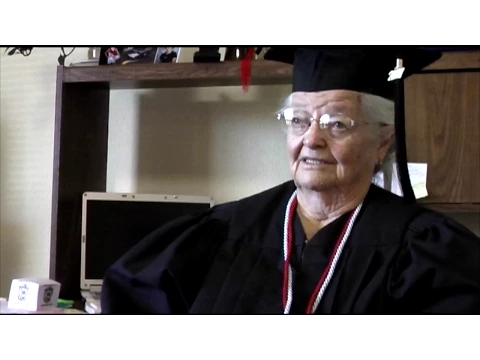

The definitive decision came late in life when many people would be decreasing cognitive activities. Nola made the opposite move: she returned to university studies regularly, attending classes, taking exams, submitting assignments, and actively participating in the academic environment.
In 2007, at the age of 95, she officially completed her degree in General Studies at Fort Hays State University in the state of Kansas. The institution confirmed that Nola met all the academic requirements expected of any student—without any special concessions or adaptations.
It was this rigor that led the Guinness World Records to formally recognize her achievement as a world record.
The Official Recognition by Guinness World Records
The Guinness World Records does not recognize stories solely based on emotional weight. The criterion requires complete documentation, institutional verification, and objective proof. In the case of Nola Ochs, all the requirements were fulfilled.
The recorded record was clear: “Oldest Person to Graduate from College”, with verified age of 95 years at the time of graduation.
The recognition transformed the graduation, initially local, into international news. Media outlets from various countries began to cite the case as an extreme example of intellectual longevity and preserved cognitive capacity.
Guinness emphasized that this was not a symbolic, honorary, or adapted course, but a regular degree, with a full course load, academic assessments, and curricular requirements identical to those of other students.
The Scientific and Social Impact of Nola Ochs’s Story
The case garnered attention not only from the media but also from researchers in the fields of gerontology, neuroscience, and education. The main question raised was simple yet powerful: how far can the human brain learn throughout life?
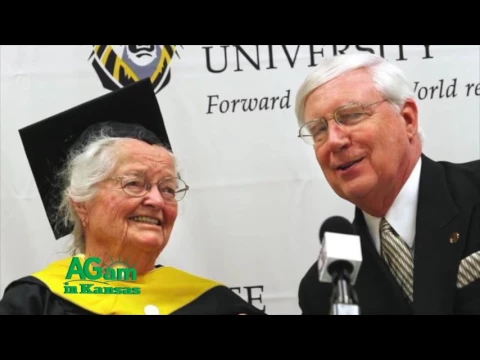
Studies had already indicated that neuroplasticity does not disappear with age, but Nola’s case brought this discussion to a new level. At 95 years old, she demonstrated the ability to:
– memorize academic content
– interpret complex texts
– produce written work
– maintain a study routine
– interact intellectually with much younger peers
Experts began to use her example to reinforce that cognitive aging is not uniform, and that factors such as continuous intellectual stimulation, curiosity, and purpose play a decisive role in preserving mental functions.
What Was a 95-Year-Old Student’s Academic Routine Like
Contrary to what many might imagine, Nola did not have an exceptionally protected routine. She attended in-person classes, interacted with students decades younger than herself, and maintained a study discipline compatible with the course’s demands.
University reports indicate that she was known for her punctuality, genuine interest in classes, and active participation in discussions. Professors stated that Nola did not seek privileges due to her age and insisted on being treated like any other student.
This attitude helped break stereotypes both inside and outside the campus, showing that chronological age does not, by itself, determine the ability to learn.
Comparisons with Other Extreme Cases of Academic Longevity
After Nola Ochs’s record, other cases began to gain visibility, but few came close to her mark. Many elderly students return to college at ages 60, 70, or even 80 — notable achievements, but still distant from the 95 years reached by Nola.
Even years later, her name continued to be a reference when the topic is education in later life at the university level.
She became a benchmark for inclusive educational policies and discussions on the need for universities to better prepare for students of all ages.
The Legacy Left by Nola Ochs
Nola Ochs passed away in 2016, at the age of 105, maintaining until the end the image of someone intellectually active and socially engaged. Her legacy goes beyond the formal record.
She came to symbolize the idea that learning has no expiration date, and that aging can be accompanied by intellectual growth, as long as there is encouragement, access, and willingness.
Universities began to use her example in institutional campaigns, lectures on active aging, and extension programs aimed at the elderly population.
More than a record, Nola left a concrete argument against the idea that there is a “right” age to learn—or a “wrong” age to try something new.
An Achievement that Redefines the Limits of Education and Human Longevity
When a 95-year-old person completes an officially recognized degree, the impact goes beyond the individual. The achievement forces a profound reassessment of concepts regarding old age, productivity, learning, and the social role of the elderly.
Nola Ochs’s story is not just inspiring — it is documented, recognized, and measurable, making it even more powerful. In a world that is aging rapidly, her record remains the highest reference for intellectual longevity applied to formal education.
And the question that remains is not “how did she do it,” but rather: how many possibilities are still dismissed simply because someone believes they are past the right age?








-

-

-

-

-

15 pessoas reagiram a isso.