





 Portuguese
  English
  Spanish
  3 min of reading
  0 comments


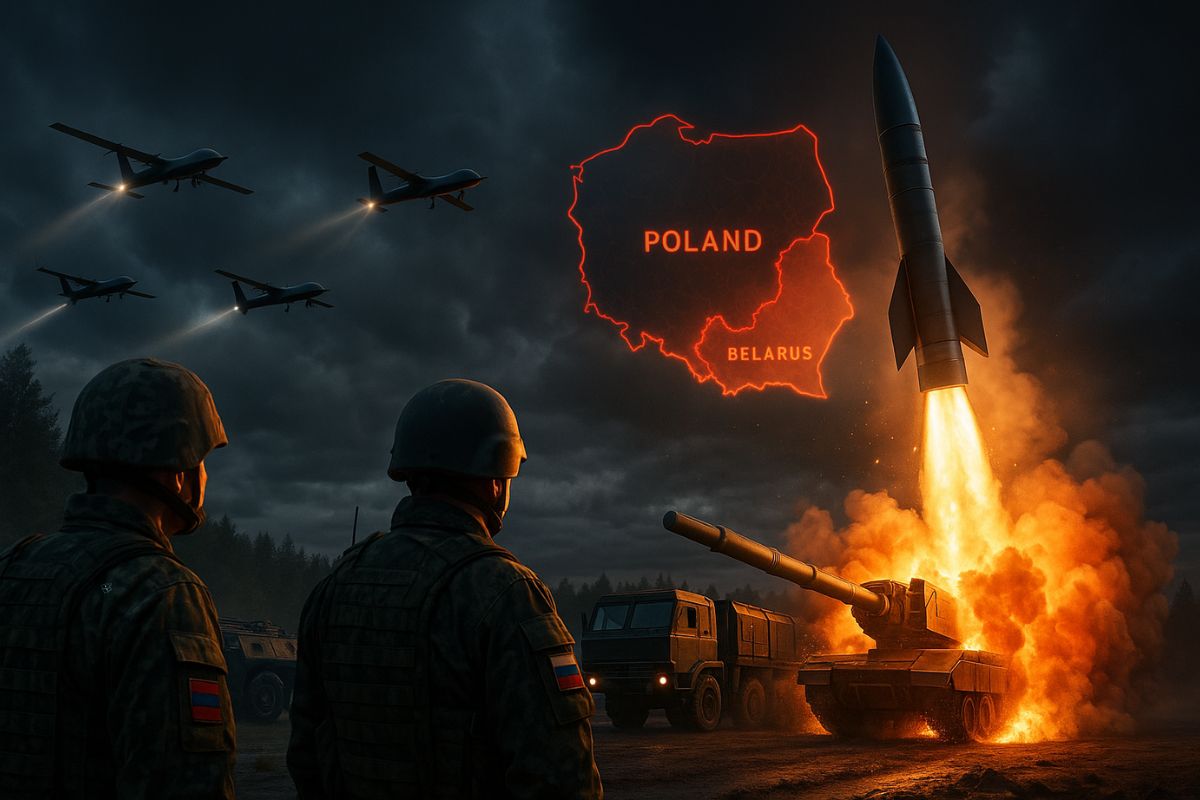
Two Days After Violations of Poland’s Airspace, Moscow and Minsk Began Military Drills with Nuclear Weaponry and the Hypersonic Missile Oreshnik on September 12, 2025, Increasing Tension with NATO.
According to information from G1, the crisis began in the early hours of September 10, 2025, when Poland recorded 19 incursions of Russian drones in its airspace — the highest number since the start of the war in Ukraine. Some equipment was shot down by Polish and NATO fighters, while others fell in different parts of the country. One of the drones even struck a house in the Lublin region, causing no injuries.
The seriousness of the situation led Warsaw to invoke Article 4 of the North Atlantic Treaty, which provides for emergency consultations among members of the alliance in cases of security threats. The incident was classified by European authorities as the most serious air violation by Russia against Europe since 2022.
Start of Nuclear Exercise on September 12
Just two days later, on September 12, 2025, Moscow and Minsk began a large-scale nuclear exercise, involving ground troops, attack aircraft, warships, and submarines.
-
A rare storm transformed part of the Gulf into an unlikely scene of hail, extreme rain, and tornado risk in the middle of the desert, with volumes that exceeded the annual average in a single day.

-
Brazil catches the world’s attention with ships powered by ethanol and biodiesel that have lower emissions, an unprecedented certification with advantages in chartering, and a revolution in cabotage.

-
A couple who only has Sundays free has built a hand-dug pool, a hamburger joint, a dance hall, and a playground in their own home without hiring a mason, and even with breaks due to accidents and the pandemic, the work has never truly stopped.

-
Furniture made with aluminum and glass does not warp and has become an alternative to replace MDF in Brazil.


The schedule includes activities until September 16 in areas of Russian and Belarusian territory, in the Baltic Sea, the Barents Sea, and even in the Arctic Circle.
Among the weaponry being tested is the hypersonic missile Oreshnik, announced by Russia in July and now deployed to Belarus.
According to the Russian Ministry of Defense, the exercise is “routine” and does not target any specific country, but the temporal proximity to the drone crisis heightened perceptions of provocation.
Reactions from Poland and NATO
Poland reacted immediately.
Prime Minister Donald Tusk stated that the country is experiencing “the moment closest to an armed conflict since World War II.”
Warsaw decided to close the border with Belarus and mobilize additional forces in the eastern region.
NATO reinforced its presence: France sent three fighters to support Polish air defense, while Germany deployed a battalion to Lithuania, strengthening military containment in the Baltic.
The alliance’s Secretary General, Mark Rutte, called the Russian actions “absolutely reckless.”
Belarus Under Direct Suspicion
Another critical point was the origin of some of the drones.
The Polish government stated that several pieces of equipment were launched directly from Belarus, which would implicate Minsk as an active participant in the escalation.
General Pavel Muraveiko, head of the Belarusian General Staff, denied the accusation, saying that his air defense simply tracked drones “off course.”
Nevertheless, the justification did not convince Warsaw or NATO allies.
Risks for Europe and Brazil
The use of the hypersonic missile Oreshnik in nuclear exercises increases the risks of strategic miscalculation.
For the European Union, the incident raises the possibility of an accident or direct confrontation.
For Brazil and other countries importing energy and grains, the escalation means additional instability in fuel, fertilizer, and food prices, as the region concentrates essential transport routes.
Analysts warn that if NATO’s Article 4 evolves into Article 5 — which provides for collective defense in case of attack — the conflict could escalate to even more serious proportions, directly affecting international trade and global security.
The sequence of events — Russian drones over Poland on September 10 and the start of the nuclear exercise on September 12 — shows that the crisis in Eastern Europe has entered a new level of military tension.
The use of the Oreshnik, combined with Moscow’s rhetoric and the closing of the Polish border, increases the risk of incidents capable of turning exercises into real confrontation.
And you, do you believe that this nuclear exercise represents only a demonstration of strength or could it be the spark for a wider conflict in Europe? Leave your opinion in the comments — we want to hear from those closely following this escalation.







Seja o primeiro a reagir!