





 Portuguese
  English
  Spanish
  4 min of reading
  17 comments


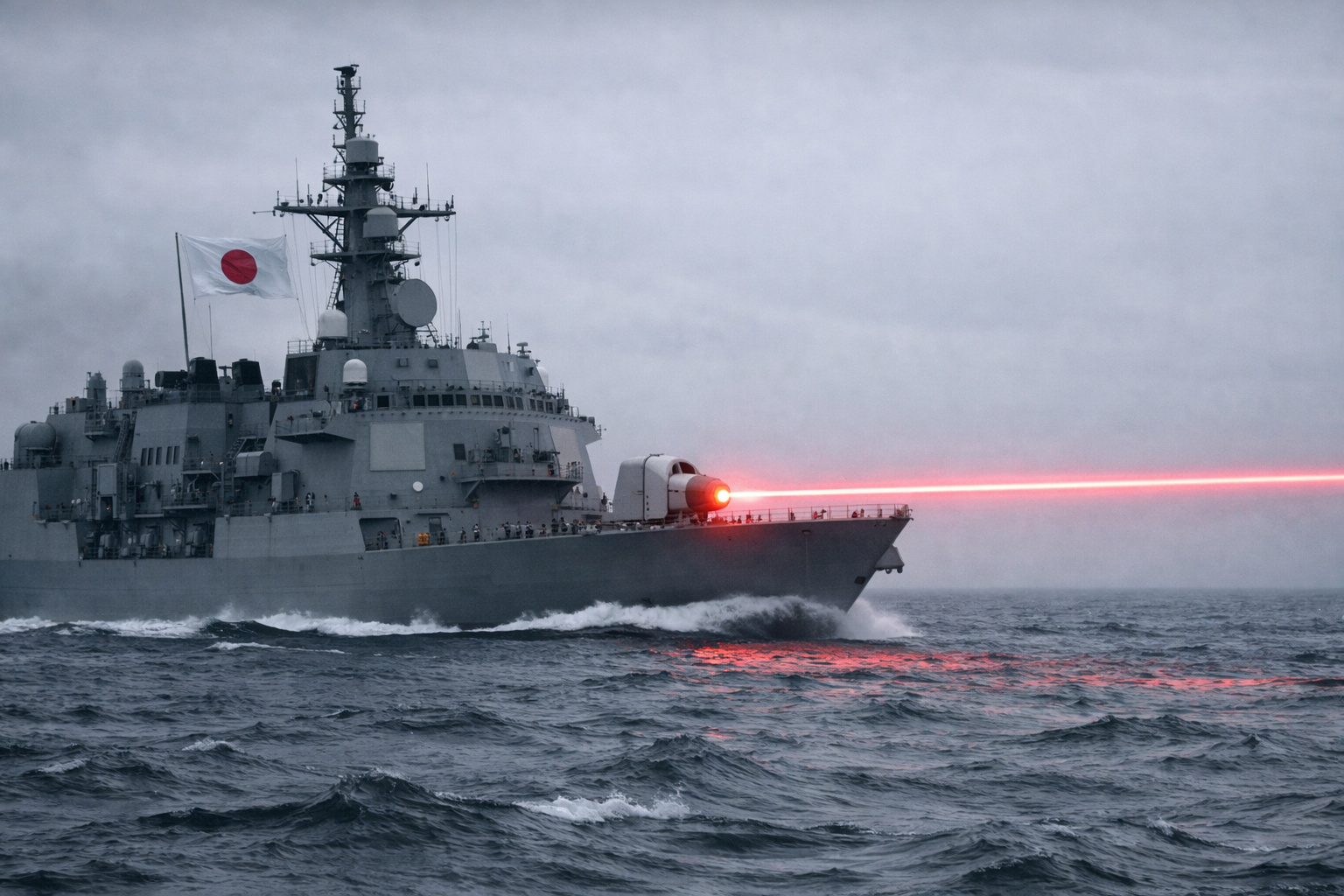


Experimental System Combines Ten High-Power Lasers Into A Single Energy Beam, Promises “Infinite Ammunition” Against Drones And Mortars And Inaugurates A New Phase In The Global Race For Directed Energy Weapons In The Maritime Environment
Japan has taken a decisive step in the military technology race by starting maritime tests of a 100-kilowatt laser weapon, installed on a 6,200-ton warship. The system is designed to neutralize drones, mortars, and light aerial threats in mid-flight, using concentrated energy capable of burning metal surfaces, without resorting to conventional projectiles.
The information was disclosed by international specialized reports, including the website Live Science, based on official announcements from the Acquisition, Technology and Logistics Agency (ATLA), an agency linked to the Japanese Ministry of Defense responsible for the development and acquisition of new military technologies.
The weapon was installed on the test ship JS Asuka, after the vessel underwent a shipyard process at Japan Marine United. The system drew attention for occupying two 40-foot modules (about 12 meters each), protected by dome-shaped structures, which indicates the size and complexity of the onboard equipment.
-
In Kenya, engineer Nzambi Matee created “bricks 2.0” using packaging plastic: a mixture with sand, heated and pressed; they are 5 times more resistant, already have official licensing, and are being used in streets and construction projects.

-
More than 20,000 positions could be opened, and thousands of technicians are starting to be trained in Brazil, as the expansion of data centers creates an urgent race for professionals to keep the internet, cloud, and artificial intelligence running 24 hours a day.

-
China approves the 15th Five-Year Plan 2026-2030 to become a global power: prioritizes brain implants, 6G with AI, humanoid robots, flying cars, quantum technology, and nuclear fusion, while strengthening defense and the economy.

-
HONOR X80i arrives with a massive 7,000 mAh battery, a 120 Hz AMOLED display with a brightness of 6,500 nits, and the new Dimensity 6500 Elite chip, promising up to 22 hours of video playback and impressive performance in casual gaming.


How The Japanese 100 kW Laser Weapon Works
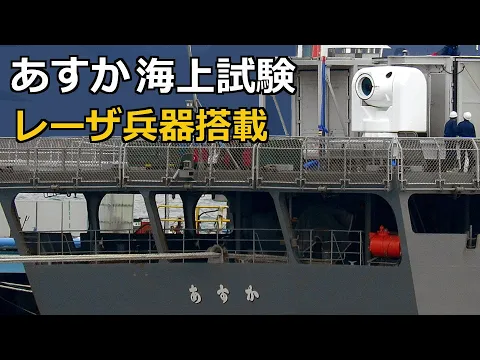

The system utilizes ten fiber optic lasers, each with 10 kW of power, combined to form a single highly concentrated 100 kW beam. It is a solid-state laser, in which light is amplified as it travels through optical fibers doped with rare earth elements, allowing for greater control, precision, and stability of the shot.
This level of power is sufficient to overheat structural components of drones, damage sensors, compromise metal surfaces, and, in many cases, cause total loss of the target aircraft. Unlike kinetic weapons, the laser does not rely on explosives or physical projectiles, greatly reducing collateral risks.
Additionally, Japanese engineers claim that the system was specifically designed to face low-cost, high-frequency aerial threats, such as adapted commercial drones, swarms of UAVs, and improvised munitions, a scenario increasingly common in modern conflicts.
Another strategic differentiator is the concept of “unlimited magazine depth.” According to ATLA, as long as there is sufficient power supply, the system can fire continuously, without worrying about ammunition reloads. In practice, the cost per shot is significantly lower than that of traditional surface-to-air missiles.
Sea Tests and Operational Challenges of the Technology
After successful land tests against drones and mortars, Japan is now advancing to the project’s most critical phase: real maritime environment tests, scheduled to begin after February 27, 2026, according to information monitored by the specialized channel @AGChatch on YouTube.
At sea, the system will face much more complex challenges. Among them are the constant movement of the deck, vibrations, wind, high humidity, atmospheric beam dispersion, and reflections caused by saline particles in the air. Maintaining shooting accuracy on a moving ship is one of the biggest technical hurdles of onboard laser weapons.
Moreover, directed energy systems require high electrical consumption and intense cooling. Even under ideal conditions, fiber optic lasers operate with an average efficiency between 25% and 35%, meaning that a large portion of the energy is converted into heat. On ships, this imposes severe engineering and infrastructure limitations.
According to Japanese authorities interviewed by the site The Asia Live, the objective of this phase is not immediate deployment but evaluating whether even more powerful versions could, in the future, be capable of intercepting missiles, something considered a game changer in naval defense.
Japan Joins The Select Group Of Powers With Directed Energy Weapons
With this advancement, Japan joins a restricted group of countries that officially develop directed energy weapons, including United States, France, Germany, and United Kingdom. China is also pointed out as a possible member of this group, after images surfaced on social media in 2024 showing a supposed laser installed on a Chinese amphibious ship.
However, so far, the only officially planned naval deployment involves vessels equipped with the Aegis system, an advanced naval defense platform ordered by the Japanese Ministry of Defense. According to the site Naval News, these ships are expected to enter service only after 2032.
On the international scene, the United Kingdom successfully tested the DragonFire system, which knocked down drones during trials conducted in the Hebrides Islands, Scotland. By the end of 2024, Chinese scientists announced the development of a high-power microwave weapon, capable of concentrating electromagnetic waves against specific targets.
Despite the advancements, experts warn that the technology is still far from being used in large-scale combat. Even so, the Japanese tests represent a strategic milestone, indicating that the future of naval warfare may become increasingly silent, precise, and energy-dependent — rather than gunpowder-dependent.






Agora se os EUA e Rússia tentarem alguma coisa com o Japão, é só testarem essa arma com eles ou não?
Então, os EUA também estão testando esse tipo de arma. 50/50 agora.
Um feixe de laser disparado no espaço, qual o risco disto atingir outros astros e planetas no espaço a velocidade da luz, visto que ele ira propagar infinitamente até que atinja algum alvo?
Muito bem