





 Portuguese
  English
  Spanish
  5 min of reading
  2 comments


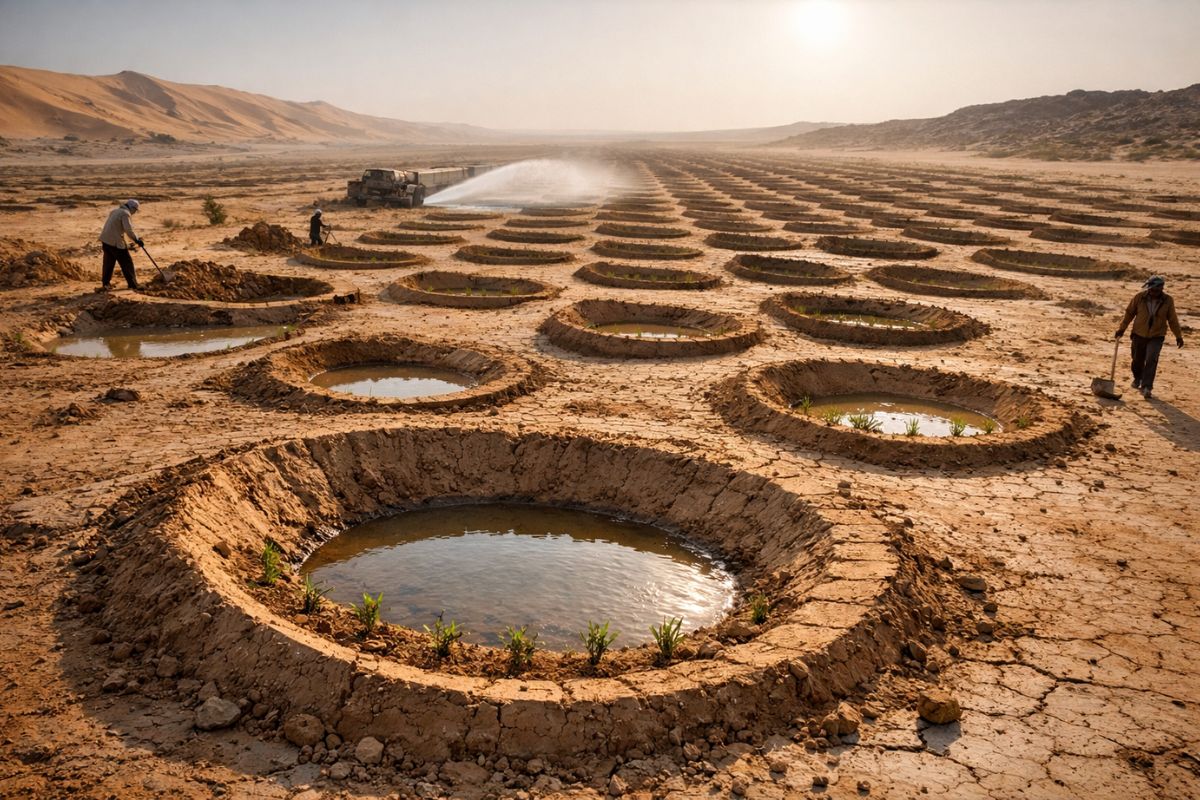


In the Sahara, The Problem Wasn’t Lack of Seedlings, but The Soil Sealed by Heat and Overexploitation. Expensive Reforestation and Even Beehives Collapsed. Growing Cavities Retain Rain, Break the Crust, Hold Deep Moisture, and Cool the Ground, Allowing Grasses and Acacias to Rebirth Without Planting in Areas Previously Lost.
The Sahara is often remembered as a place where nearly everything evaporates before turning into life. However, behind the “impossible” landscape, there was a silent physical blockade, created by extreme heat and intensive land use, that turned the soil into a hard and impermeable surface.
When researchers and local communities began to focus first on water and soil structure, the Sahara stopped being just a symbol of failure. The turnaround did not come from sophisticated machines, but from simple half-moon excavations, capable of capturing rain, breaking the crust, and paving the way for the spontaneous recovery of the ecosystem.
Why The Sahara Defeated “Modern” Projects

In the Sahara, the challenge begins at the ground: the sand can exceed 70°C, and the air above 40°C creates an evaporation rate so high that any surface moisture disappears quickly. This combination makes “modern” initiatives look promising on paper and crumble in the field because the water disappears before fulfilling its ecological role.
-
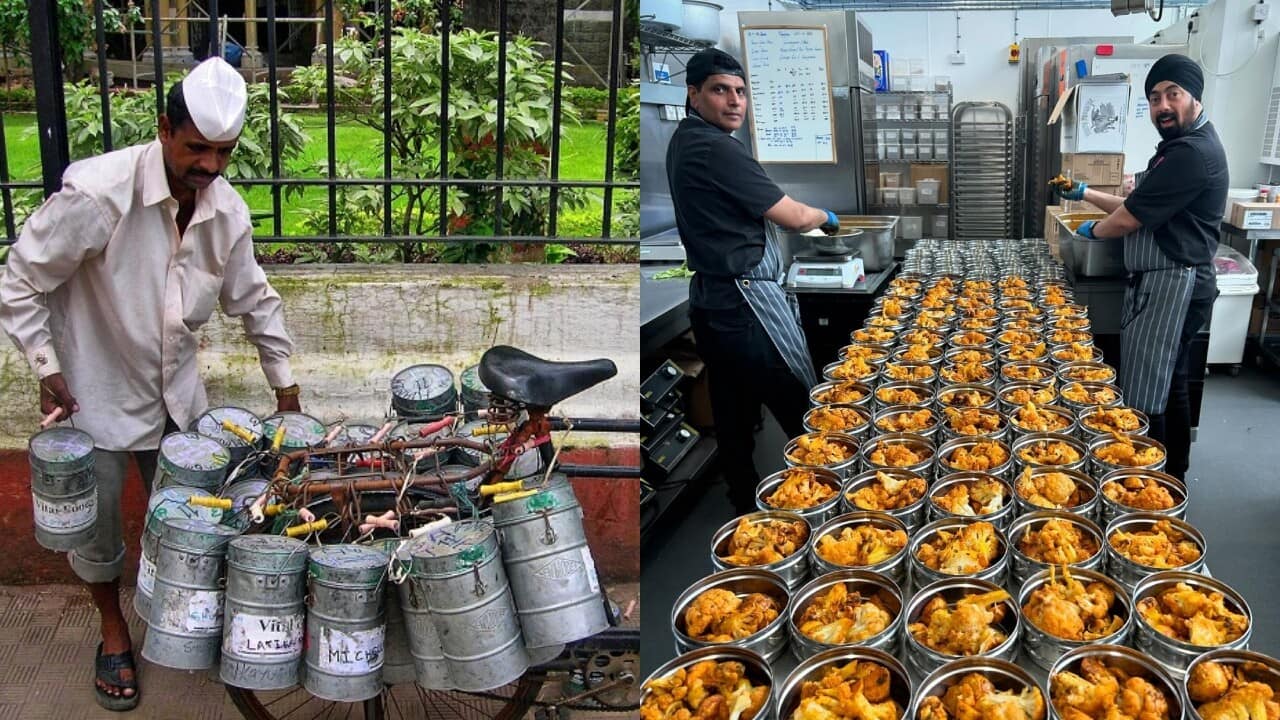
How 5,000 Indian dabbawalas manage to deliver around 200,000 lunchboxes a day in Mumbai for over 130 years using bicycles, crowded trains, and a manual system that continues to operate with impressive accuracy.
-
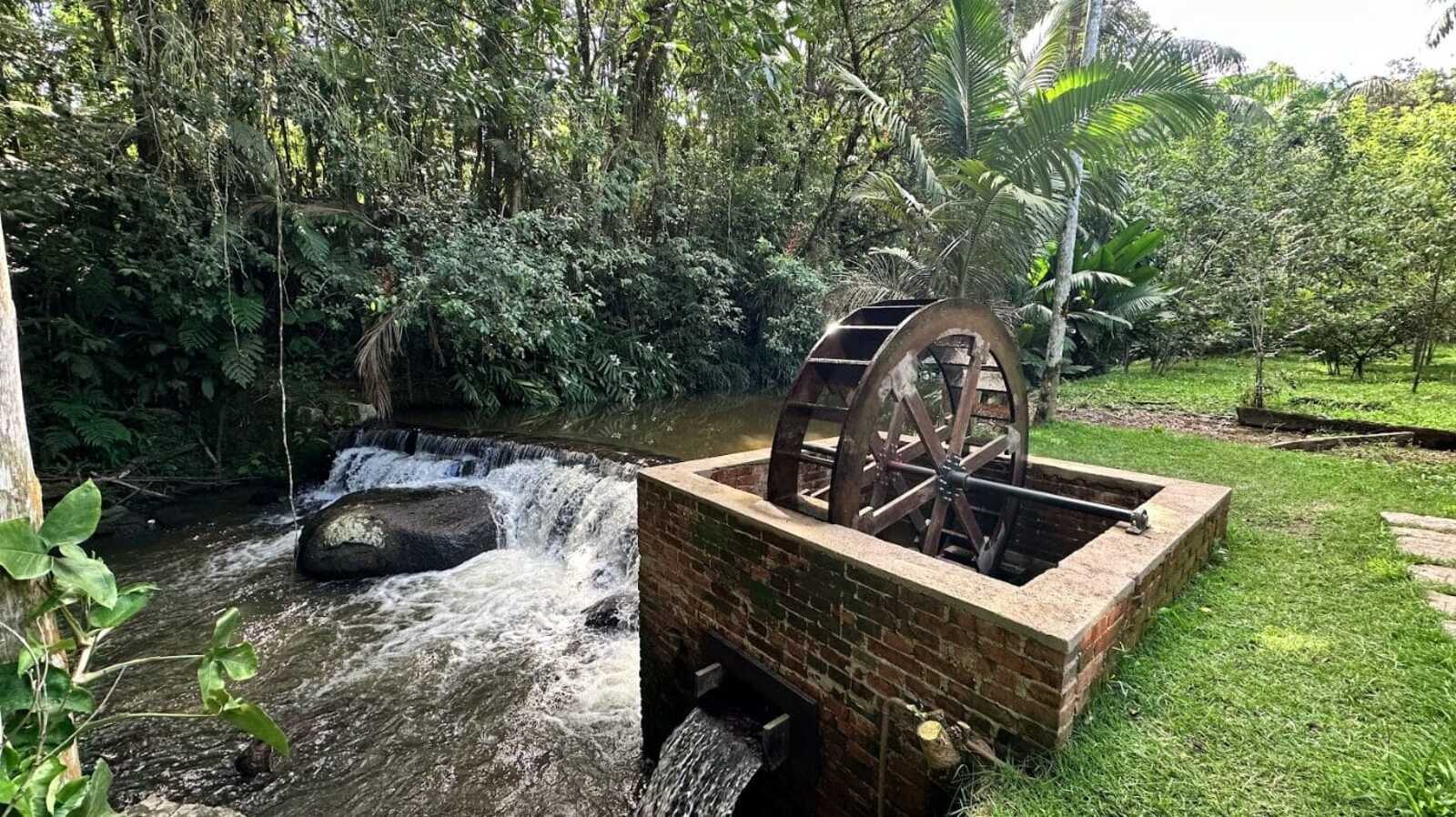
While restoring a historic mansion from 1910, a brick structure with an old turbine that generated energy from the Rio do Testo emerged, along with a hidden door and a rare floor concealed under layers of wax.
-
Italian researchers have detected what appears to be a second Sphinx buried under the sands of Egypt, and satellite scans reveal a gigantic underground megastructure hidden beneath the Giza Plateau for over 3,000 years.

-
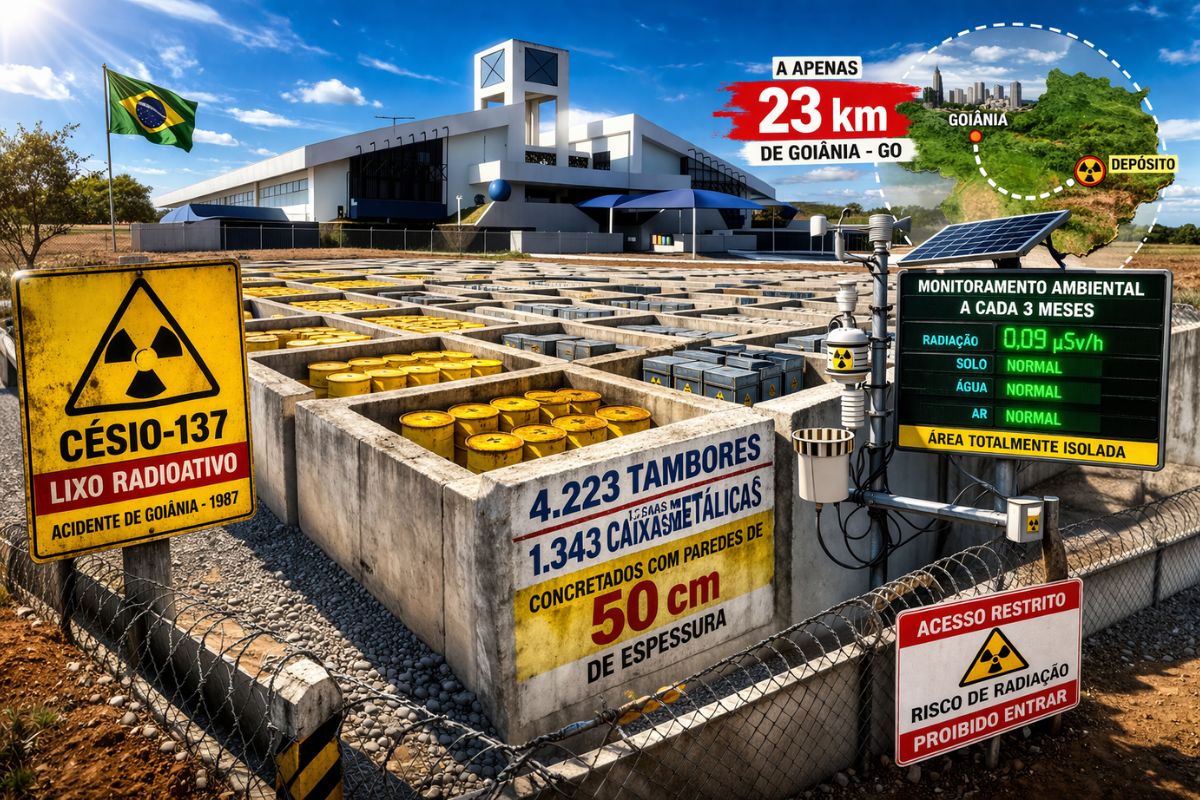
There are 4,223 drums and 1,343 metal boxes concreted with 50-centimeter walls that store the radioactive waste from Cesium-137 in the worst radiological accident in Brazil, just 23 kilometers from Goiânia, with environmental monitoring every three months.

The critical point, however, was even more basic. Extreme heat and overexploitation favored the formation of a hardened and impermeable crust, preventing rainwater from penetrating. Without infiltration, roots cannot find persistent moisture, seedlings die early, and restoration cycles stall, even after decades and vast investments, with billions of dollars and trees wasted on frustrated attempts.
When Biology Doesn’t Win Over Physics

In the Sahara, even “ecological” solutions ran into the thermal limits of the environment. One idea was to use beehives to accelerate pollination and boost regeneration, but the very climate dismantled the proposal: with the air above 40°C and the ground boiling, the wax of the hives melted and the honey became liquid, destroying the bees and interrupting the process.
This episode left a hard and objective lesson. Without solving the physical problem of water in the soil, biology lacks the foundation to function.
Pollinators, seeds, and seedlings depend on minimally stable microenvironments. When the soil is sealed and too hot, the ecosystem loses the chance to “organize” itself because it lacks the first requirement: moisture available for long enough.
Half-Moons: The Design That Changes the Path of Water

The turnaround in the Sahara occurred when the strategy shifted from the logic of “planting to save” to “preparing to rebirth.”
A millennia-old manual technique came into play: crescent-shaped excavations, known as half-moons, positioned against the slope of the land to capture every drop of rain and reduce runoff that would carry the water away, as well as limit erosion.
The central mechanism is simple and powerful. By retaining water in the cavity, the pressure helps break the hardened crust, allowing moisture to infiltrate into deeper layers, where the sun does not reach with the same intensity and evaporation is lower.
This design creates a local microclimate: in areas protected by these pits, the soil temperature can be up to 15°C lower, opening a thermal window for germination, rooting, and survival.
The Rebirth That Doesn’t Depend on Planting
With moisture retained in the Sahara’s subsurface, the first return tends to come from native grasses. They sprout where nothing used to settle, and their roots work as biological engineering: increasing porosity, creating channels, improving infiltration in subsequent rain events, and making the soil less compact.
It’s a cascading effect that starts small and gains stability over time, because each cycle improves the conditions for the next.
From there, the environment begins to attract mobile life, which enhances recovery without requiring anyone to carry forests into the desert. Insects and birds begin to circulate and transport seeds from other areas.
Resilient native trees, such as acacias, come into play with a decisive advantage: their seeds can remain dormant for years and “wake up” when moisture finally becomes viable. The result is the spontaneous emergence of adapted vegetation, forming interlinked green corridors where there was once only continuous aridity.
What This Turnaround Teaches About Restoring Extreme Landscapes
The story of the Sahara shows that restoration is not just about choosing species or “betting” on technologies. It’s about understanding the physical bottleneck that prevents life from establishing.
When water runs off, evaporates quickly, and does not enter the soil, the system fails at its core. The half-moons work because they reposition water in the right place: within the ground, where it lasts longer and becomes an ecological condition.
It also becomes clear that simple solutions are not synonymous with easy solutions. In the Sahara, positioning against the land slope, repetition across the landscape, and maintaining the structures make a difference in capturing rain and sustaining the microclimate.
The big change is to replace the obsession with “planting immediately” with a more realistic sequence: retain, infiltrate, cool, and only then let nature occupy the space.
The Sahara was not “tamed” by a technological promise, nor by an excess of seedlings, but by a course correction: treating the soil as the first organism to be recovered.
When the crust breaks and water begins to infiltrate, the desert stops expelling life and starts inviting it back, with grasses, transported seeds, and native trees emerging in their own time.
And you, when looking at this turnaround in the Sahara, do you trust more in simple physical solutions or in complex modern projects to recover degraded areas?
What similar technique have you seen work, even on a small scale, to hold water and revive the land where it seemed there was no way out?







This method worked for me thanks to my observation and understanding water flow trappers
Israel attempted using Limans ie: Harbour – Gk), circular shaped structures designed to retain water, in its Negev desert….a concept similar to the one discussed in the article.