





 Portuguese
  English
  Spanish
  4 min of reading
  4 comments


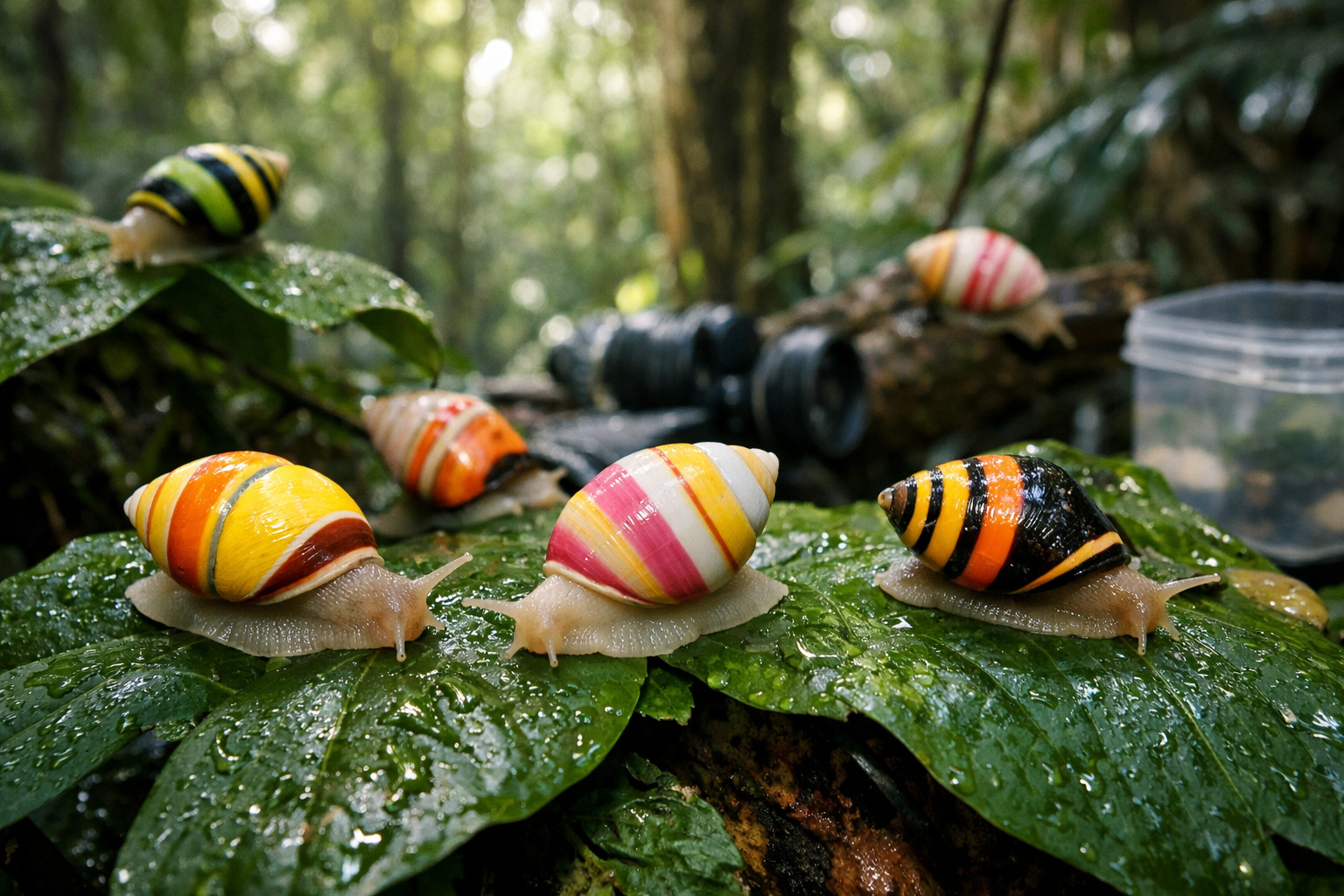


The Return of O‘ahu Tree Snails to the Forest Marks the Result of Decades of Science, Institutional Cooperation, and Resistance Against Invasive Species That Nearly Erased an Ecological and Cultural Symbol of Hawaii
After more than 30 years considered extinct in the wild, extremely rare Hawaiian tree snails have returned to inhabit their original environment in a scientific operation that symbolizes one of the longest and most complex conservation efforts ever conducted in the archipelago. The reintroduction occurred on December 10, 2024, in the Ko‘olau Mountains, within the Honolulu Watershed Forest Reserve on the island of O‘ahu.
The information was disclosed by the Hawaii Department of Land and Natural Resources (DLNR), with support from the U.S. Fish and Wildlife Service, universities, and armed forces of the United States, consolidating nearly half a century of studies, captive breeding, and rigorous control of invasive predators.
O‘ahu Tree Snails: Living Jewels of the Hawaiian Forest
Locally known as kāhuli, the Hawaiian tree snails are often described as true jewels of the forest. Their multicolored shells appear in traditional poems, songs, hula dances, and even in Hawaiian folklore legends, which attribute to the animals the symbolic ability to “sing.”
-
Seen from space, a colossal volcano nearly 5,000 meters high in Russia has released 1,600 km of smoke over the Pacific, forming “devil’s horns” of lava and revealing the brutal force of the Ring of Fire.
-
Expedition 501: Scientists drill into the ocean floor and discover a giant reserve of fresh water hidden beneath the sea, extracting nearly 50,000 liters and revealing an invisible system that could reshape the map of water scarcity.

-
Archaeologists find an intact tomb over 2,500 years old, with more than 100 preserved objects, weapons, jewelry, and human remains never touched.
-
Volcanic lava transforms into threads as fine as human hair that travel over 30 kilometers by wind and fall like cutting rain on roofs and backyards in Hawaii and Iceland.

Beyond their cultural value, these snails play an essential ecological role. They feed on fungi and algae that grow on leaves and trunks, directly contributing to the microbiological balance of the forests and the nutrient cycle of the soil. However, this natural heritage has suffered an accelerated collapse over the past century.
It is estimated that there were once over 750 species of native snails in Hawaii. In just the last 100 years, about 60% of these species have gone extinct. Currently, 44 species are officially listed as endangered under the U.S. Endangered Species Act, while many others remain without any legal protection.
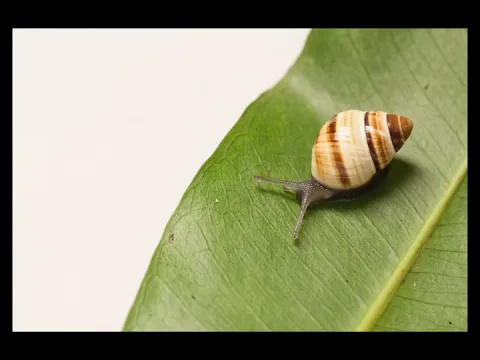

Invasive Predators and the Silent Collapse of Populations
A large part of the extinction crisis is linked to the introduction of invasive species. The Pacific rat arrived on the islands about 1,000 years ago, brought by Polynesian navigators. Centuries later, roof rats and ship rats landed with European ships, drastically amplifying the impact on native fauna.
The situation worsened further in the 20th century. In the 1930s, the giant African snail was introduced to Hawaii as a garden ornament. Today considered the second worst invasive species on the planet, it prompted an attempt at biological control that ultimately turned disastrous.
To contain its proliferation, environmental managers introduced the Rosy Wolf Snail, a highly efficient predator. The result was devastating: in addition to attacking the African invader, it quickly began exterminating native snails, which had no evolutionary defenses against this type of predator.
The Science Behind Survival: Decades of Laboratory Work
Dr. Michael Hadfield, professor emeritus at the University of Hawaii at Mānoa, was one of the first scientists to alert about the imminent extinction of tree snails. Since the 1970s, he and his students have meticulously documented the life cycle, reproduction, and accelerated decline of these species.
In 1981, several species of O‘ahu snails were officially listed as endangered. Ten years later, Hadfield collected the last 11 known specimens of the species Achatinella fuscobasis in the wild and initiated an experimental breeding program in the lab, a move considered high-risk.
The initial artificial environments accurately simulated cycles of light, temperature, and humidity. As snails feed on fungi that naturally grow on leaves, researchers began cultivating these fungi on Petri dishes, ensuring continuous and controlled feeding.
Exclosures: Physical Barriers Against Extinction
With the advancement of captive breeding, scientists realized that it would be impossible to reintroduce snails without physically protecting them from predators. Thus, exclosures emerged, areas isolated by electric barriers and slippery surfaces that prevent access by rats, predatory snails, and even invasive chameleons.
The first structures were rudimentary: simple electric fences, barbed wire, and even salt moats. Still, the results were immediate. Outside of the protected areas, the snails disappeared; inside, they thrived.
Today, these areas have evolved into advanced structures known as kāhuli kīpuka, approximately the size of a house, with solid walls and low-voltage electric systems that only repel predators without killing them.
Conservation as a Generational Effort
Currently, the program is led by a new generation of scientists, such as David Sischo from the DLNR, a former student of Hadfield. He coordinates the Snail Extinction Prevention Program (SEPP), a partnership involving universities, the U.S. Army, museums, and zoos.
Despite the advancements, challenges remain enormous. It is estimated that about 100 species of snails could disappear in the next decade if additional measures are not adopted. Even so, there is hope that technological advances and more efficient predator control will allow, in the future, the full reintegration of these species into the forest.
According to specialists involved in the project, complete recovery will not be the work of a single generation, but rather a continuous effort that will span decades.
The reintroduction of tree snails from O‘ahu not only represents the return of a species but also proves that science, when supported by institutional cooperation and long-term vision, can reverse even extinctions deemed definitive. It is a silent victory, built slowly, leaf by leaf, generation by generation.
Do you believe that scientific conservation efforts like this can reverse extinctions caused by human actions, or has time become a decisive factor against biodiversity?






Que noticia!!!! Son iguales a los caracoles cubanos jajaja
Polimitas pictaa
Que belleza de animalitos!!!cuando se quiere se puede,felicitaciones a todos los que hicieron posible para que estás bellezas no desaparezcan.Llevo tiempo pero lo lograron!!!!
Pues si