





 Portuguese
  English
  Spanish
  5 min of reading
  0 comments


The Nvidia CEO, a Company Valued at $3 Trillion, Finally Breaks the Silence and Reveals the Next Big Project of the Company. It Will Be a More Intriguing and Complex Segment Than AI! See What’s Coming and Why This Could Change the Future.
Nvidia, globally recognized for its excellence in technology and innovation, is not content with just being a leader in the GPU sector. The company, which ranks among the most valuable in the world, is always a step ahead, seeking new opportunities and markets.
With its vast financial capacity and future-oriented strategic vision, the tech giant is now preparing to explore a new promising segment, reaffirming its commitment to transforming the world once again.
The rise of artificial intelligence (AI) has not only revolutionized various industries but also catapulted Nvidia to the top of global technology, boosting its market value to trillions of dollars.
-
There is a gap of hundreds of kilometers between weather observation points in the United States, and now drones flying at 6,000 meters altitude in strong winds are filling this gap to predict tornadoes before they kill.
-
The most famous volcano in the world could paralyze one of the largest metropolises on the planet: Japan accelerates emergency plans for the eruption of Mount Fuji, which could bury Tokyo in ash for over two consecutive weeks.

-
The United States has a serious problem with its F-35s: China is already producing fighters at a pace that exceeds American capacity and could manufacture up to 300 aircraft per year before the end of the decade, shifting the global military balance.
-
Remains with battle wounds of over 100 soldiers from the Roman Empire are found beneath a football field in Vienna, leaving everyone surprised.


As highlighted by BI, with AI expanding beyond graphics processing, Nvidia is now betting big on an even more complex field: robotics.
With big names like Elon Musk sharing this vision, Nvidia is determined to make humanoid robots and autonomous machines a reality, leveraging its vast computational power. But, will the company be able to conquer this ambitious new market?
Jensen Huang and His Vision for the Future of Robotics
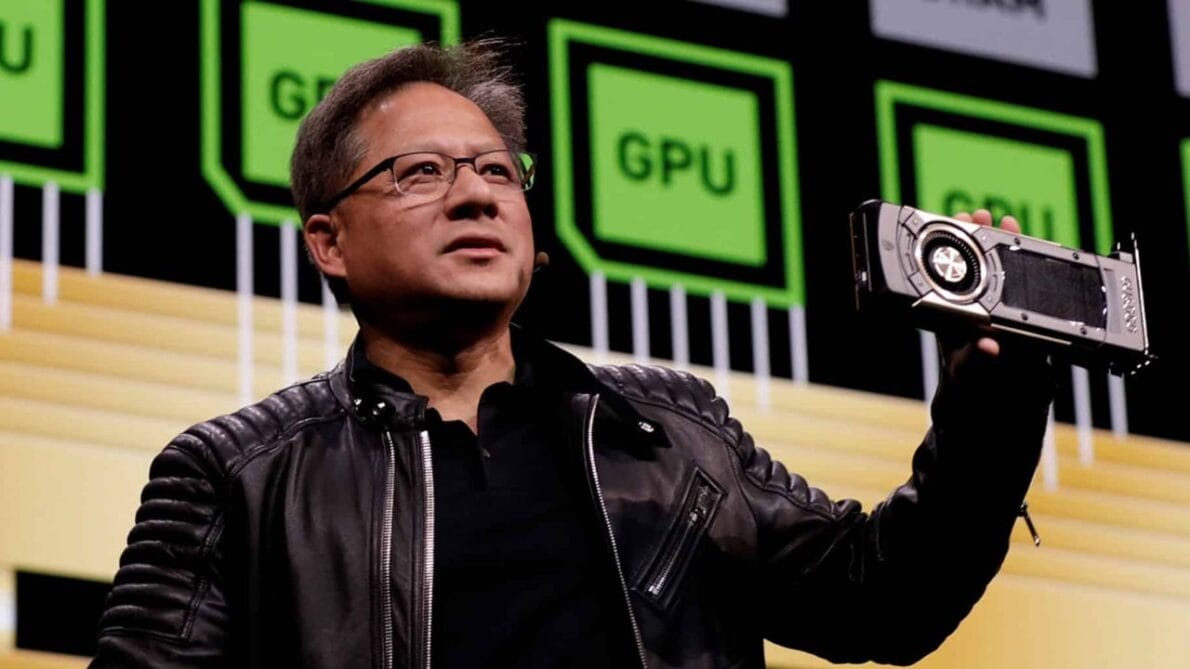
At the Computex 2024 event held in Taipei, Taiwan, Jensen Huang, Nvidia CEO, took the stage wearing his iconic black leather jacket.
Alongside humanoid robots displayed on a giant screen, Huang made a bold statement: “Robotics is here. Physical AI is here. This is not science fiction.”
Although the robots on stage resembled more wheel-based machines used for deliveries, Huang clarified that robotics will be a fundamental part of the future.
Nvidia has already dominated the market for GPUs (graphics processing units), fueling the AI boom and driving its market value to unprecedented levels, but to sustain this growth, the company needs to expand into new markets.
Robotics may be the answer, but the transition to this field will not be easy. Unlike advancements in language-based AI, where foundational models and large data libraries simplified development, robotics involves much more complex challenges that go beyond programming: it requires the integration of mechanical engineering, software, and physics.
The Challenge of Scaling Robotics with AI
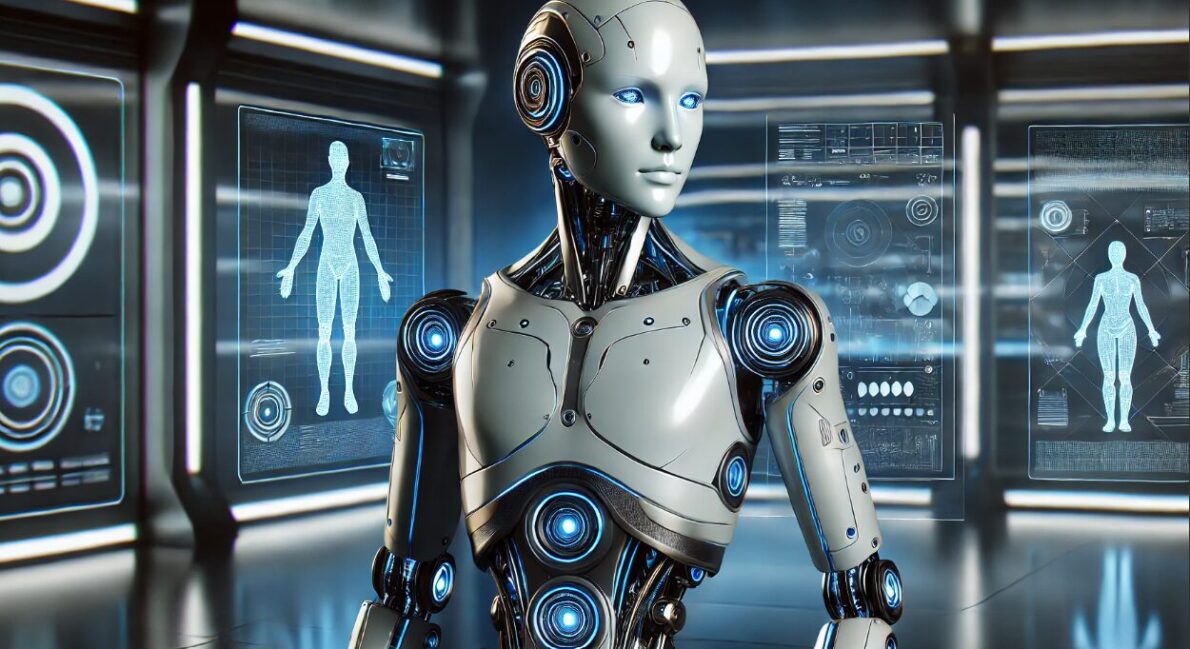
As Raul Martynek, CEO of Databank, explains, “Robotic AI is the most complicated of all, because a language model is software, while robots are a problem of mechanical engineering, software, and physics.” Creating autonomous robots requires a level of expertise that is currently only accessible to professionals with a PhD in robotics.
This scenario was similar to language-based AI around a decade ago. At that time, building an effective AI model also required enormous specialization.
Today, with the popularization of language and image models, developing AI applications has become more accessible. Nvidia intends to do the same for robotics, but simplifying the integration of AI into physical environments is much more challenging.
Nvidia’s Robotics Platform
To make autonomous robots a reality, Nvidia has developed a range of tools and platforms.
Omniverse, for example, is a simulation platform that allows developers to customize and test robot simulations in a virtual environment. “Isaac,” in turn, is a kind of “academy” that runs within Omniverse, where robots can “train” in different environments.
Additionally, Nvidia offers specialized chips, such as “Jetson Thor,” and is also working on developing foundational models for humanoid robots, like the “Groot” project.
However, despite these innovations, making this technology accessible to regular developers is still a challenge. An example of this is the work required to collect data.
Tesla, for example, pays workers $48 per hour to perform tasks in special suits to train its humanoid robot, Optimus. This data collection process to train robots is slow and costly, and still represents a significant obstacle for the industry.
The Robotics Market
Nvidia’s success in the robotics market depends on its ability to make technology more accessible and scalable.
Several companies, including BMW, Boston Dynamics, and Siemens, are already using Nvidia’s platforms to train robots in factories. Nvidia itself estimates that the robotic automation market, especially in automobiles, will grow about 20% per year until 2027.
The big question, however, is whether Nvidia will be able to lower the barriers to entry so that more developers and companies adopt its robotics solutions, as it has already done with language and image AI.
Competitors are already trying to create their own robotic development platforms before Nvidia can dominate the sector.
An example is Scaled Foundations, a company that offers its own robotic development platform called Grid, which encourages users to create their own robotics models.
The Competition and the Challenges of Robotic Development
Although Nvidia is at the forefront of robotic development, it is not alone in this race. Companies like Skild AI have already raised hundreds of millions of dollars to develop their own robotics models.
Furthermore, some experts question the viability of humanoid robots as the next big breakthrough.
As a former Nvidia robotics specialist said, “I am very skeptical. The cost to create a versatile humanoid robot will be greater than creating a robot that doesn’t resemble a human but performs a specific task more quickly and efficiently.”
Indeed, humanoid robots present a much greater technical challenge than robotic arms or automated delivery machines.
While Huang’s vision is ambitious and futuristic, there are many doubts about whether the market and technology are ready to adopt it on a large scale.
The Future of Nvidia: From Gaming and Graphics to Robotics and Automation
Nvidia is fully committed to robotics and automation as the next big markets. The company envisions a future dominated by autonomous technologies, starting with robotic arms in factories, autonomous vehicles, and even entire cities controlled by AI.
This move is a bold step for Nvidia, which until recently was primarily known for its graphics chips and the gaming market. But, as pointed out by Sophia Velastegui, an AI expert who has worked for Apple, Google, and Microsoft: “Robotics captures our imagination.”
The future of Nvidia depends on its ability to make robotics a reality accessible to developers and companies.
The company has already proven its competence in revolutionizing language-based AI and images, but now faces a much more complex challenge.
Creating humanoid robots and autonomous machines is not just a matter of computing but also involves physical engineering, mechanical engineering, and massive data collection.








Seja o primeiro a reagir!