





 Portuguese
  English
  Spanish
  6 min of reading
  0 comments


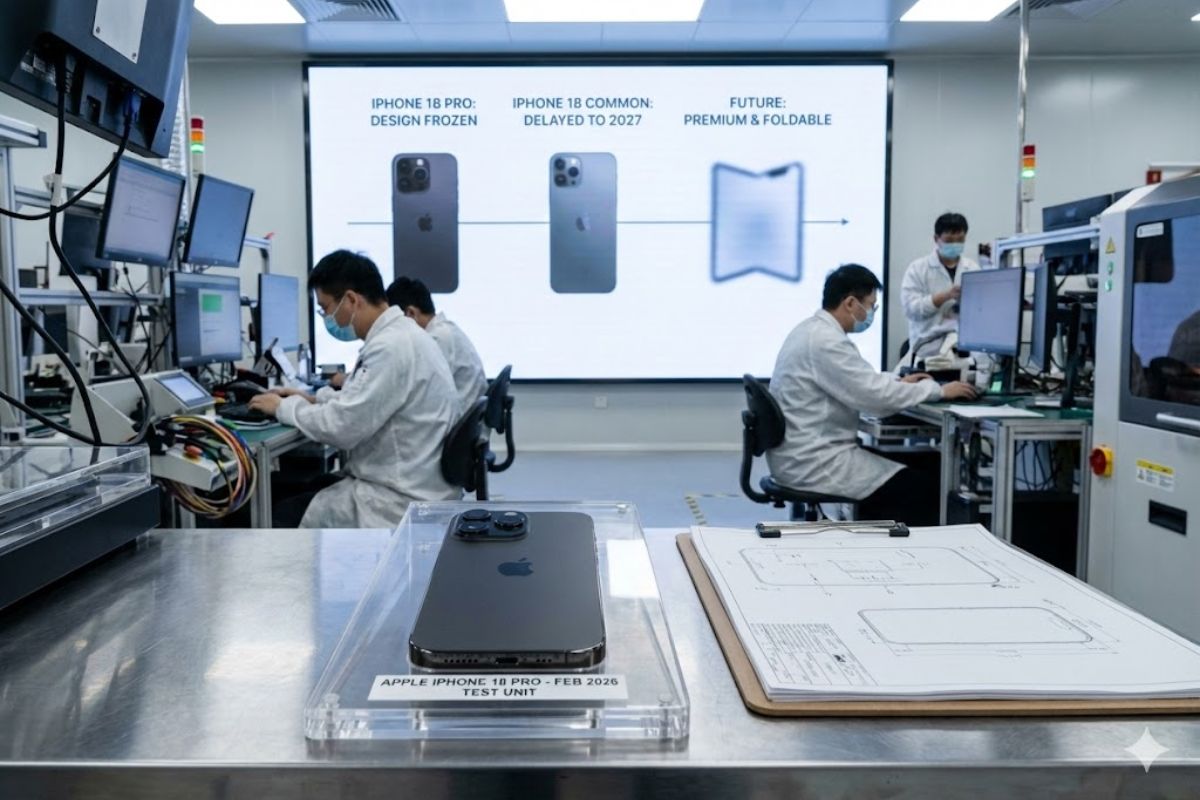
With iPhone 18 Pro Engineering Frozen, Apple Begins NPI Testing Phase in China Right After Lunar New Year, Splits Timelines, Pushes Regular iPhone 18 to 2027, and Focuses Resources on Pro, Max Line, and Ambitious High-End Foldable iPhone with Higher Margins and Exclusivity.
Starting in February 2026, Apple breaks the tradition of the “sacred period” of Lunar New Year in Asia and reactivates assembly lines in China to kick off the NPI phase of the iPhone 18 Pro, a small-scale production trial that tests molds, tolerances, and factory flows before the mass production expected for mid-year. The early schedule indicates that the hardware of the iPhone 18 Pro is frozen, with reused external design from the 17 Pro, while engineers internally validate a more complex package of changes that includes a 2-nanometer A20 Pro chip, new camera, and advancements in Face ID under the display.
On the other end of the planning, the “regular” iPhone 18 is pushed into its own cycle, with NPI testing only at the end of 2026, mass production between January and February 2027, and launch in the spring of that year. By splitting the calendar between iPhone 18 Pro and regular iPhone 18, Apple launches a two-stage release cycle, avoids logistical bottlenecks, concentrates investment in the premium line, and frees engineering capacity for the development of the first foldable iPhone, treated internally as a high-complexity project.
iPhone 18 Pro Testing Begins in China Right After Lunar New Year

Behind the scenes of the Asian supply chain, February is an atypical month. Traditionally, Lunar New Year halts factories, assembly lines, and logistics for days or weeks.
-
In a flooded well, archaeologists found a 1,700-year-old Roman egg that still contains clear and yolk intact inside the very thin shell.

-
Something is happening around the Earth: Inside the huge explosion of fireballs in 2026

-
A hot air bubble coming from Argentina expands over Brazil, causing thermometers to exceed 38 degrees with a thermal sensation of 40 degrees in late March, affecting 6 states at once.

-
The radish leaf that almost everyone throws away has more polyphenols, flavonoids, and fiber than the consumed root, and a 2025 study showed that the leaf contains compounds that protect the intestine, combat inflammation, and may inhibit the growth of cancer cells.


In 2026, Apple partially breaks this logic by scheduling the resumption of machines dedicated to the iPhone 18 Pro right after the holiday, marking the beginning of the NPI phase.
New Product Introduction, or NPI, is not mass production.
It is a limited-scale pre-series that verifies whether what was designed in Cupertino can be manufactured consistently in Zhengzhou and other partner plants.
This is the moment when teams discover if molds work, if mechanical tolerances hold up to factory rhythm, and if the assembly of the new iPhone supports the added complexity of more sophisticated internal components without causing cascading defects.
By bringing the iPhone 18 Pro lines online so early, Apple buys an additional margin of safety.
The goal is that between July and August 2026, the lines are ready to run at a mass production rate, accumulating millions of units by the global launch in September, without surprises or delays.
In practice, the iPhone 18 Pro becomes the first model of the generation to “come to life” within Chinese factories, months before the public even sees the device.
Split Cycle Pushes Regular iPhone 18 to 2027
The other side of the strategy is the split cycle.
While the iPhone 18 Pro enters NPI in February 2026, the conventional iPhone 18 remains off the front lines.
Apple’s projected timeline places the basic model on a nearly one-year delayed track in relation to the Pro version.
According to scenarios worked behind the scenes, the “regular” iPhone 18 only enters NPI at the end of 2026, with mass production shifted to January and February 2027 and an estimated launch in the spring of that year.
This breaks years of tradition where the basic line and Pro line arrived together in September and solidifies a temporal hierarchy in which the iPhone 18 Pro assumes leadership in both technology and timeline.
Separating the timelines allows Apple to avoid internal competition for components, factory capacity, and engineering attention.
Instead of calibrating all iPhone variants at once, the company first focuses on the 18 Pro and 18 Pro Max, stabilizes production, and only then shifts focus to the conventional iPhone 18.
The result is a “premium cycle” in 2026 and a “mass cycle” in 2027, with direct impacts on the perception of value and obsolescence for each audience segment.
External Design Kept, iPhone 18 Pro Hardware Redesigned Internally
One of the keys to speeding up the schedule for the iPhone 18 Pro was the decision not to radically alter the external design.
The device is expected to inherit the chassis from the iPhone 17 Pro, reusing molds, mechanical processes, and an already stabilized supply chain.
Outwardly, everything indicates continuity, which reduces physical risks and shortens the structural testing phase.
This apparent aesthetic repetition serves as a “Trojan horse” to allow for profound changes inside.
The 18 Pro generation incorporates the leap to the A20 Pro chip manufactured on a 2-nanometer process, which requires new thermal management, redesign of the logic board, and adjustments in power supply.
There are also significant modifications in the camera set and the preparation of Face ID elements under the display, a technology that further pressures the packaging of components.
It is this internal puzzle, not the casing, that requires a longer and more rigorous NPI to avoid overheating issues, assembly failures, or defect rates above acceptable levels.
By freezing the external format of the iPhone 18 Pro and focusing efforts on internal architecture, Apple attempts to balance two conflicting agendas: maintaining a recognizable visual identity while delivering performance and efficiency leaps that justify the annual upgrade for its loyal Pro line audience.
Total Focus on the Premium Line and Foldable iPhone Project
The split cycle has another effect: it frees resources for Apple to concentrate engineering on the premium line and the development of the iPhone foldable, treated as a product of extremely high technological and image risk.
The very timeline highlighted behind the scenes indicates that separating iPhone 18 Pro and regular iPhone 18 reduces logistical bottlenecks and simultaneously allows key teams to alternate between refining the Pro and advancing the foldable.
By prioritizing the iPhone 18 Pro, 18 Pro Max, and the future foldable iPhone, Apple clearly signals that margin and average ticket are more significant in the strategic equation than the immediate volume of the entry line.
In a more mature market scenario, with extended replacement cycles, the company bets that consumers willing to pay more for exclusive features will continue to sustain profitability, while the basic model goes at its own pace, less pressured by the calendar.
In practice, the premium line starts functioning as a technological and financial showcase, financing part of the risk of bringing a foldable iPhone to market.
At the same time, the detachment of the regular iPhone 18 to 2027 may push some impatient buyers toward the Pro models, increasing the relative weight of the high end on the sales curve.
What Apple’s New Strategy Indicates About the Future of the iPhone
The anticipation of testing, the freezing of external design, and the split cycle between Pro and basic model create a new map for the iPhone.
Instead of a family that moves in a block, Apple begins to operate with layers of release: top of the line first, base later, always focusing on maintaining the narrative of innovation anchored in the Pro line and in future formats, like the foldable.
For the end user, this means living with a more fragmented calendar, where the iPhone 18 Pro quickly incorporates the main innovations in chip, camera, and display, while the regular iPhone 18 tends to arrive later, inheriting some of those technologies already tested on a large scale.
For the market, the message is that Apple is willing to reorganize its own logic of launches to maximize returns in higher-margin segments, even if this alters a decade-long tradition of synchronized announcements.
Given this scenario where the iPhone 18 Pro arrives first, the regular iPhone 18 slides to 2027, and the foldable iPhone gains priority behind the scenes, do you find yourself migrating to the Pro line, waiting for the basic model to come later, or holding on to your current device until the first foldable iPhone from Apple appears?







-

-

2 pessoas reagiram a isso.