





 Portuguese
  English
  Spanish
  3 min of reading
  0 comments


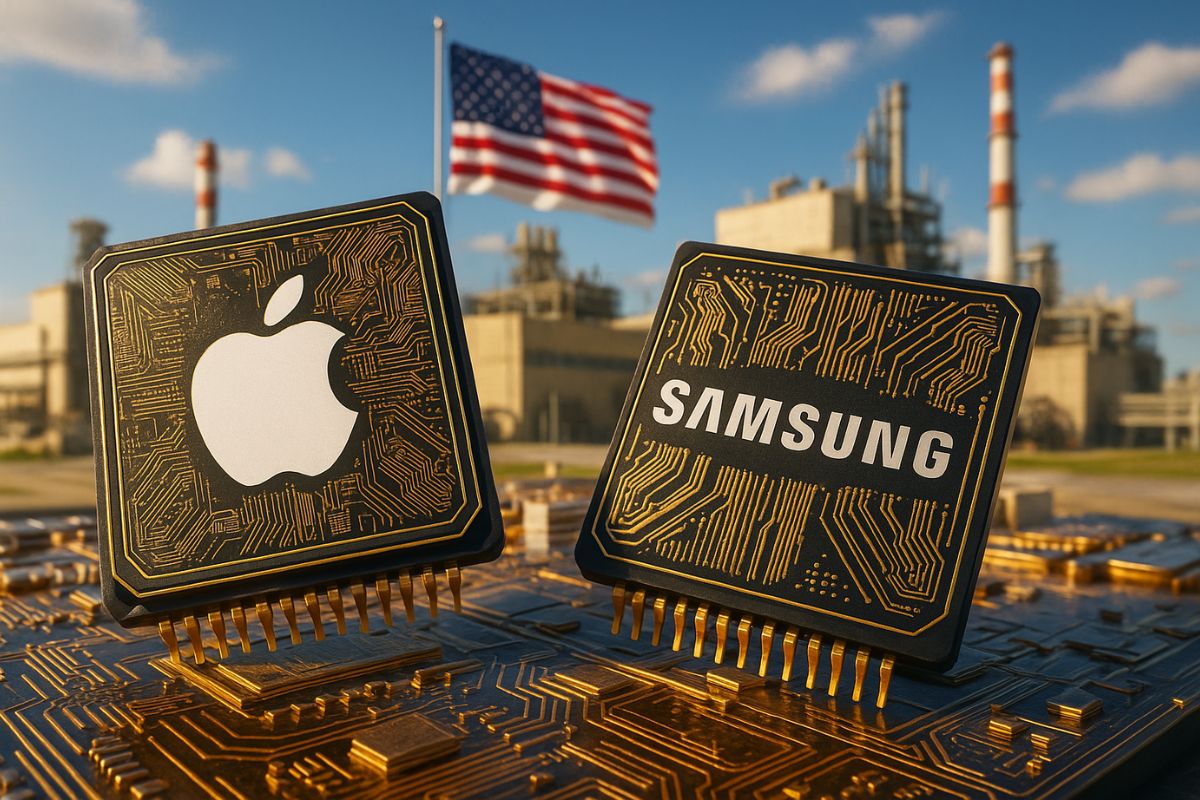
Companies Want to Bypass U.S. Tariffs with Innovative Sensors Set to Debut in iPhone 18
The giants Apple and Samsung are joining forces to launch an innovative chip technology that promises to change the way imaging sensors work in mobile phones. The project, according to the Financial Times, involves the production of stacked sensors with three layers, expected to debut in the next generation of the iPhone 18.
This innovation marks not only a technological advancement but also a strategic shift for Apple, which aims to reduce its dependence on Sony, a traditional sensor supplier, and avoid U.S. trade tariffs on foreign products. The development will be carried out on U.S. soil, at Samsung’s facility in Austin, Texas, as part of Apple’s ambitious American Manufacturing Program, which plans over US$ 600 billion in investments in the country.
What Changes with This New Chip Technology?
The main innovation lies in the three-layer stacked sensors, a solution that promises to drastically improve image capture, energy efficiency, and processing speed. The goal is to reduce energy consumption while providing higher image quality for photos and videos in low-light settings.
-
After decades of failed attempts, Brazil is once again looking to space with an orbital rocket measuring 12 meters, weighing 12 tons, costing R$ 189 million, and scheduled for launch in 2026, in a new race to finally achieve autonomous access to orbit.

-
The Earth will plunge into a few minutes of darkness in broad daylight in August 2026, when a total solar eclipse transforms the sky into one of the most impressive astronomical phenomena in recent years.

-
How the terraforming of Mars can transform the planet: artificial aerosols can increase the temperature by up to 35°C in 15 years, creating conditions for liquid water.

-
Scientists drilled nearly 8,000 meters into the ocean floor above the fault that caused the 2011 tsunami in Japan and discovered that a layer of clay 130 million years old was responsible for making the wave much worse than any model had predicted.


These chips will be part of the new line of iPhones expected for 2026 and will be produced using what Apple describes as a world-first technology. Though not all technical details have been revealed yet, it is expected that the sensors will offer superior levels of performance and thermal stability, essential for advancing features such as computational photography, augmented reality, and embedded artificial intelligence.
Why is Apple Leaving Sony Behind?
Currently, Sony is Apple’s main supplier of image sensors, but faces a geopolitical disadvantage: it does not manufacture chips in the United States. As a result, its products are vulnerable to the import tariffs imposed by the Trump administration, which continues to influence U.S. trade policy.
On the other hand, Samsung, besides being a rival to Apple in the smartphone market, has chip production facilities on American soil, which facilitates logistics, reduces costs, and protects Apple’s supply chain during times of global instability. This strategic shift may represent a new balance in the mobile industry’s supply ecosystem.
How Much Will Be Invested in This New Stage?
The partnership is part of a broad strategy by Apple to internalize critical semiconductor manufacturing stages, in a move that comes alongside the push for technological sovereignty in the U.S. The American Manufacturing Program has already announced more than R$ 3.2 trillion in investments in the country, focusing on semiconductors, batteries, and AI.
Samsung, for its part, is also investing heavily in the United States and is already engaged in agreements with companies like Tesla and AMD to develop AI chips, automotive sensors, and high-performance components.
What Is the Impact on the End Consumer?
The practical result for users should be felt in better image quality on iPhones, longer battery life, and more sophisticated computational photography features, such as ultra-fast autofocus, real-time HDR, and intelligent noise reduction in videos.
Additionally, this technology may serve as a foundation for the use of generative AI directly on the device, reducing reliance on the cloud, which has been a priority in the recent iOS updates and in Apple’s plans to compete with Google and OpenAI.
Do you think this change could further strengthen Apple in the smartphone market? Will the alliance with Samsung generate real innovation, or is it just a geopolitical move? Leave your opinion in the comments; we want to hear from those following this competition closely.








Seja o primeiro a reagir!