





 Portuguese
  English
  Spanish
  5 min of reading
  0 comments


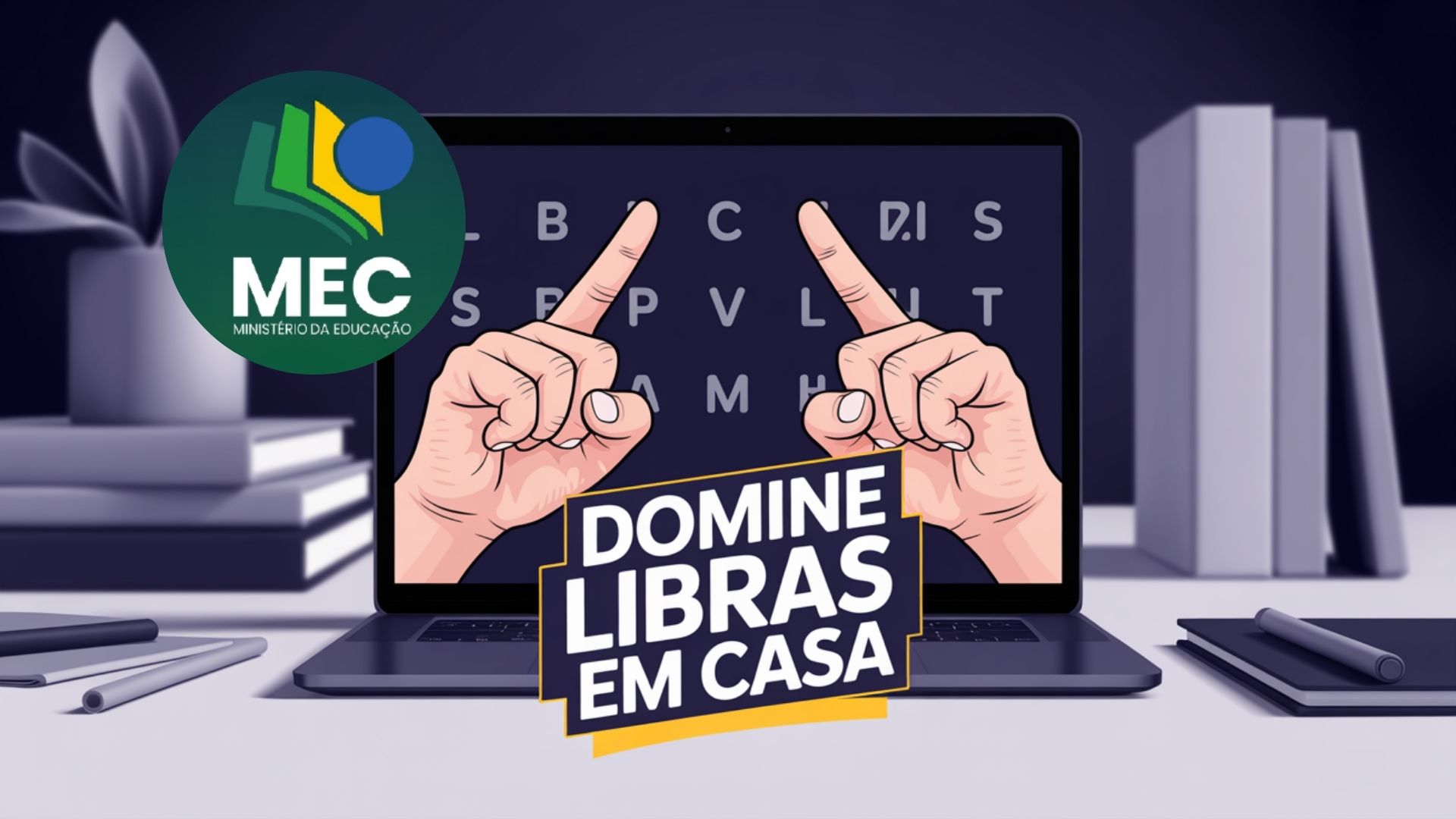
Free Course Addresses Libras in E-Learning Format, with Official Certificate and Content Produced by the Government, Offering Accessible Training for Those Who Want to Improve Communication with Deaf People.
Learning Brazilian Sign Language from home, with a recognized certificate and content produced by the federal government, is already a reality.
The online course “Introduction to Libras”, offered on the Virtual School.Gov platform (EV.G), is free, has a workload of 60 hours, a deadline of 60 days for completion, and a certificate issued by the National School of Public Administration (Enap), with content developed by the Ministry of Human Rights and Citizenship.
Especially aimed at federal, state, and municipal public servants, the training is open to anyone interested in communicating with deaf people through Libras.
-
Become a professional in logistics, mechanics, computer science, chemistry, or gastronomy at the Federal Institute: Ifes opens more than 1,000 spots in free technical courses with selection without an exam.

-
Take a 100% online and free course at Itaú: Foundation releases 156 options with certificates, registrations open for all of Brazil, unlimited access, areas such as technology, education, and management, and a flexible schedule without tutoring.

-
Senai will pay up to R$ 700 per month for those who take free technical courses: there are 12,000 open positions across Brazil and training with access to the technology market.

-
Take one of the free courses from SENAI! There are over 100 options for training completely online and with a guaranteed certificate in Logistics, Mechanics, Business, Energy, Safety, and much more; see how to enroll and boost your resume with SENAI EAD.

As the course is in distance education mode, the student organizes their schedule and can watch the classes on a computer or mobile phone, as long as they have internet access.
Training in Libras with a Focus on Inclusion
The central proposal of the training is to qualify the service and interaction with people with hearing disabilities in public services and other environments.
Right at the beginning, the course highlights the Law No. 10.436/2002, which recognizes Libras as a legal means of communication and expression for Brazilian deaf communities and determines that public authorities adopt measures to support and disseminate the use of the sign language.
By addressing this legal basis, the content reinforces that Libras is not just a complementary resource, but a language with its own structure, essential for guaranteeing rights, access to information, and social participation of deaf people.
Thus, the training is part of a broader agenda of human rights, citizenship, diversity, and inclusion promoted by the federal government.
Essential Theoretical Contents About Deafness and Communication
The learning pathway combines theoretical foundations about deafness and society with practical activities in Libras.
In the first units, participants come into contact with topics such as causes, discovery, and degrees of hearing loss, understanding that deafness is not a homogeneous experience and that there are different levels and contexts.
Next, the course presents two ways to look at deafness: the traditional “hearing” perspective, which tends to view the deaf person from the lack of hearing, and the socio-anthropological perspective, which recognizes deafness as a cultural and linguistic difference.
From this contrast, the content encourages the revision of prejudices and stereotypes and reinforces respect for deaf identity.
Another point covered is legislation on Libras and the rights of people with disabilities, including the obligations of the State and public and private institutions to ensure communicational accessibility.
The course also addresses strategies for communication with deaf people, discussing good practices for interaction, appropriate posture in service, and the importance of eye contact and clarity in expression.
In the initial units, there is also space to discuss deaf identity and culture, covering aspects such as the sign community, socialization spaces, cultural production, and the role of schools and institutions in building the citizenship of deaf people.
Practical Modules of Libras: Alphabet, Expressions, and Everyday Vocabulary
After the conceptual part, the course advances to the practice of Libras.
The content is organized progressively, allowing the student to have a first contact with sign language even without any prior knowledge.
One of the blocks deals with the manual alphabet and personal pronouns, an important step for participants to learn to spell names, form simple sentences, and start basic dialogues.
Next, facial expressions are introduced, an essential resource in Libras to mark emotions, questions, and nuances of meaning, in addition to vocabulary related to the topic of family.
The content also includes signs related to calendar and numbers, which allows discussing days of the week, months, dates, and quantities in everyday situations.
Another set of classes addresses houses and rooms, expanding the repertoire for describing environments, routines, and social spaces.
The training also covers vocabulary about means of transportation, useful for travel, service at terminals, and public services.
It also includes signs related to animals and classifiers, which help to detail characteristics and movements.
And offers a module dedicated to professions, important for discussing work, services, and functions performed by different people.
By bringing these topics together, the course provides a basic initial communication in Libras, sufficient for the student to start interacting with deaf people in simple everyday situations with more respect and autonomy.
The goal is not to train interpreters, but to create conditions for more inclusive service and for building accessible environments.
Target Audience and Course Functioning
Although the priority audience is composed of federal, state, and municipal public agents, the Virtual School.Gov makes it clear that anyone can participate.
The training is open, free, and with a certificate, with no limit on spots and no selection process.
As the course is self-instructional, there are no closed classes or fixed schedules.
Interested individuals can enroll at any time and have 60 days to complete the activities, totaling 60 hours of study.
During this period, it is possible to organize the pace according to one’s own routine, progressing through the units over weekdays, weekends, or holidays.
At the end, those who meet the workload and complete the required evaluative activities receive a certificate issued by Enap, an institution linked to the federal government that works on the training and development of public servants.
This document can be used for capacity certification purposes, according to the regulations of each agency or institution.
How to Enroll
To participate in the course “Introduction to Libras”, interested individuals should access the website www.escolavirtual.gov.br/curso/11, click on “Enter” to make a free registration or log in.









-

Uma pessoa reagiu a isso.