





 Portuguese
  English
  Spanish
  4 min of reading
  0 comments


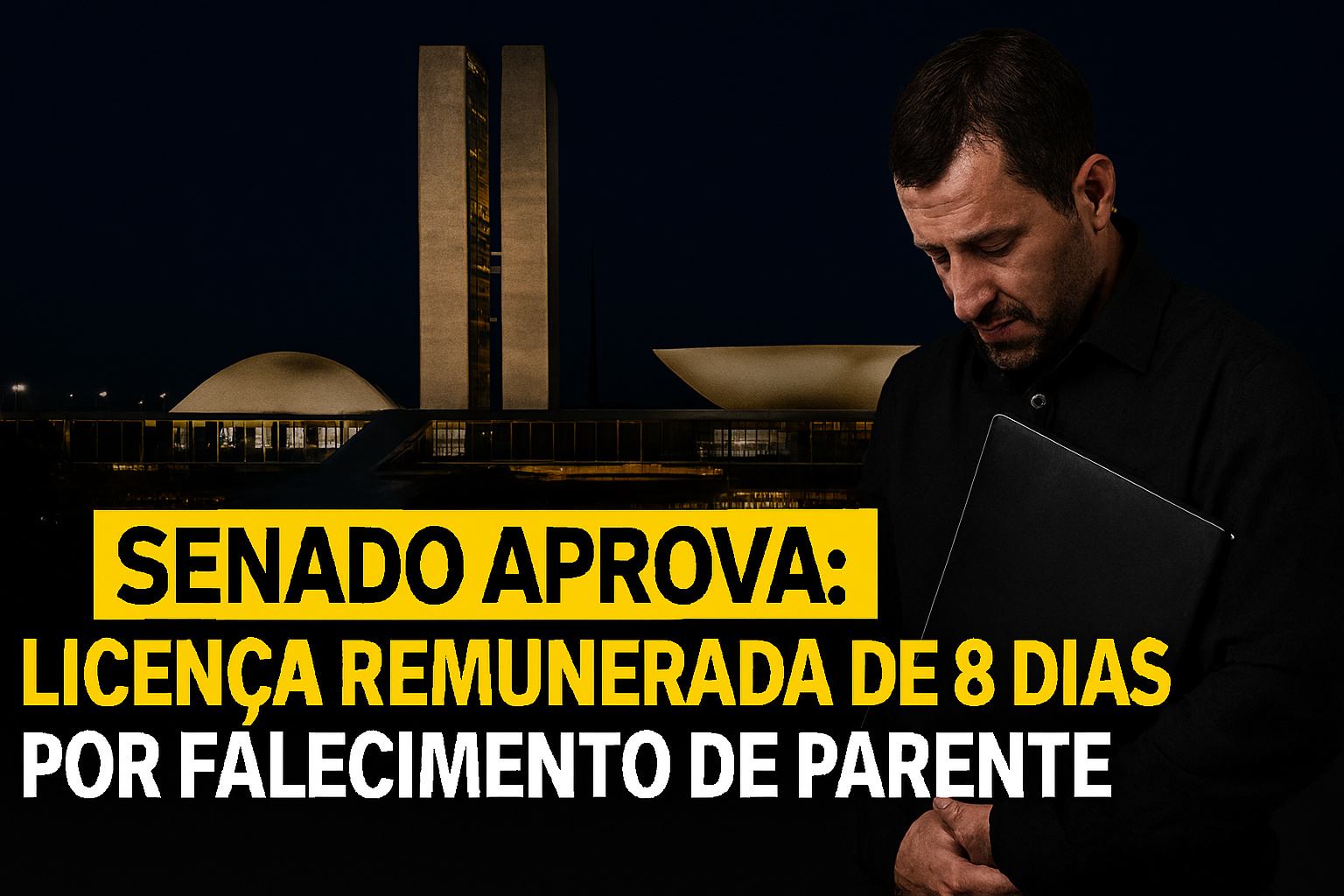
Senate Approves PL 1,271/2024: Bereavement Leave for the Death of a Relative Under the CLT Increases from 2 to 8 Days; Proposal Goes to the Chamber Before Becoming Law.
On September 24, 2025, the Social Affairs Committee (CAS) of the Federal Senate approved the Bill 1,271/2024, which proposes a significant change to article 473 of the Consolidation of Labor Laws (CLT). The measure extends the paid leave that workers are entitled to in the event of the death of a close relative from 2 to up to 8 consecutive days.
The proposal was presented by Senator Chico Rodrigues (PSB-RR) and unanimously approved in the committee. The text now goes to the Senate Plenary for consideration and then to the Chamber of Deputies before becoming law.
This change, if confirmed, represents one of the most relevant recent achievements in the field of labor rights, enhancing worker protection during one of life’s most delicate moments: family mourning.
-
The noise law will no longer be in effect at 10 PM starting in June with a new rule valid during the 2026 World Cup.

-
The Chamber opens a debate on driver’s licenses at 16 years old as part of a reform that includes around 270 proposals to change the Brazilian Traffic Code and may redesign rules for licensing, enforcement, and circulation in the country.

-
The new Civil Code could revolutionize marriages in Brazil with “express divorce” and changes that could exclude spouses from inheritance.

-
Banco do Brasil sues famous influencer for million-dollar debt and intensifies debate on delinquency, risks of seizure, and direct impact on Gkay’s credibility.


What the Law Currently Provides
Currently, the CLT — in article 473, clause I — establishes that the worker can be absent for up to 2 consecutive days without loss of salary in the event of the death of a spouse, ascendant (parents, grandparents), descendant (children, grandchildren), sibling, or person who lives under their economic dependency.
This period, considered insufficient by experts and unions, often does not even cover the time needed to deal with the funeral, travel, and the initial emotional and bureaucratic adjustments after the loss.
What Changes with PL 1,271/2024
The project extends the benefit to up to 8 consecutive days of paid leave. In addition to the increased period, the text also updates and details the list of relatives who entitle the worker to leave, including:
- Spouse or partner;
- Parents, stepmother and stepfather;
- Children and stepchildren;
- Minor under guardianship or custody;
- Siblings.
In practice, the law modernizes the CLT by adapting the benefit to Brazilian social reality, recognizing that the mourning period requires more time for emotional and family care.
The Social Impact of the Expansion
The change meets a long-standing demand from workers and labor unions. Various studies have shown that the two-day period is insufficient for employees to emotionally recover and organize practical matters after the death of a close relative.
According to a study by the International Labour Organization (ILO), European countries such as France, Spain, and Portugal already guarantee between 5 and 10 days of leave for mourning situations. Thus, Brazil was among the most restrictive legislations in this regard.
With the approval of PL 1,271/2024, the country moves closer to a more humane and balanced standard, recognizing that the worker is not just a productive force but also a human being with emotional and family ties.
Criticism and Debates in the Senate
During the proceedings in the Social Affairs Committee, there were debates regarding the economic impact of the measure. Representatives from the business sector claimed that the expansion could generate additional costs for companies, especially in small organizations.
On the other hand, senators and legal experts reminded that the costs are minimal compared to the relevance of the benefit. They argued that the absence for a few days is easily absorbed by companies, while the positive effect for the worker is incomparably greater.
The rapporteur highlighted that the right to mourn is also a right to human dignity, a constitutional principle that should guide the interpretation of labor laws.
Next Steps of the Proposal
The text approved in the CAS still needs to go through the Senate Plenary. If approved, it will go to the Chamber of Deputies for further analysis. Only after approval in both Houses and presidential sanction will the measure come into effect as law.
If there are no amendments or substantial changes, the expectation is that the new rule will come into effect as early as 2026, updating the CLT on one of the most sensitive issues for workers.
More Time to Grieve with Dignity
The PL 1,271/2024 addresses not just days on the calendar, but respect for the human being during one of life’s most difficult moments. Recognizing that the loss of a family member requires more than 48 hours of leave is a way to bring humanity to labor legislation.
If confirmed, Brazil will take a historic step, aligning itself with countries that consider mourning an emotional and social health issue. For millions of CLT workers, this change will be a silent but significant victory in their daily lives.
In the end, the question that resonates is simple: how can productivity be expected from someone who hasn’t even had the time to bury their dead?










Seja o primeiro a reagir!