






 Portuguese


Discovery in Saqqara: The 4,400-Year-Old Mastaba Belonged to Official Yunmen, Preserves Reliefs Painted with Agricultural Scenes and Offerings, and Features Two Funeral Chapels, One for His Father, Iti, in Egypt
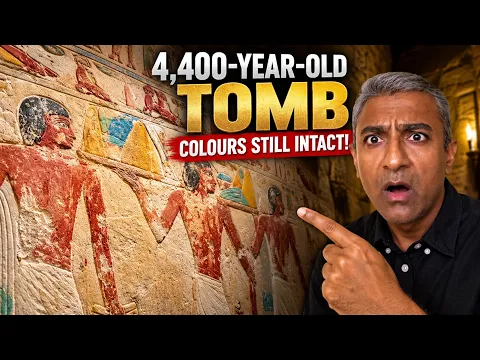
A Spanish-Egyptian mission has uncovered a Saqqara tomb dating back about 4,400 years, comprising two funeral chapels and decorated with reliefs still retaining some of their original colors. The mastaba belonged to high-ranking official Yunmen, who also honored his father, Iti.

Saqqara Tomb Built for Yunmen and His Father
The structure was located in the Mariette necropolis, north of the main archaeological site of Saqqara, and dates back to the end of the Fifth Dynasty of the Old Kingdom, a period roughly between 2494 and 2345 B.C.
-
In 1940, 17-Year-Old Boy Found a Cave in France with About 2,000 Paintings and Over 6,000 Figures Dating Back Up to 19,000 Years

-
Saltwater Intrusion Advances Beneath Coastal Cities, Raising Alarms: Threatens Wells, Aquifers, Pipelines, and Water Supply for Millions

-
Two environmental engineers take on the challenge of recycling used toilet paper at a shopping mall, developing a solution to divert waste from landfills and creating a machine capable of processing up to 600 kilograms per day and converting the material into fertilizer
-
Brazilians Look to the Sky: Orionid Meteor Shower to Illuminate October Nights with Streaks from Halley’s Comet


The mastaba was commissioned by Yunmen, a high-ranking administrator who served Pharaoh Djedkare Isesi. Unlike a structure built solely for the official, it received two separate funeral chapels.
The second area was designated for Iti, Yunmen’s father. Egypt’s Ministry of Tourism and Antiquities identified the two chapels as belonging to officials recorded as Younmin and his father Ity.
According to researchers from the Autonomous University of Barcelona, this organization may reflect a trajectory of social mobility. Yunmen likely began his career in provincial administration before reaching a position related to the central government.
The arrangement allowed for the memory of the father, who held a more modest official position, to be incorporated into the funerary monument built by his son.

Reliefs Still Retain Pigments After 4,400 Years in the Tomb
The state of preservation of the decorations is among the features that captivated researchers. The walls display carved scenes depicting agricultural activities, processions of offerings, donkeys, and other animals.
Some of these reliefs still preserve their original pigmentation after more than four millennia. The scenes merge elements related to funerary rituals with representations of everyday activities and animals.
The tomb also features a high-quality architrave, along with elaborate funerary inscriptions reflecting the titles and administrative roles held by Yunmen.
For researchers at the Autonomous University of Barcelona, the texts help to identify historically and socially significant figures related to the final years of the Fifth Dynasty.
Discovery emerged during mapping of the ancient necropolis
The excavation was conducted during the summer by researchers from the Autonomous University of Barcelona in collaboration with the Supreme Council of Antiquities of Egypt. The work was directed by Egyptologist Josep Cervelló.
The broader goal of the mission was to reconstruct the organization of the ancient necropolis, including possible streets, gathering areas, and the paths taken by people and offerings during the rituals conducted at the site.
It was during this work that the team came upon the tomb of Saqqara, previously unknown. Therefore, the discovery occurred within a research effort focused on understanding the functioning of the funerary space as a whole.
Two nearby structures may still be investigated
The mapping also revealed signs of the existence of two other structures in the vicinity of the mastaba. These have not yet been excavated and could be investigated in future work seasons of the mission.
The discovery adds new architectural, artistic, and administrative elements to knowledge about the end of the Fifth Dynasty, bringing together inscriptions, funerary decoration, and information related to Yunmen’s position within the Egyptian administration.
Egyptian authorities classified the find as one of the most impressive discoveries of the season, especially due to the level of preservation of the sculpted scenes and the remnants of their original colors.
This article was prepared based on information from the Autonomous University of Barcelona, the Egyptian Ministry of Tourism and Antiquities, and the Supreme Council of Antiquities of Egypt, with data, numbers, and statements preserved as per the consulted material.


