





 Portuguese
  English
  Spanish
  5 min of reading
  0 comments


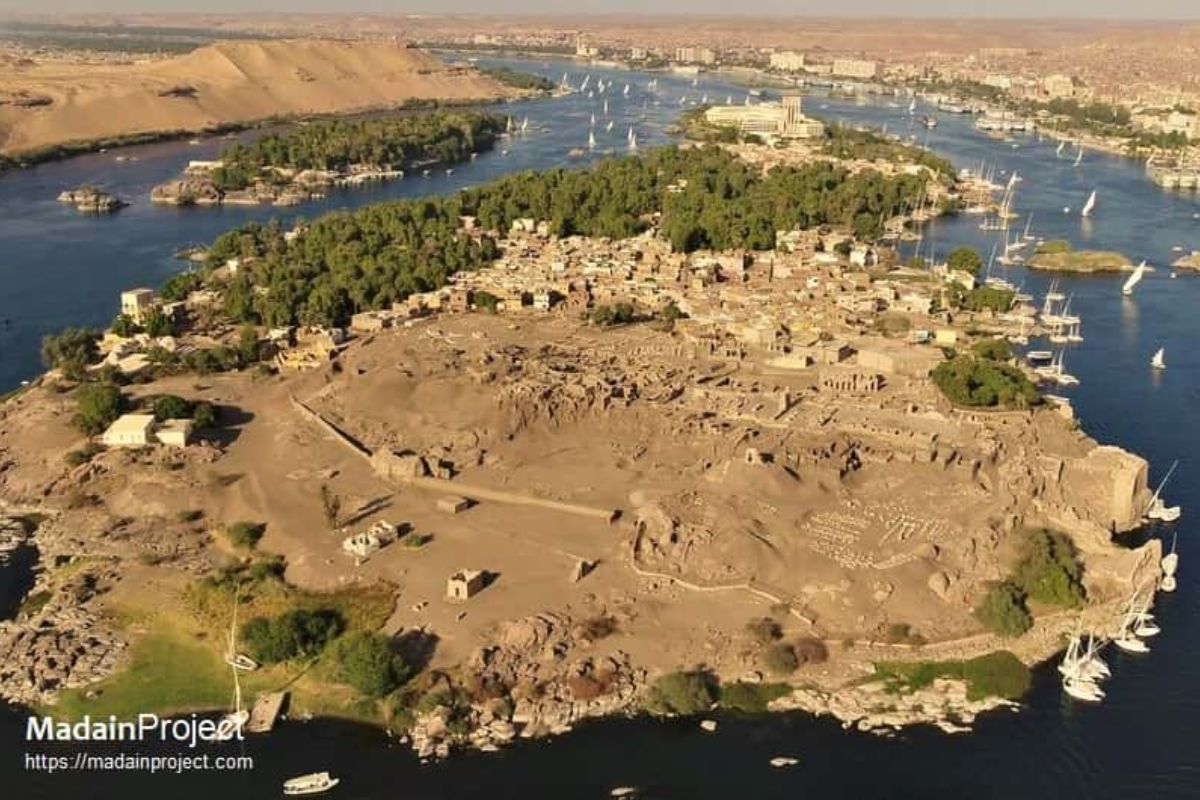
On Elephantine Island in Egypt, archaeologists found 4,000-year-old speiss fragments that prove Middle Kingdom metallurgists were already producing controlled arsenical bronze, a technique that other civilizations of the ancient world would only master centuries later.
The history of metallurgy in the ancient world has just gained a chapter that no one expected. Archaeologists identified on Elephantine Island in Egypt the first direct evidence that Middle Kingdom metallurgists, around 4,000 years ago, mastered the controlled production of arsenical bronze, an alloy of copper and arsenic significantly more resistant than pure copper. The discovery was detailed in a study published in the journal Archaeometry and led by Jiří Kmošek from the Academy of Fine Arts in Vienna and the Czech Academy of Sciences, in partnership with Dr. Martin Odler from Newcastle University.
At the center of the discovery is a material called speiss, composed of a mixture of impure metals with high levels of arsenic, iron, and lead. The speiss found on Elephantine Island in Egypt dates back to the 12th Dynasty, a period between 2000 and 1650 BC. Its presence at the archaeological site proves that Egyptian metallurgists knew that adding this material to molten copper strengthened the bronze produced. Until now, no example of such an ancient use of speiss as a reagent in bronze production had been documented at any archaeological site in the world.
What is speiss and why does its discovery on Elephantine Island in Egypt change history

Speiss is a byproduct of metallurgy composed of a mixture of impure metals. In later periods of ancient history, this material was known to be used as a reagent in the production of arsenical bronze, but archaeologists assumed that its use in controlled metallurgical processes had only begun in more recent times.
-
Sitting on the sidewalk at the end of the afternoon: the simple habit that brought neighbors together, slowed down the routine, and reveals why social interaction was stronger before the digital age.

-
Daughter of a public servant, a young woman from MA turns her fight for the environment into a victory and secures a full scholarship at a university in the USA.

-
Psychology explains why the generation that grew up in the 60s and 70s became so tough but still struggles to ask for help even when they are drowning, and the cost of this is extremely high.

-
The lemon that grows alone in Brazilian backyards has powers you can’t even imagine: it lowers high blood pressure, prevents kidney stones, fights cholesterol, and even removes rust from any surface.

The presence of arsenical copper in older Egyptian artifacts was generally attributed to natural contamination of ore samples.
The discovery on Elephantine Island in Egypt overturns this assumption. The speiss fragments found at the archaeological site near Aswan demonstrate that Middle Kingdom metallurgists were not just using contaminated copper by chance.
They knew that adding speiss to molten copper produced a stronger alloy, and they did so intentionally and in a controlled manner. “The use of speiss in the production of arsenical bronze during the Middle Bronze Age on Elephantine Island has been confirmed,” the researchers wrote, revealing “a more complex metallurgical process than previously suspected.”
How archaeologists analyzed the 4,000-year-old fragments from Elephantine Island in Egypt

The research team did not rely solely on visual observation. Portable X-ray fluorescence (pXRF), optical microscopy, and scanning electron microscopy technologies were used to study the speiss fragments located at the archaeological site.
These analyses allowed for precise determination of the chemical composition of the material and dated it to belong to the 12th Dynasty of Egypt, a period that is part of what historians call the Middle Kingdom.
In addition to arsenic, the analysis revealed that the use of speiss on Elephantine Island in Egypt also introduced small amounts of antimony and lead into the produced metals. This information is relevant because it may have complicated previous archaeologists’ efforts to establish the origins and ages of ancient bronze samples.
Artifacts that show traces of antimony and lead may have been incorrectly classified regarding their provenance, precisely because the scientific community did not know that these elements were introduced in a controlled manner during smelting.
What arsenical bronze meant for Middle Kingdom metallurgists
Arsenical bronze was a superior alloy to pure copper for making weapons, tools, and ritual objects. By adding arsenic to copper during smelting, metallurgists on Elephantine Island in Egypt obtained a harder metal, more resistant to wear, and with better ability to maintain sharp edges.
Arsenical bronze blades stayed sharp longer, spear tips penetrated more efficiently, and working tools lasted longer before needing replacement.
Mastering this technique 4,000 years ago placed Egyptian metallurgists in a technological position that other civilizations of the ancient world would only reach centuries later. The controlled production of arsenical bronze requires precise knowledge of melting temperatures, material proportions, and the behavior of metals in different states.
It is not something that happens by accident. The artisans of Elephantine Island in Egypt developed a sophisticated process that demonstrates technical mastery comparable to that of civilizations that history traditionally considers more advanced.
The origin of speiss and the trade networks that fed metalworking on Elephantine Island in Egypt
The research team has not yet definitively determined the exact origin of the speiss samples. However, strong indications point to the Eastern Desert of Egypt as the likely source of the material, where the existence of arsenopyrite ores is documented.
If confirmed, this origin reveals that trade networks between different communities in the region were already transporting specific raw materials for metallurgy long before those recognized by archaeology.
The implication is that Elephantine Island in Egypt did not operate autonomously in its metallurgical production. It was part of a supply chain that connected mines in the desert, transport routes along the Nile, and foundry workshops in urban centers.
This logistical complexity in such a remote time challenges the view that societies 4,000 years ago operated in a simple and localized manner. Metallurgists not only mastered the production technique but also coordinated access to raw materials from distant regions.
What the discovery on Elephantine Island in Egypt reveals about ancient world technological knowledge
The research team believes that their findings confirm a surprisingly early state of Egyptian metallurgy.
The technologies identified on Elephantine Island in Egypt would not become common in other regions of the ancient world for at least a few more centuries, repositioning Middle Kingdom Egypt as a center of metallurgical innovation that preceded civilizations generally considered pioneers in this field.
For archaeology, the discovery opens new questions about what else may be hidden in the sites of ancient Egypt.
If a technique as advanced as the controlled production of arsenical bronze with speiss existed 4,000 years ago on Elephantine Island in Egypt, other equally sophisticated technologies may be waiting to be identified in artifacts already excavated or in yet unexplored sites. The history of human knowledge is older and more complex than books often tell.
What impresses you most about this discovery: the advanced technique from 4,000 years ago or the fact that archaeologists have only realized it now? Do you think ancient Egypt still holds many technological surprises? Leave your thoughts in the comments. Discoveries like this prove that the history of humanity is far from being fully written.







Seja o primeiro a reagir!