





 Portuguese
  English
  Spanish
  5 min of reading
  0 comments


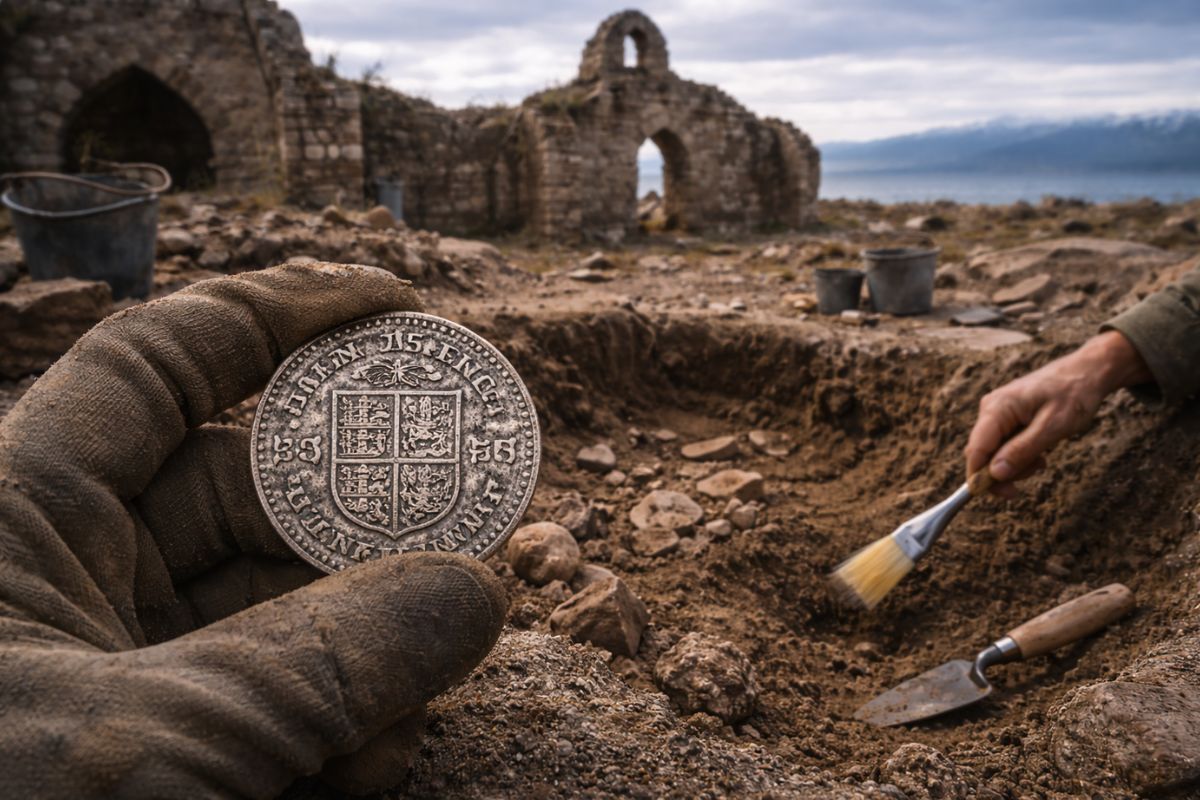
The coin is a “real de a ocho” struck during the reign of Philip II and was placed on a stone during the founding ceremony of the city in 1584 by navigator Pedro Sarmiento de Gamboa who was later captured by the English while trying to get supplies
A silver coin the size of a hand, buried under the foundations of a ruined church in the far south of Chile, has just solved one of the oldest mysteries of Spanish colonization in South America. Archaeologists confirmed that the 440-year-old piece marks the exact location of Ciudad del Rey Don Felipe, a colony where almost all 300 colonists died of hunger.
The discovery was made in March 2026, during excavations at the archaeological site located on the northern shore of the Strait of Magellan, in the region that today corresponds to Punta Arenas, in southern Chile, according to a report by Live Science magazine.
The coin was not there by chance. It was deliberately placed on a stone in the foundation of the first church of the colony on March 25, 1584, as part of a common founding ritual in Spanish colonies of the New World. And the most impressive thing is that the exact description of this ritual and the location of the coin was in the writings of Pedro Sarmiento de Gamboa, the navigator who founded the colony.
-
Elected for the 9th time as the happiest country in the world, Finland has created a program that offers a free 7-day trip with all expenses paid for foreigners to learn how to live like Finns, including a companion, sauna, lake, and complete disconnection from their cell phones.

-
Explorers enter a preserved mansion with a factory inside and find an attic and basement full of rarities: never-used suitcases, new dishes, bags of coins, and a 1964 Monarque motorcycle from a single owner that seemed like an unfinished resting place.
-
Japan transforms glass bottles destined for waste into lightweight “pumice stone”: a factory in Hiroshima crushes, dries, burns at 900°C, and expands Super Sol for construction, gardens, and agriculture.

-
Couple restores 19th-century château in France and transforms abandoned property with a moat, walled garden, orange grove, and 45 rooms into a home that blends the past, charm, and comfort.

In other words: the archaeologists knew what they were looking for. And they found it exactly where the documents from four centuries ago said it would be.
Why did Spain found a colony in the Strait of Magellan?

The answer has a name: Francis Drake. The English privateer, authorized by Queen Elizabeth I, passed through the Strait of Magellan in 1578 and wreaked havoc on Spanish operations along the Pacific coast, attacking ships and port cities in Chile and Peru. Drake was so successful that the Viceroy of Peru ordered Sarmiento de Gamboa to go after him.
Sarmiento never caught up with Drake, but returned with a different mission: King Philip II of Spain appointed him governor of the Strait of Magellan in 1581, with orders to build forts and establish colonies to prevent the English from using the passage, according to the Heritage Daily portal.
At the time, the Strait of Magellan was the only known maritime route between the Atlantic and the Pacific. Controlling this passage meant controlling global trade. Sarmiento’s mission was, in practice, to lock the door to the Pacific in the face of the English.
But the reality was very different from the plan.
What happened to the 300 colonists?
Sarmiento’s expedition left Spain with a fleet of ships and hundreds of colonists, but arrived at the Strait of Magellan devastated. Storms, shipwrecks, and desertions drastically reduced the group even before they set foot on land, according to the Ancient Origins portal.
In 1584, Sarmiento founded two colonies: Ciudad del Nombre de Jesús (in present-day Argentina) and Ciudad del Rey Don Felipe (in present-day Chile). The latter, where the coin was found, was in a brutal area: rocky soil, relentless winds, and a Patagonian winter that the European colonists were not prepared to face.
Agriculture was practically impossible. The supplies that were supposed to come from Spain never arrived because storms destroyed the supply ships. Sarmiento set out to seek help, but his ship was diverted by the storm and he ended up captured by the English. He never returned.
The colonists were left alone. No food, no reinforcements, no way out.
When the English navigator Thomas Cavendish passed by the colony in January 1587, he found only 18 survivors among the original 300. The bodies of the others were scattered, unburied. Cavendish took some of the artillery, allowed one of the survivors to pass, and renamed the place with the name that would go down in history: Puerto del Hambre. Port of Hunger.
The last colonist was rescued in January 1590, by another English ship. The irony is cruel: the colony founded to block the English was ultimately saved by the English themselves.
What exactly did the archaeologists find?
The coin is a “real de a ocho”, known among pirates as “piece of eight,” one of the first globally circulating coins in history. On one side, it has the Jerusalem Cross. On the other, the coat of arms of King Philip II, according to Live Science.
It was located using metal detectors and millimeter-precision geolocation equipment, under what the archaeologists identified as the foundations of the first church of the colony, as explained by Francisco Garrido, an archaeologist at the National Museum of Natural History of Chile.
The importance of the coin goes beyond its historical value: it allows mapping the entire colony. According to Garrido, knowing where the church was makes it possible to deduce the position of all other structures because Spanish colonies followed a standardized urban pattern.
This is not the first discovery at the site. In 2019, the same team had already found two bronze cannons from the colony, also using Sarmiento de Gamboa’s writings as a guide. The coin completes the puzzle.
Why does this discovery matter today?
Because it transforms documents written four centuries ago into physical evidence. Joaquín Zuleta, a philologist at the University of the Andes, explained to the Greek Reporter portal that the discovery creates a direct connection between archival accounts and the modern landscape of the Strait of Magellan, something rare in colonial archaeology.
The coin has a few centimeters in diameter. But it carries the weight of an entire city and centuries of unanswered questions. As the portal Arkeonews wrote: “Sometimes, the smallest objects carry the weight of entire cities and centuries of unanswered questions.”
The Strait of Magellan today is a busy route, with cruise ships and freighters passing through the same point where 300 Spaniards died of hunger trying to lock a door that the world ended up opening anyway. The coin buried by Sarmiento in 1584 survived everything: the winter, the hunger, the abandonment, and four centuries of forgetfulness. The colonists did not have the same luck.
With information from Live Science, Ancient Origins, Heritage Daily, Arkeonews, and Greek Reporter.







Seja o primeiro a reagir!