





 Portuguese
  English
  Spanish
  6 min of reading
  0 comments


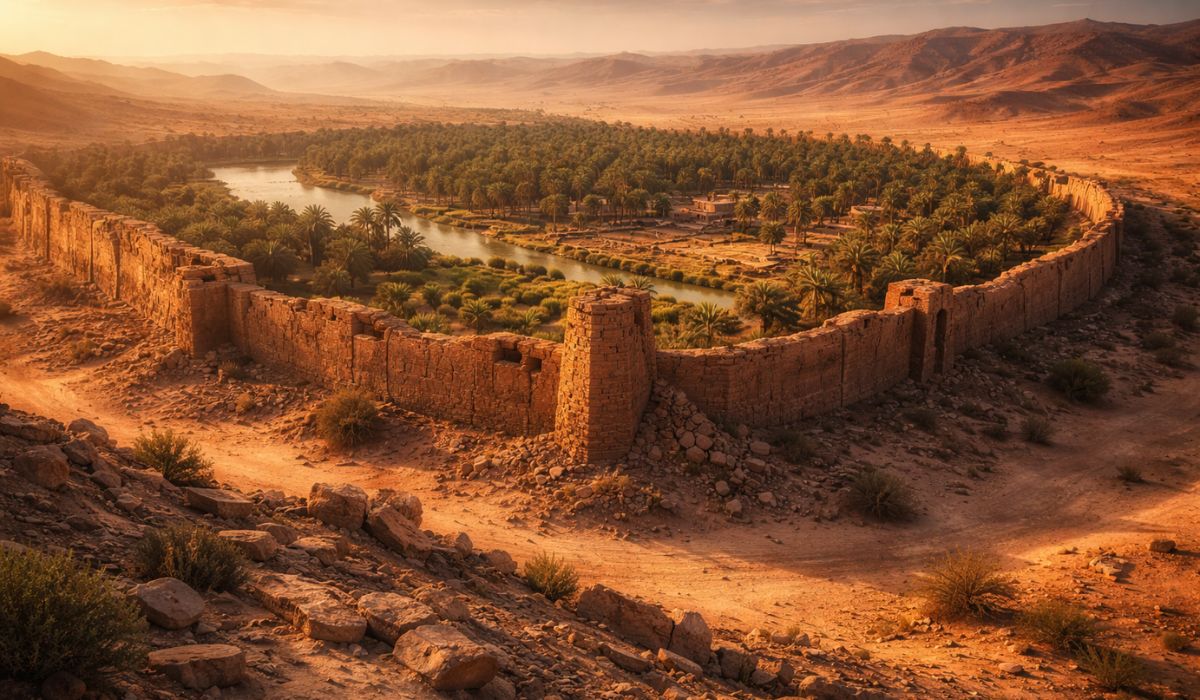
Walls erected around oases in northwest Saudi Arabia help researchers reassess ancient desert occupation, with indications of sedentary communities, organized agriculture, and territorial control in a landscape historically seen differently.
A set of walls erected around oases in the northwest of present-day Saudi Arabia is leading archaeologists to reassess the understanding of human occupation of the desert.
Instead of indicating only the movement of mobile groups, recent research points to the presence of sedentary communities capable of building large structures, organizing agricultural areas, and controlling water sources over centuries.
The broader study on this system was published in June 2025 in the journal Antiquity.
-
Giving your CPF at the supermarket has become routine, but in 2026 the rule will change: see how your data is used and when it is worth informing.

-
China has launched mysterious invasion barges into the sea with giant ramps that connect like Lego pieces and can form floating bridges of nearly 1 km to transport armored vehicles directly to the beach, in a kind of secret weapon for Taiwan.

-
Neither green in the fridge nor overripe forgotten in the fruit bowl: this is the correct way to store bananas.

-
Kitchens are replacing old items with a faster, more economical, and precise electric version for daily preparation.

According to the authors, the evidence reinforces the existence of a complex formed by six large walled oases in the northwest Arabian Peninsula, associated with a model of lasting settlement in a desert environment.
Tayma and Qurayyah were already known in archaeology.
The most recent work, however, consolidated this regional picture by also gathering data on Khaybar, Dumat al-Jandal, Hait, and Huwayyit.
As a result, the focus shifted from an isolated site to a broader system of occupation, with recurring characteristics in different areas.
Walled oases and water control in the desert
The structures described in the study did not only delimit an inhabited core.
According to the researchers, the walls protected water sources, cultivation areas, livestock, and spaces related to the daily life of these communities.
In this context, the walled oasis functioned as an organized territorial unit around essential resources.
The article relates this pattern to agricultural production and animal husbandry.
The authors mention cereals, fruits, and, from the second millennium BC, date palms, in addition to the presence of goats and sheep.
The wall, therefore, surrounded an entire productive landscape, not just a shelter point.
According to the specialists, this fact is central to understanding the significance of these constructions.
In the study, the team states that the walled oasis should not be interpreted merely as a defensive work, but as part of a model of socioeconomic development and territorial control in irrigated rural areas.
According to the authors, the construction and maintenance of these walls required collective mobilization and continuous investment.
For the team, this suggests planning, coordination of work, and population permanence in an environment where water and arable land were crucial for survival.
How archaeologists identified the oasis complex
The reconstruction of this system was done using more than one method.
In the 2025 study, the researchers crossed satellite images with field observations and, in some cases, resorted to ancient records.
In Dumat al-Jandal, for example, the analysis included georeferenced aerial photographs taken in 1964.
This material helped identify a network of mud brick walls in the eastern part of the oasis.
According to the article, the set is about 2 kilometers long and reinforces the interpretation that the site was part of the same model of walled occupation observed in other points of the region.
In Harrat Khaybar, field visits to Al-Ayn and al-Tibq revealed walls with bastions comparable to those of Khaybar.
The researchers estimate that these circuits had, in the initial phase, about 8 and 2 kilometers in length, respectively, in addition to approximately 2 meters in thickness.
Based on the architecture and the ceramic material collected on the surface, the authors consider it possible that these structures are contemporary, around 2000 BC.
However, the study treats this chronology as an estimate supported by the available evidence for the analyzed set.
Dating the walls shows distinct phases of occupation
The researchers themselves emphasize that not all the walls belong to the same historical moment.
Instead of a single construction episode, what appears is a long-lasting tradition, with local adaptations and distinct chronologies in each oasis.
According to Antiquity, this model may have begun in the first half of the third millennium BC, in Tayma and Qurayyah.
Therefore, the oldest examples of this type of structure date back about 5,000 years.
Later, the pattern would have reached the Khaybar region at the end of the third millennium BC.
In the case of Dumat al-Jandal, the recorded monumental fortifications belong to a much later moment, at the end of the first millennium BC, indicating permanence or reuse of this type of spatial organization at different times.
This distinction is important to avoid simplifications.
The study does not describe a system created all at once, but a model of occupation that, according to the authors, was adopted and transformed over time in different oases in northwest Arabia.
Khaybar helps measure the scale of ancient constructions
Among the most extensive examples ever documented is Khaybar, the subject of a previous study published in 2024 in the Journal of Archaeological Science: Reports.
In this research, the team estimated that the wall originally had about 14.5 kilometers in length, with a thickness between 1.70 and 2.40 meters.
Today, just under half of the original layout remains preserved, which corresponds to about 5.9 kilometers.
The survey also recorded 74 bastions still visible along the remaining circuit.
Radiocarbon dating placed the construction between 2250 and 1950 BC.
According to the researchers, the fortification surrounded a large rural territory, reinforcing the interpretation that the space housed a sedentary community and a productive area, not just an isolated defensive point.
The 2024 study also noted that the discovery raises questions about the precise function of the wall and about the relationship between the groups settled inside and outside the oasis.
In this case, the interpretation proposed by the authors avoids reducing the structure to a simple military response and highlights the need to understand the social and territorial context in which it was built.
Al-Natah expands the picture of sedentary occupation
Another work from the same project, published in 2024 in the journal PLOS One, dealt with the site of al-Natah, located within the walled oasis of Khaybar.
There, the researchers described a small Bronze Age town, occupied between the second half of the third millennium BC and at least the mid-second millennium BC.
According to the team, the set includes elements that point to a more complex organization than generally attributed to desert areas of the region during this period.
Among these elements are permanent settlement, articulation with agriculture, and the presence of structures associated with stable occupation.
Combined, the studies of Khaybar, al-Natah, and the other walled oases expand the picture of ancient northwest Arabia.
Instead of a landscape interpreted only from mobility, the evidence also indicates forms of territorial fixation, resource management, and significant collective construction.
What the studies indicate about desert occupation
The main change proposed by the researchers lies in the way of interpreting these landscapes.
For the authors, the presence of extensive walls around oases suggests that part of the desert was occupied by communities capable of defining boundaries, protecting strategic resources, and maintaining infrastructures for long periods.
This argument does not eliminate the importance of mobile populations in the history of the region.
What the study does is show that the local dynamics were more diverse than previous readings indicated, with coexistence of distinct forms of occupation and social organization.
There are still open questions about the degree of political centralization of these communities and about the differences between one oasis and another.
The authors also highlight that new research may better clarify the chronology of some sites and the territorial scope of this settlement pattern.







Seja o primeiro a reagir!