






 Portuguese
  Spanish


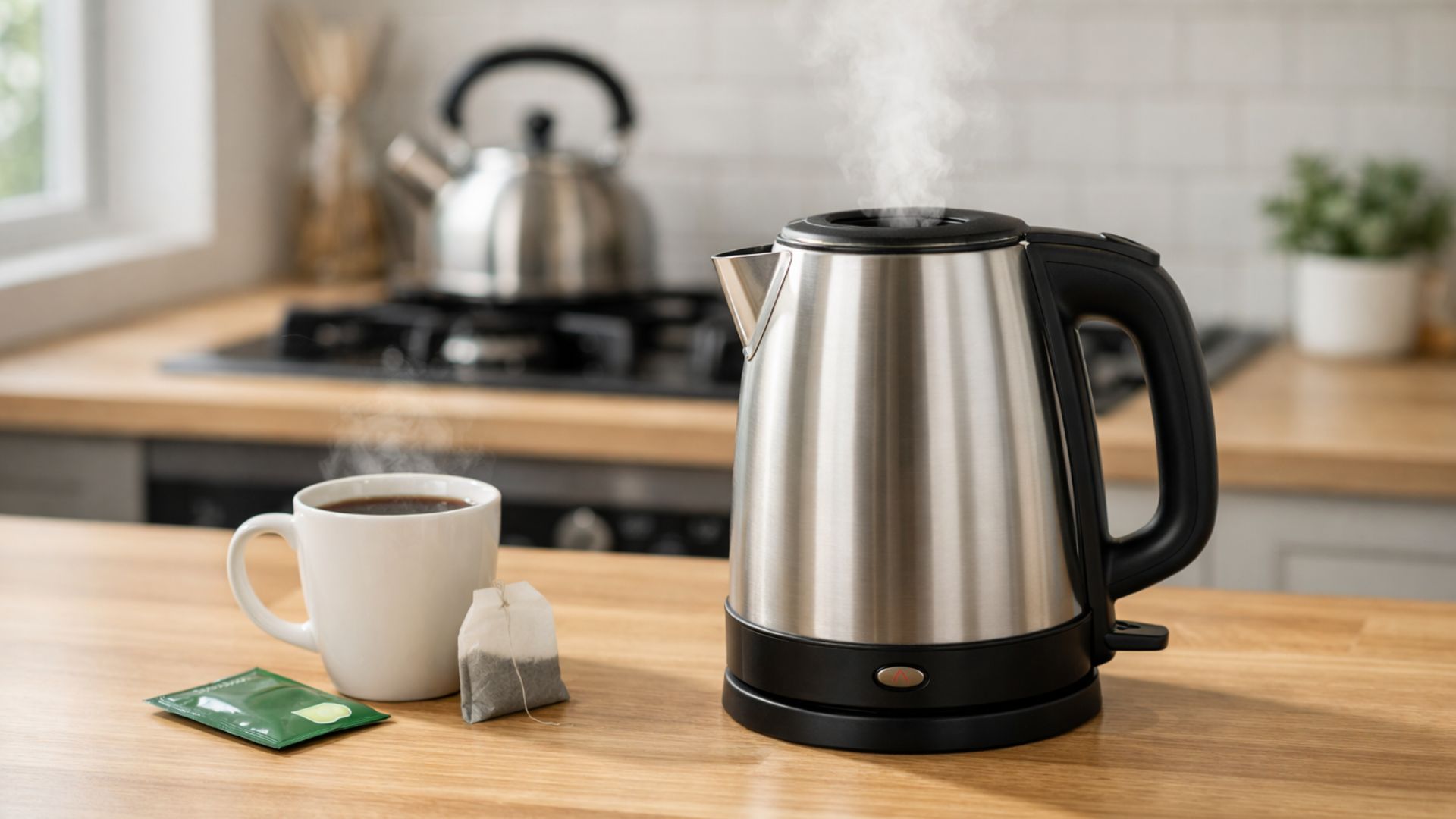

Silent change in kitchens gains strength with the search for agility, lower energy consumption, and practicality in preparing drinks and quick recipes, transforming a daily habit into a more efficient and predictable process within the home routine.
The electric kettle has ceased to be an accessory restricted to specific routines and has increasingly taken the place of the traditional kettle placed on the stove or even the pot used solely to boil water.
This change follows a simple logic of domestic use: when the task is unique, repetitive, and daily, the dedicated equipment tends to shorten steps and make preparation more predictable.
Daily use accelerates adoption of the electric kettle
In kitchens where coffee, tea, porridge, instant noodles, and recipes that start with hot water appear throughout the day, the device has gained space by reducing dependence on the stove for a single function.
-
A college in Peru turned a street billboard into a ‘factory’ for drinking water that pulls moisture from the air: in three months, the panel produced almost 9,500 liters in one of the driest capitals on the planet.

-
The coast of Pernambuco has more than a dozen deliberately sunken ships at the bottom of the sea, and what started as a junkyard has become one of the largest wreck diving parks in Brazil, a refuge for turtles and schools of fish.
-
A woman left São Paulo to help her 88-year-old father in the hinterland of Paraíba, found the abandoned family farm, switched cassava and cattle for organic fruits, and harvested 24 tons of melon and watermelon in the semi-arid region, proving that tradition, irrigation, and planning can transform forgotten land into a sustainable business.

-
A network of cameras created to hunt down stolen cars recorded over 1 million alerts in a single American city in one year, overwhelmed the police, and forced the department to disable precisely the feature that was supposed to be the system’s strong point.



Instead of lighting the flame, waiting for the container to heat up, and monitoring the boil, the user transfers this operation to an item designed specifically for that purpose.
This switch is also explained by the fragmented routine of homes.
Not every kitchen revolves around long meals, full pots, and multiple simultaneous steps.
In many households, what repeats more frequently are short preparations between commitments, with small volumes of water heated for a mug of coffee, a hot drink, or the quick start of a recipe.
Energy efficiency and less waste
In this scenario, the advantage of the electric kettle appears even before boiling.
By concentrating heating in a dedicated appliance, it prevents water from competing for space with frying pans, pots, and other preparations that truly require the stove.
The most visible consequence is not just the rush to finish the task, but the simplification of a step that tends to repeat several times a week.
According to the U.S. Department of Energy, using an electric kettle — just like a kettle or covered pot — to boil water is a faster alternative with lower energy consumption than less efficient methods.
The agency’s guidance reinforces that reducing heat loss shortens the time needed to reach boiling, which helps explain why the appliance has come to be seen as a practical choice, and not just as a complementary kitchen item.
The perception of savings, therefore, does not depend solely on the experience of those who have already adopted the appliance on the countertop.
When water is heated on the stove, part of the energy dissipates in the process between the heat source, the base of the container, and the liquid.
In the electric kettle, the operation occurs in a more concentrated manner, with fewer intermediate steps and less need for continuous attention.
More practical and predictable home routine
This gain in efficiency weighs more heavily on smaller tasks, which previously seemed too simple to justify a specific piece of equipment.
Boiling water for one or two cups, for example, tends to be a short but recurring action.
When added up over the days, these repetitions transform a common gesture into a relevant point of kitchen organization and domestic consumption.
Another decisive aspect is the control of the heated volume.
In many homes, the habit is not to boil exactly what will be used, but to prepare more water than necessary out of habit or convenience.
The electric kettle favors a more precise adjustment of this quantity, especially when the demand involves small portions, which reduces waste and avoids unnecessary heating.
Although some models have extra features, such as temperature regulation, the notion of precision does not necessarily depend on sophisticated functions.
In practice, it manifests in heating only what is necessary, with less variation in time between one use and another.
For those who frequently prepare drinks and instant solutions, this regularity weighs more than any decorative or technological element.
Compact kitchens boost replacement
That is also why the electric kettle has started to resonate with compact kitchens and urban routines.
In smaller environments, every free burner makes a difference during lunch or dinner preparation.
Reserving one of them just to heat water may seem like a detail, but it stops being irrelevant when preparation coincides with other foods, utensils, and cooking times competing in the same space.
At the same time, the replacement does not eliminate the role of the stove nor transform the appliance into a universal solution.
Pots remain indispensable when water will be combined from the start with other ingredients or when heating is part of a complete recipe.
The central point of the change lies less in absolutely replacing utensils and more in separating tasks that work better when performed by different equipment.
What to consider when choosing an electric kettle
In daily practice, this means that the electric kettle better serves water that will be used immediately and in isolation, while the stove remains essential for what requires joint cooking, reduction, mixing, and continuous preparation.
The distinction seems simple, but it helps to understand why the appliance has advanced without necessarily expelling traditional methods from the kitchen.
When it comes to choice, price has ceased to be the only relevant criterion.
Capacity, shape, ease of handling, and clarity of water marking influence daily routine more than the visual appeal of the product.
Those who live alone or prepare small quantities throughout the day tend to adapt better to smaller models, while families and kitchens with more intense use usually require larger reservoirs.
Power, in turn, affects the heating pace, but does not alone resolve the user experience.
An uncomfortable kettle to fill, serve, or clean can lose value in daily life, even when it promises high performance.
In an item designed to be activated many times, ergonomics and practicality cease to be details and begin to directly interfere with the use of the appliance.
Habit change in modern kitchens
There is also a less discussed effect of this change: the silent reorganization of domestic habits.
When a daily task becomes quicker and more predictable, it tends to be incorporated with less friction into the routine.
The preparation of breakfast, the drink in the afternoon, or the improvised meal between commitments starts to require fewer steps, less waiting, and less attention to a process that, on the stove, usually keeps the user occupied for longer.
It is this combination of speed, rationalization of stove use, and better energy utilization that helps explain the ongoing change in kitchens.
The electric kettle has not become a trend due to technological nostalgia or countertop fads, but because it directly responds to a very specific demand of domestic life: boiling water simply, consistently, and efficiently.


