





 Portuguese
  English
  Spanish
  4 min of reading
  0 comments


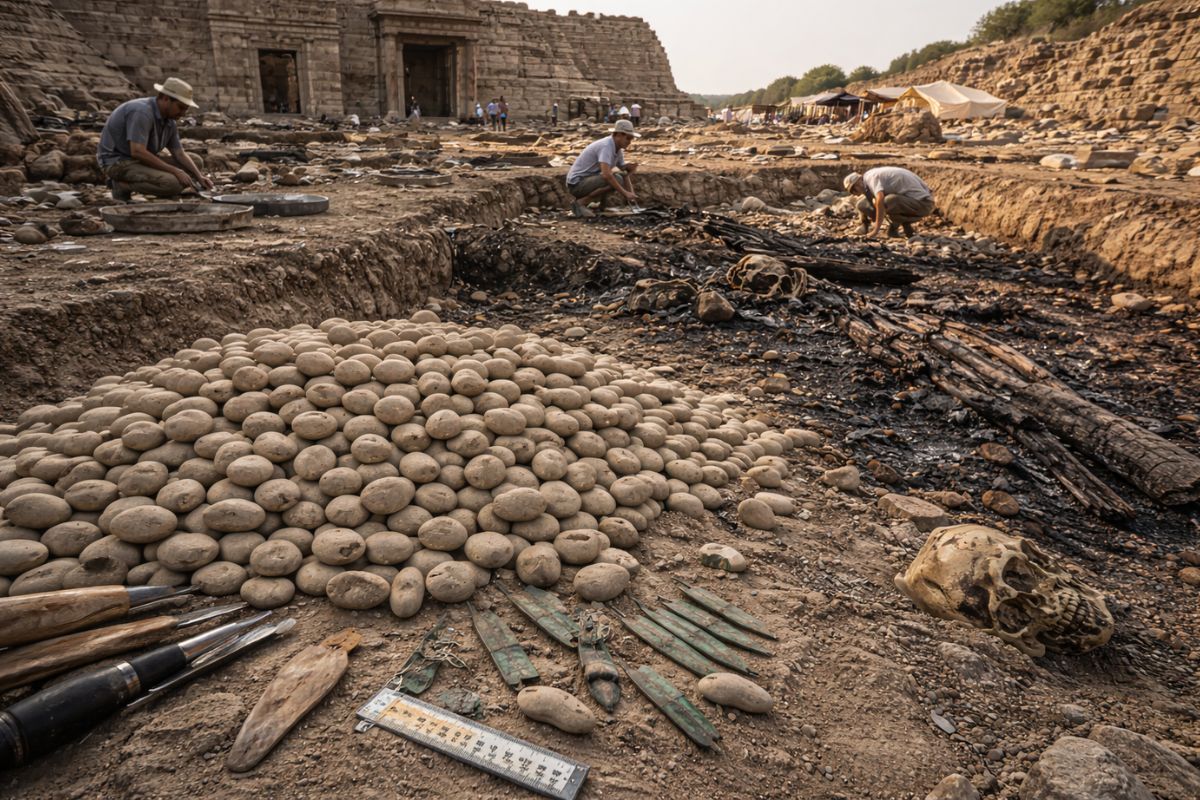
The stones were polished until they became aerodynamic, capable of crushing skulls at a distance when thrown with leather slings, and the dating matches exactly with the period that the ancient Greeks attributed to the Trojan War: around 1184 BC.
For centuries, historians treated Homer’s Iliad as literature. A beautiful story about gods, heroes, and a woman beautiful enough to launch a thousand ships to sea. Helen, Achilles, the wooden horse. Fiction. Myth. Poetry.
But beneath a hill in northwestern Turkey, called Hisarlık, archaeologists are unearthing something that changes this conversation. Thousands of 3,500-year-old sling projectiles, concentrated in a small area in front of what would be the royal palace of Troy. Along with arrowheads. Burned buildings. And skeletons of people hastily buried, as if there was no time for a decent funeral.
Professor Rüstem Aslan, from Çanakkale Onsekiz Mart University, who leads the excavations, was straightforward: “This concentration of projectiles in such a small area indicates intense combat. A desperate defense or a large-scale assault.”
-
Seen from space, an image taken by an astronaut shows an unlikely oasis in the Saudi Arabian desert, protected by a terrain that slows the advance of sand, surrounded by green circles, remnants of an extinct lake and nearly 10,000 years of preserved history.

-
Seen from space, an image taken by an astronaut shows an unlikely oasis in the Saudi Arabian desert, protected by a terrain that slows the advance of sand, surrounded by green circles, remnants of an extinct lake and nearly 10,000 years of preserved history.

-
Support during childbirth advances in Brazil and strengthens the role of doulas: expectant mothers gain more comfort, guidance, and support from the beginning to the postpartum period.

-
Independence from an early age, plenty of time outdoors, and zero pressure for performance: the Dutch method of parenting has produced the happiest children on the planet and challenges everything other countries believe is necessary for good education.

The most lethal weapons of the Bronze Age

The stones found in Troy are not ordinary stones. They are clay and river projectiles, polished until they became perfectly aerodynamic. When thrown with leather slings, they were capable of crushing skulls at a distance. In the Bronze Age, there was no more lethal projectile weapon.
The dating is the detail that makes everything fit. The stones are between 3,200 and 3,600 years old. Ancient Greek historians, such as Herodotus and Eratosthenes, placed the Trojan War around 1184 BC. The numbers match. The layer of destruction that archaeologists are excavating corresponds exactly to the period that Homer described.
And it’s not just the stones. In the same layers, the team found Bronze Age arrowheads, completely burned structures, and human remains buried without any funeral ritual, as if the city had fallen suddenly and violently.
Even a metacarpal bone used as a game die was found, suggesting that soldiers passed the time gambling while waiting for battle. A human detail that crosses 3,500 years and makes the scene seem too real to be fiction.
What Troy really was

Troy was not just any little town. It was located next to the Dardanelles Strait, the passage between Europe and Asia. This made it a vital trading center, rich in goods and strategically positioned to control naval traffic between two continents.
The city had stone towers, long walls, and a complex urban structure. In Hittite texts of the time, Troy appears under the name Wilusa. It was a well-defended fortress. And it was a target worth attacking.
Excavations in Troy began in 1871 with Heinrich Schliemann, the German businessman who proved that the legendary city was real. Schliemann found ruins, walls, and gold. But his aggressive methods damaged important archaeological layers. Only now, 150 years later, does technology allow for precise excavation of the exact layer that corresponds to the period of the war.
What is still missing
There is no physical evidence of the wooden horse. And it probably will never exist. Scholars believe that the horse may have been a poetic metaphor for subterfuge or betrayal, not a real object. Wood does not survive 3,000 years.
There is also no inscription saying “the Trojan War happened here.” Archaeology does not work that way. What exists is a cumulative body of material evidence that all points in the same direction: a rich and fortified city, suddenly and violently destroyed, in a period that matches Greek records, with weapons scattered in front of the palace and bodies thrown without ceremony.
Each excavation season adds a piece. The arrowheads came in 2024. The sling projectiles came in 2025. The layer of destruction is being opened meter by meter. And what appears beneath the ground is increasingly difficult to call myth.
Why this matters
The Iliad is one of the founding texts of Western civilization. If the war it describes really happened, it’s not just archaeology that changes. It’s the way we understand the boundary between history and literature.
Homer may have exaggerated the gods, the invulnerable heroes, and the beauty of Helen. But beneath the poetry, there may have existed a real siege, a real battle, and a city that truly fell.
The sling projectiles found in front of the palace of Troy in 2025 do not prove that Achilles existed. They do not prove that Paris abducted Helen. But they prove that someone attacked that city with everything they had. And that the defenders fought to the end.
Perhaps Homer did not invent the war. Perhaps he just told it his way.
With information from Ancient Origins, Greek Reporter, Jerusalem Post, and Daily Mail.








Seja o primeiro a reagir!