





 Portuguese
  English
  Spanish
  4 min of reading
  17 comments


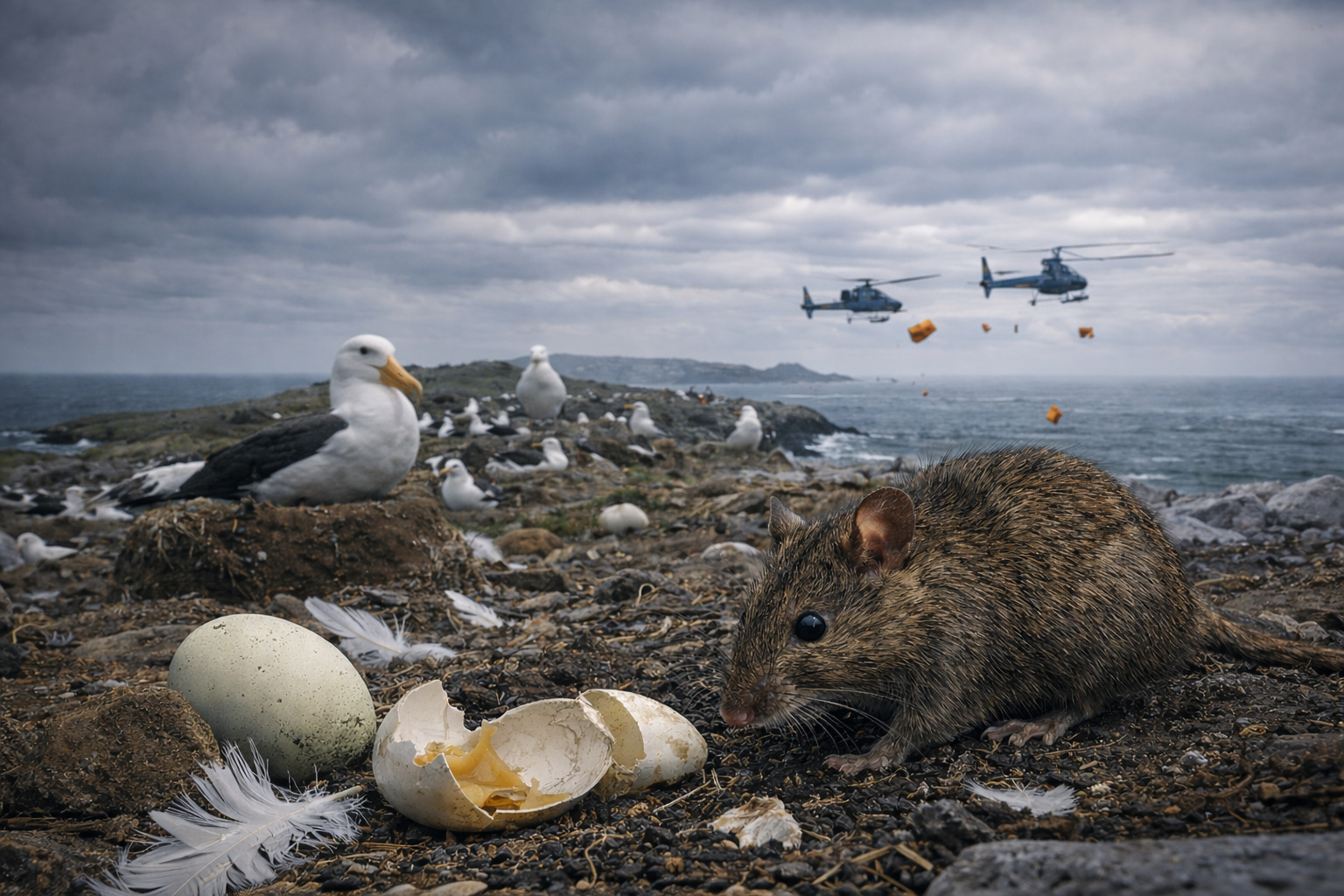


Invasive Rats Nearly Extinguished Millions of Seabirds in Midway and Forced the Largest Air Eradication Operation in the World; Understand the Ecological Impact and the Results.
In the middle of the North Pacific Ocean, thousands of miles from any major urban center, Midway Atoll, a territory of the United States, hosts one of the planet’s most strategic ecosystems for oceanic birds. The Sand, Eastern, and Spit islands are breeding grounds for over 3 million seabirds, including some of the largest albatross colonies in the world, such as the Laysan Albatross and the Black-footed Albatross.
This extreme isolation, which protected the local fauna for thousands of years, also made the archipelago extremely vulnerable to any invasive species introduced by humans.
How Rats Got to Midway and Triggered an Ecological Collapse
Rats are not native to Midway. They accidentally arrived during the 20th century, mainly during the period when the atoll was used as a military base. Ships brought field rats and domestic rats, which found an environment with no natural predators and an abundance of food.
-
A Brazilian millionaire couple restores a farm over 150 years old in the interior of São Paulo and transforms the historic property with Portuguese tiles, antique furniture, and new spaces into a refuge that blends tradition, comfort, and sophistication.

-
Submerged city in a lake in Minas reveals intact streets, preserved vehicles, and houses after more than 60 years, impressing divers.

-
Yellowstone has started to rise again in an area of the caldera, and the movement rekindles fears surrounding the U.S. supervolcano, as scientists monitor the deformation and try to understand what is happening underground.

-
Woman arrested after receiving $1.2 million due to banking error and not returning the amount.



The impact was devastating. Unlike what happens on continents, rats began to attack live seabird chicks, including juvenile albatrosses that remain in the nest for months before flying. Reports from the US Fish & Wildlife Service documented birds with open wounds, chewed beaks, and slow death due to infection or blood loss.
In some areas, up to 70% of albatross chicks were killed before reaching the fledging stage, a level of predation capable of collapsing entire populations in just a few decades.
Why Albatrosses Were the Biggest Victims
Albatrosses have a slow reproductive cycle. They:
- Lay only one egg per year
- Take 5 to 9 years to reach sexual maturity
- Form stable pairs and always return to the same place to breed
This means that the continuous loss of chicks is not quickly compensated. In Midway, the actions of the rats put some colonies on the brink of functional extinction, even with millions of adult birds still present.
The Extreme Decision: Total Eradication of the Rats
Faced with the real risk of ecological collapse, U.S. environmental authorities authorized a measure considered a last resort: the largest air operation for rat eradication ever conducted on oceanic islands.
The project was led by the US Fish & Wildlife Service, with support from researchers and international conservation organizations. The strategy involved:
- Aerial distribution of rodenticide baits
- Use of helicopters equipped with precision dispersion systems
- Detailed mapping to avoid sensitive areas and non-target species
The operation covered the entire land area of the atoll, including hard-to-reach regions, ensuring that no pockets of rats survived.
Why the Eradication Needed to Be Aerial
In remote islands like Midway, traditional methods — traps or manual control — would be ineffective. Rats reproduce quickly, occupy underground tunnels, and hide in dense vegetation. Any failure would allow the invasive population to recover.
Aerial dispersal ensured total coverage, which is essential in a small, isolated, and highly sensitive ecosystem. Studies published in journals like Science Advances show that incomplete eradications often fail and worsen the problem.
Results Observed After the Eradication
After the completion of the operation, data began to confirm the positive impact:
- Sharp decline in chick mortality
- Return to normal nesting behavior
- Gradual recovery of more sensitive species
Long-term monitoring indicates that previously declining colonies began to show consistent population growth, something considered unlikely without the total elimination of rats.
The Ethical and Environmental Controversy
Despite the success, the operation generated intense debate. The use of rodenticides on a large scale raises concerns about:
- Impact on non-target species
- Risk of environmental contamination
- Precedent for similar interventions in other ecosystems
For this reason, the Midway project has been globally cited as a case study, both for its positive results and the ethical dilemmas involved. Today, it is a reference in scientific reports and debates on conservation on islands.
Why Midway Became a Global Conservation Landmark
The Midway case clearly demonstrated that:
- Invasive species can cause silent extinctions
- Non-intervention can be as destructive as poorly planned actions
- In certain contexts, extreme measures are the only viable alternative
The archipelago has become a symbol of a new era of conservation: one where science, technology, and tough decisions come together to prevent irreversible losses.
Midway is not just a group of islands in the Pacific. It is a living laboratory that exposed the limits of coexistence between invasive species and isolated ecosystems. The eradication of rats saved millions of birds, but it also left a question that resonates in conservation projects around the world: how far is humanity willing to go to repair the imbalances it has created?





Es impecable las ratas son omnívoras
Y para cuando los gatos callejeros?
En tierra del fuego los castores también fueron introducidas por el hombre y están haciendo estragos en los bosques de lenga