





 Portuguese
  English
  Spanish
  6 min of reading
  0 comments


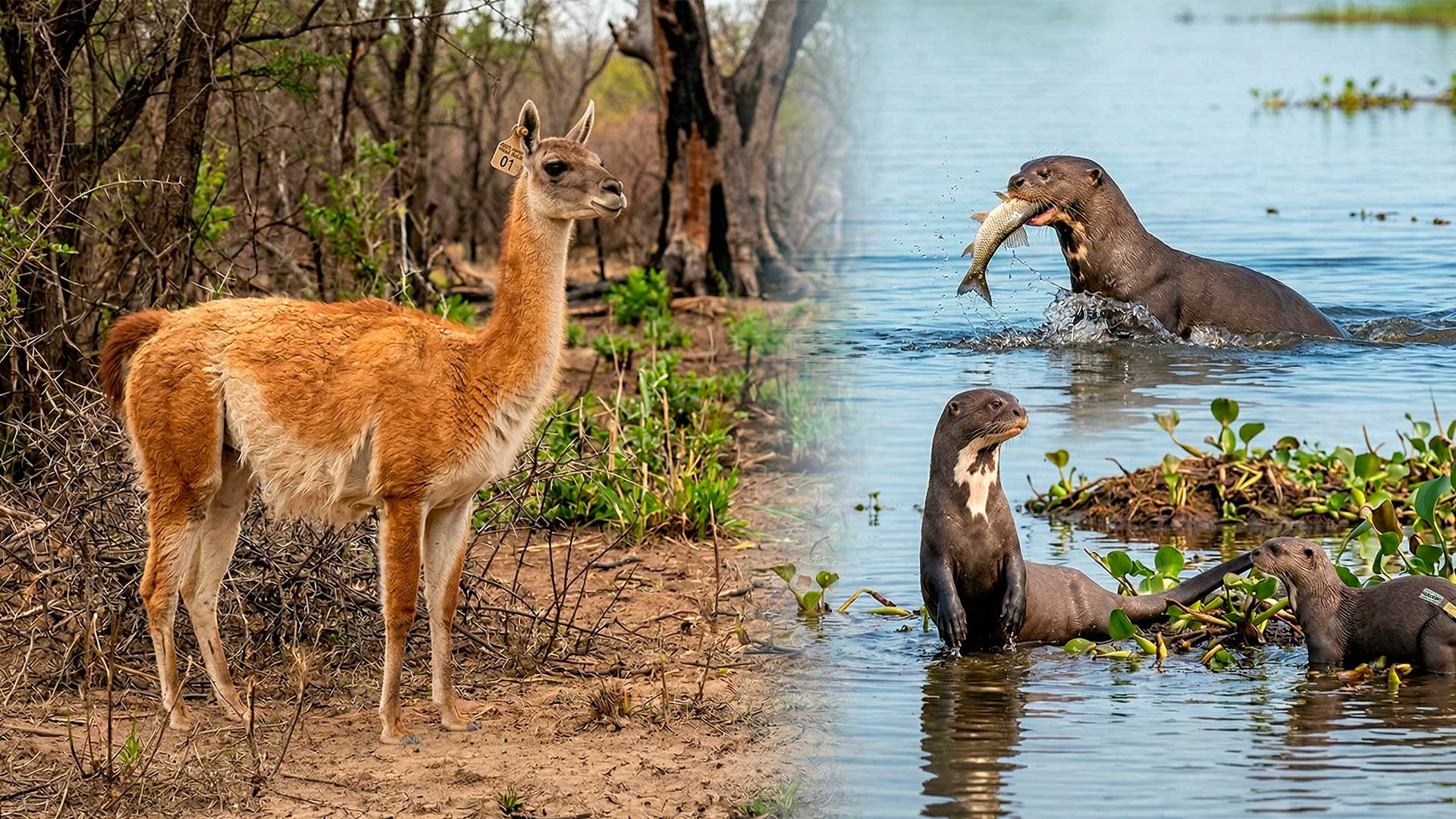
After more than 110 years without the largest native herbivore of South America, the Argentinian Chaco has welcomed a key animal to contain fires, reorganize vegetation, and rebuild lost food chains
The guanaco has returned to the Argentinian Chaco in December 2025, ending an absence of over a century in one of the country’s most pressured regions. The return took place in El Impenetrable National Park, in northern Argentina, after a land operation of 3,200 kilometers, considered a world record in conservation for the species.
The animal, scientifically identified as Lama guanicoe, is the largest native wild herbivore in South America. Adults can weigh up to 120 kilograms and nearly 1.2 meters in height at the back, characteristics that help explain its ecological weight within biomes such as the Dry Chaco.
The reintroduction was led by the Rewilding Argentina Foundation in partnership with the National Parks Administration, APN, and the provinces of Chaco and Santa Cruz. The five animals came from Parque Patagônia, in the far south of the country, and underwent genetic, population, and health assessments before the journey.
-
Returning to the Moon now costs a billion-dollar bill and reignites the competition between the USA and China for science, technology, and rare minerals on lunar soil.

-
While the world looks at oil, the war with Iran is already disrupting helium supply from Qatar, affecting car and iPhone chips, threatening AI expansion, and putting pressure on aluminum packaging at the highest value in four years.

-
Global warming will expose a treasure hidden under the ice of Antarctica and may spark an international dispute over gold and valuable minerals.

-
A street vendor from Praia Grande built a robot made of scrap from scooters and washing machines that pulls his popcorn cart on the beach, emits sounds, and interacts with customers, becoming an attraction on the coast of São Paulo.


More than just returning a lost species, the initiative aims to repair an ecological void that has persisted since the 19th century. Without the guanaco, the forest accumulated excessive vegetation, increased the risk of intense fires, and lost an essential agent for the natural functioning of the food chain.
Why the disappearance of the guanaco disrupted the Chaco for decades and aggravated issues like fire, excess biomass, and loss of natural prey
The regional extinction of the guanaco in the Argentinian Chaco was primarily caused by predatory hunting and agricultural expansion throughout the 19th century. The species did not disappear from the planet but was eliminated from this area, which profoundly altered the landscape dynamics.
In the Dry Chaco, the guanaco played a role that no other native species could fully replace. By grazing, it controlled the undergrowth, reduced biomass accumulation, and decreased the material that could fuel large-scale fires.
This role also influenced other animals. Predators in the biome, such as the ocelot, lost a historical prey, and this affected the balance of predation at different levels of the food chain.
How the operation of capture, transport, and adaptation of the five animals taken from the south of Argentina to El Impenetrable National Park was conducted
The logistics required an unusual solution even by international rewilding standards. The animals were captured in Parque Patagônia using a herding technique that employed four motorcycles in a V formation, guiding the group to a funnel and then to the trailer’s chute.
The procedure was designed to preserve the family groups and minimize stress. Additionally, a special trailer was used, developed for the long journey between Santa Cruz and Chaco, focusing on the well-being of the guanacos during transit.
Before boarding, the five individuals underwent complete health examinations and a genetic assessment to ensure diversity in the new population. The team also set up pre-release pens in El Impenetrable, allowing for gradual adaptation to the environment before the final release.
The Argentine government classified the land transfer of 3,200 km as the longest ever conducted in the world for conservation purposes for the species. The success of the journey, with the animals arriving healthy at their destination, turned the operation into a technical and logistical reference.
Rewilding Argentina itself documented the action on its social media, where it has over 272,000 followers. The mobilization showed that large reintroductions require detailed planning, infrastructure, and continuity, not just the symbolic release of the animals.
Why the return of the largest native herbivore of South America can change the ecosystem from the first day inside the Dry Chaco forest
The guanaco is a large grazer, and this means that its presence directly interferes with the structure of the vegetation. By moving around and feeding, it helps to open spaces, limits excessive plant growth, and favors a landscape less prone to extreme fire.
This effect may seem subtle at first, but it often spreads throughout the ecosystem. Less accumulated biomass means less pressure on the forest during dry periods, as well as better conditions for the regeneration of plant species and the movement of other animals.
There is also an indirect impact on food chains. When a large herbivore returns to occupy its place, predators, scavengers, and other components of the environment start to respond to this new food and movement supply.
El Impenetrable already hosts recovery programs for the yabotí turtle and the ocelot. With the return of the guanaco, the park restores yet another lost link and strengthens an ecological restoration process that has been built over the years.
Argentina accelerates rewilding projects with guanacos in Chaco and giant otters in Iberá, strengthening regional leadership in environmental restoration
The return of the guanaco did not happen in isolation. In July 2025, Argentina also recorded another significant milestone with the release of four giant otters, species Pteronura brasiliensis, in the Gran Parque Iberá, in Corrientes, after more than 40 years of local extinction.
This program brought together Rewilding Argentina, the Brazilian Giant Otter Project, and the European Association of Zoos and Aquaria, EAZA. One of the released animals, Nima, was born at the Madrid Zoo and arrived in Argentina in January 2023, highlighting the international level of cooperation involved.
The giant otters fulfill another essential role, now as top predators. They control populations of fish and other aquatic organisms, help reorganize life in rivers, and indicate environmental improvement in monitored wetlands and water bodies.
The case of the guanaco in Chaco and the giant otter in Iberá reveals a pattern. Argentina has been consolidating itself as one of the most active hubs on the continent in wildlife reintroduction and in restoring ecological processes on a large scale.
The challenges to keep the project alive include monitoring, habitat protection, genetic diversity, and support from surrounding communities
The return of a species does not end the conservation work. For the population to become stable, it will be necessary to maintain a rigorous routine of genetic monitoring, health protection, and monitoring the adaptation of the animals to the new territory.
It will also be essential to strengthen anti-poaching enforcement, contain habitat degradation, and curb deforestation, especially in the most sensitive areas of the biome. Without this, the risk is to repeat the same pressures that caused the disappearance of the guanaco more than 110 years ago.
Another strategic point is the creation of wildlife corridors between protected areas, allowing for freer movement and greater population resilience over time. In projects of this scale, excessive isolation can compromise both reproduction and genetic diversity.
In addition to the ecological effect, the return of these species opens up space for nature tourism and new economic opportunities in northern Argentina. When restoration progresses with planning, the benefits are not limited to wildlife and also reach the communities living nearby.
The return of the guanaco to Chaco and the giant otters to Iberá shows that environmental restoration has ceased to be a promise and has become a concrete result. Still, there are those who view these projects with total enthusiasm and those who demand more long-term guarantees. Leave your comment and say whether the reintroduction of large animals should become an absolute priority in the environmental policies of South America.








Seja o primeiro a reagir!