





 Portuguese
  English
  Spanish
  5 min of reading
  33 comments


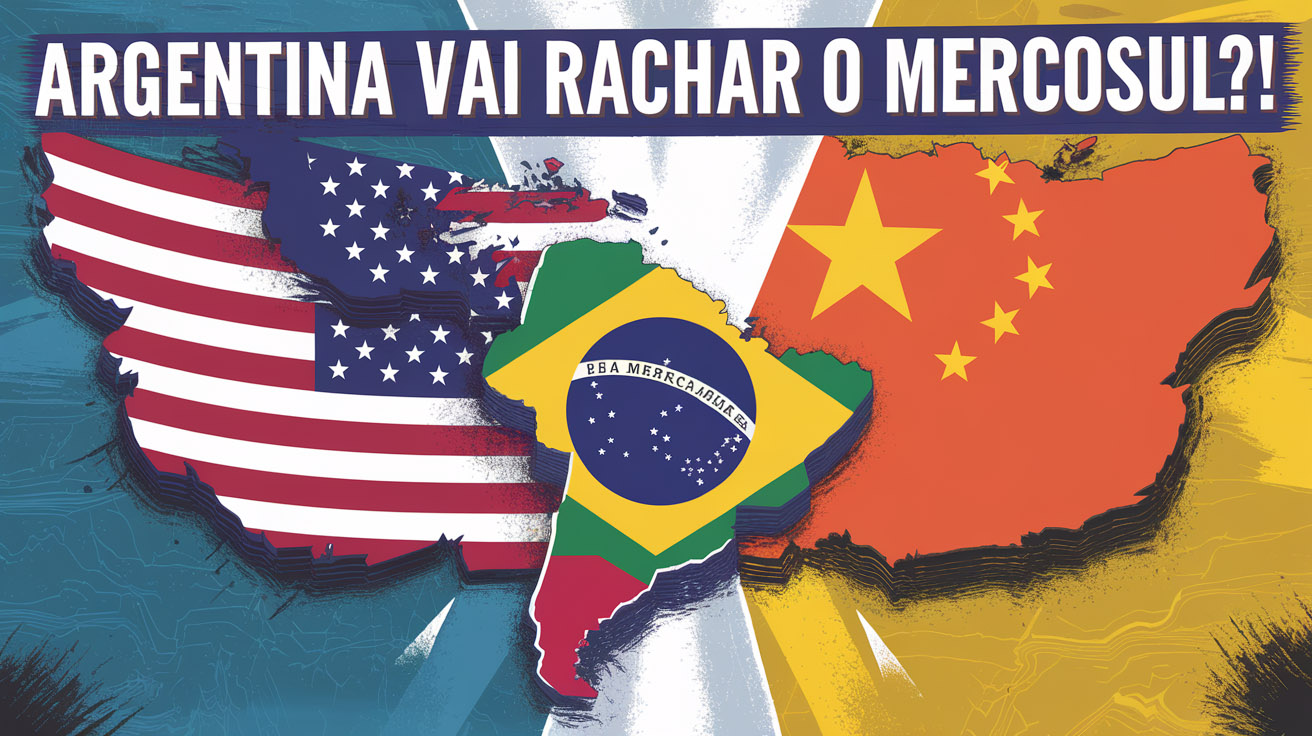


Argentina May Shake Mercosur And Force Brazil To Choose Between The US And China! The Bloc Is On The Verge Of A Crisis, And The Exit From Buenos Aires May Favor The Great Powers. The Future Of South American Trade Is At Stake, And Milei’s Decision May Change Everything. Is Brazil Ready For This Choice?
In a move that could shake the geopolitical structures of South America, Argentina signals a possible break with Mercosur, threatening the stability of the bloc and forcing Brazil into an unprecedented diplomatic crossroads.
The consequences of this decision could redraw alliances and influences on the continent, putting global powers in competition for regional dominance.
Argentine President Javier Milei recently declared that he is considering withdrawing his country from Mercosur if remaining in the bloc prevents the signing of a free trade agreement with the United States.
-
“No one will make us change the Pix,” says Lula after the US report.

-
Lula responds directly to Trump and says that Pix is from Brazil and will not change under pressure from anyone, after a report from the United States pointed out the Brazilian payment system as an American trade barrier.
-
Amazon has just announced a new fee on all deliveries, and your online purchases will become more expensive starting April 17, including for those buying from the United States here in Brazil.

-
He sold his share for R$ 4 thousand, saw the company become a giant worth R$ 19 trillion, and missed the opportunity of a lifetime.


During the World Economic Forum in Davos, Switzerland, Milei stated that his intention is to advance the agreement without abandoning Mercosur, but emphasized that if necessary, he will prioritize the US.
“If extreme conditions demand it, yes [we will leave Mercosur]. But there are mechanisms that can be used within Mercosur, so we believe this can be done without necessarily having to abandon the bloc”, Milei declared, according to published by Sputnik Brasil.
Economic And Geopolitical Impacts
According to Sputnik Brasil, analysts indicate that a potential exit of Argentina from Mercosur could have significant effects for South America.
Corival Alves do Carmo, a professor at the Department of International Relations at the Federal University of Sergipe (UFS), assesses that while the exit is unlikely due to the importance of the bloc for Argentine exports and trade with Brazil, if it occurs, it would represent the end of Mercosur as envisioned in the 1980s.
“However, as long as the other members remain, it could be a way to revitalize the bloc around Brazil and even include new members”, notes the specialist in an interview with Sputnik Brasil.
The permanence of Argentina in Mercosur, with authorization to close a bilateral agreement with the US, could also undermine the unity of the bloc, as it would encourage other countries to take the same path, compromising the customs union.
“Mercosur would cease to be relevant, as only a small part of the members’ trade would be regulated by the bloc’s rules”, added Carmo to Sputnik Brasil.
Risks For The Argentine Economy
The signing of free trade agreements with the US and China could deepen Argentina’s trade deficits with those countries.
“In 2023 and 2024, in order, Brazil, the US, and China were the main destinations for Argentine exports. And the largest deficits were with China, Brazil, and the US. In this sense, a free trade agreement would deepen the deficits with China and the US, and considering the productive structure of each country, it is unlikely that in the short term Argentina could replace imports from China with imports from the US”, said Carmo to Sputnik Brasil.
Consequences For Brazil
For Brazil, the exit of Argentina from Mercosur would represent a significant loss, as the main Brazilian products exported to Argentina are manufactured and could be replaced by Chinese and American production.
“Brazil would be the big loser”, highlights Carmo in an interview with Sputnik Brasil.
Influence Of Global Powers In The Region
With the United States adopting a more closed and protectionist posture under Donald Trump, there is the possibility of increased Chinese influence in South American countries.
Sputnik Brasil interviewed Carmo, who believes that China may expand its political influence in the region, but that South America still has strong cultural and economic connections with the US.
“Brazilian agribusiness loves to do business with China, but with its earnings, they buy houses in Miami”, he points out.
Possible Solutions To Avoid Mercosur Fragmentation
Eduardo Galvão, a professor of public policies at Ibmec DF and director of the global consultancy Burson Brasil, stated to Sputnik Brasil that the current rigidity of Mercosur is one of the reasons why some countries seek individual exits.
“It’s like a football team, where the players want to shine on their own because they feel the collective doesn’t work. The solution may lie in modernizing the bloc’s rules, creating a balance between flexibility and integration. Allowing controlled bilateral negotiations while maintaining the benefits of an integrated regional market could be the key to preserving Mercosur’s relevance without compromising national interests”, he analyzes.
Galvão warns that Argentina’s exit from Mercosur would be a severe political and economic blow, opening a dangerous precedent and potentially resulting in the fragmentation of the bloc.
“Moreover, an Argentina outside Mercosur would strengthen the influence of powers such as the US and China in the region. The US would benefit from a direct partner like Argentina, while China could take advantage of the bloc’s fragility to expand its agreements with other South American countries. In the end, Mercosur would be leaving a vacuum that great powers would quickly compete for. Although Milei is prioritizing an agreement with the US, this decision is not just technical; it is political”, said Galvão to Sputnik Brasil.
Division Of South America Into Two Blocks Of Influence
If the release for bilateral negotiations in Mercosur advances, South America may end up divided into two blocks of influence: on one side, countries like Argentina, seeking agreements with the US; on the other, nations like Uruguay and even Brazil deepening relations with China.
“This dispute would place Brazil, the largest economy in the region, in a delicate position, forcing it to mediate divergent interests between global powers and the objectives of Mercosur itself”, concludes Galvão in an analysis for Sputnik Brasil.
The Argentine decision is still under discussion, but the impact of this potential break could redefine the paths of politics and economics in South America, making Brazil a key player in a geopolitical chess game of great proportions.
In light of this scenario of uncertainties and global disputes, will Brazil be able to balance its relations between the US and China without compromising the future of Mercosur?







Meu sonho é Brasil ser dominado pela China, poderíamos até que fim colocar um governo Socialista, pessoal do 8 de janeiro, corda e poste em praça pública, viva a federação socialista do Brasil. Viva a China.
Vai quebrar a cara EUA nunca vai querer A. Latina desenvolvida. O futuro são os Brics, em breve os Brics vão ter moeda própria e EUA vai ficar mais fraco com dólar desvalorizado.
Brasil precisa de país falido não melhor larga estes vermes de lado cuida de nosso país sem estes miseráveis