





 Portuguese
  English
  Spanish
  5 min of reading
  0 comments


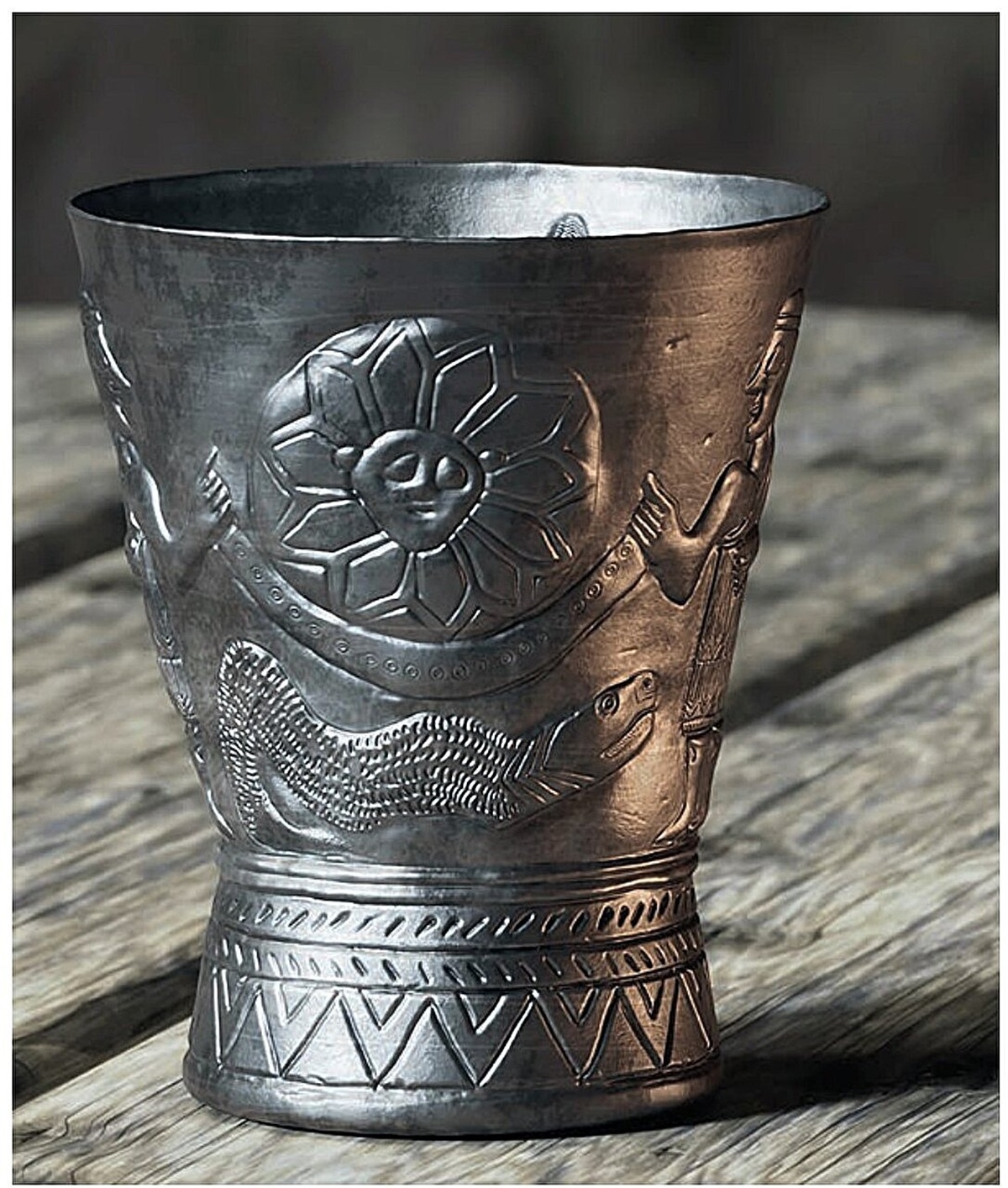
Images Engraved on a 4,000-Year-Old Silver Cup Found in the Hills of Judea May Reveal a Distinct Cosmic Creation Narrative, Contradicting the Traditional Interpretation That Related the Piece to the Babylonian Myth of Enuma Elish
The images on a cup approximately 4,000 years old may depict a cosmic creation narrative.
This possibility arises from a new study that revisits the traditional interpretation of the cup from ˁAin Samiya, a silver piece 8 centimeters tall produced during the Middle Bronze Age, between 2650 and 1950 B.C.
For decades, scholars have attributed a connection between the cup and the Babylonian creation myth known as Enuma Elish, but this connection has never achieved definitive consensus.
-
After decades of failed attempts, Brazil is once again looking to space with an orbital rocket measuring 12 meters, weighing 12 tons, costing R$ 189 million, and scheduled for launch in 2026, in a new race to finally achieve autonomous access to orbit.

-
The Earth will plunge into a few minutes of darkness in broad daylight in August 2026, when a total solar eclipse transforms the sky into one of the most impressive astronomical phenomena in recent years.

-
How the terraforming of Mars can transform the planet: artificial aerosols can increase the temperature by up to 35°C in 15 years, creating conditions for liquid water.

-
Scientists drilled nearly 8,000 meters into the ocean floor above the fault that caused the 2011 tsunami in Japan and discovered that a layer of clay 130 million years old was responsible for making the wave much worse than any model had predicted.


Now, a new analysis suggests that the object presents another view on the origin and organization of the cosmos.
A Unique Discovery in the Hills of Judea
The cup emerged about 55 years ago, when archaeologists found it in an ancient tomb in the hills of Judea. From the beginning, researchers recognized its unique character.
The object is considered the only known genuine work of art from this period in the Levant, which enhances its historical and archaeological value.
The piece features scenes distributed across its outer surface, but structural damage and a lost fragment make it difficult to fully understand the narrative.
The visible elements draw attention. A hybrid figure, part human and part animal, appears holding pieces of plants.
Right below, a small rosette of celestial appearance emerges. The legs of this creature seem to belong to two distinct bulls, which join at the upper part of the body.
A large snake rises next to the figure, composing a scene marked by hybrid and symbolic elements.
The following sequence shows two human figures holding the ends of a crescent.
Inside it, a sun with an evident face rests, known as a frontal scene. At this moment, the snake appears lying under the crescent, in a less prominent position, as if it were subdued.
The Ancient Association with the Enuma Elish
During the first decades after the discovery, scholars such as Yigael Yadin suggested that this iconography represented an early form of the Enuma Elish myth. In the Babylonian narrative, the god Marduk defeats the sea goddess Tiamat and uses her body to form the heavens, the Earth, and humanity. This hypothesis gained traction, although it was not unanimous.
Some researchers pointed out that the cup does not depict scenes of combat or violence, central elements in the Babylonian myth. Furthermore, the Enuma Elish emerged about a thousand years after the cup was made, which raises doubts about the possibility of a direct relationship between the two.
An Interpretation Focused on Cosmic Order
The new study published in the journal Ex Oriente Lux proposes another understanding. The authors argue that the cup may represent the gradual process of ordering the cosmos, rather than a specific myth. For them, the first scene shows an initial state of chaos, while the second represents the organized structure of the universe.
The rosette, interpreted as the solar divinity, provides the central clue. In the first scene, the sun appears small, as if it has just been born.
In the next scene, it grows in size and adopts a frontal representation. The researchers claim this change intentionally shows the passage of time. The artist likely employed simple strategies to suggest evolution and maturation.
The deities depicted maintain the same physical stature in both scenes. This characteristic reinforces the idea of immortality, as divine beings do not undergo intense bodily changes. However, details emerge that indicate transformation.
The figure that once seemed nude now wears a refined tunic. The head adornment gains complexity and earrings appear on the ears.
Subtle wrinkles on the neck suggest symbolic aging. The snake also ages, adopting a more curved posture as chaos is replaced by order.
This process indicates that the artist sought to represent a cyclical narrative. The rise of the sun with frontal traits and an expression of strength reinforces the dominion of the deities organizing the cosmos. The snake, once imposing, becomes a symbol of defeated chaos.
Points of Contact with Other Ancient Traditions
The study mentions parallels between the cup and other representations of creation myths in the Near East. In different cultures of the region, the form of a crescent boat appears as a vehicle for celestial objects, especially the sun. This symbolism integrates the cultural and religious context of the Bronze Age.
Hybrids of bulls and humans also appear in various artistic manifestations. Two notable examples highlighted by researchers are the final scene of the sarcophagus of Seti I, dated to 1279 B.C., and the relief of bull-men in the Hittite sanctuary of Yazılıkaya, dated to approximately 1230 B.C. These parallels suggest that the iconographic elements of the cup may have roots in very ancient Mesopotamian traditions.
Based on these clues, the authors believe that the artist responsible for the cup likely came from southern Mesopotamia.
The production of the piece, however, may have occurred in northern Mesopotamia or northern Syria, regions known for the availability of silver.
The Persistence of Uncertainty
Although the new study presents detailed arguments, some doubts remain. The original state of the cup when it was discovered was not fully recorded, creating gaps that complicate absolute interpretations. The analyses depend exclusively on the comparison of images, as there are no associated texts for the object.
Some experts remain skeptical. Mark Smith, a biblical scholar from Princeton Theological Seminary, told Smithsonian magazine that the cup could depict other myths, such as the Baal cycle.
He agrees that the association with the Enuma Elish lacks solid foundation, but questions the idea that the object represents a creation myth. In his view, the interpretation is still inconclusive.
The cup from ˁAin Samiya remains an enigmatic piece. Its images provoke debates that have extended for decades and will likely continue for a long time.
The new proposal expands the repertoire of possible interpretations and reinforces the symbolic complexity present in Bronze Age art, revealing how ancient societies sought to represent the cosmos through forms and visual narratives.








Seja o primeiro a reagir!