





 Portuguese
  English
  Spanish
  5 min of reading
  0 comments



The Artemis 2 mission does not land because the Orion capsule was not made to descend, and the Apollo evidence includes 382 kg of rocks, laser reflectors, and photos.
Yesterday, four astronauts from Artemis 2 passed by the Moon, observed the dark side, and returned to Earth. However, Artemis 2 did not land, and this has already become fuel for doubts and theories on the internet.
The explanation, however, is not mysterious. Artemis 2 was a flyby and return mission, and this is part of a staged strategy. At the same time, there is robust evidence cited that the Apollo program occurred, including lunar rocks, laser retroreflectors, and records observed by different countries.
Why Artemis 2 did not land on the Moon
The central answer is straightforward: the Orion spacecraft of Artemis 2 was not designed to land. It functions as a vehicle to go near the Moon and return to Earth.
-
NASA observed from orbit a green patch advancing over a reservoir in South Africa, and what seemed harmless revealed a real threat to water, fish, and public health.

-
A YouTuber who was trying to recreate piece by piece the mechanism of the oldest computer in the world ended up helping scientists uncover how it, lost for about 2,000 years, likely measured time with impressive accuracy.

-
Retired airplanes are worth billions: behind the “junkyard,” a strict industrial process dismantles each part, recovers metals and electronics, transforms fuselages into clean raw materials, and returns value to the global industry.

-
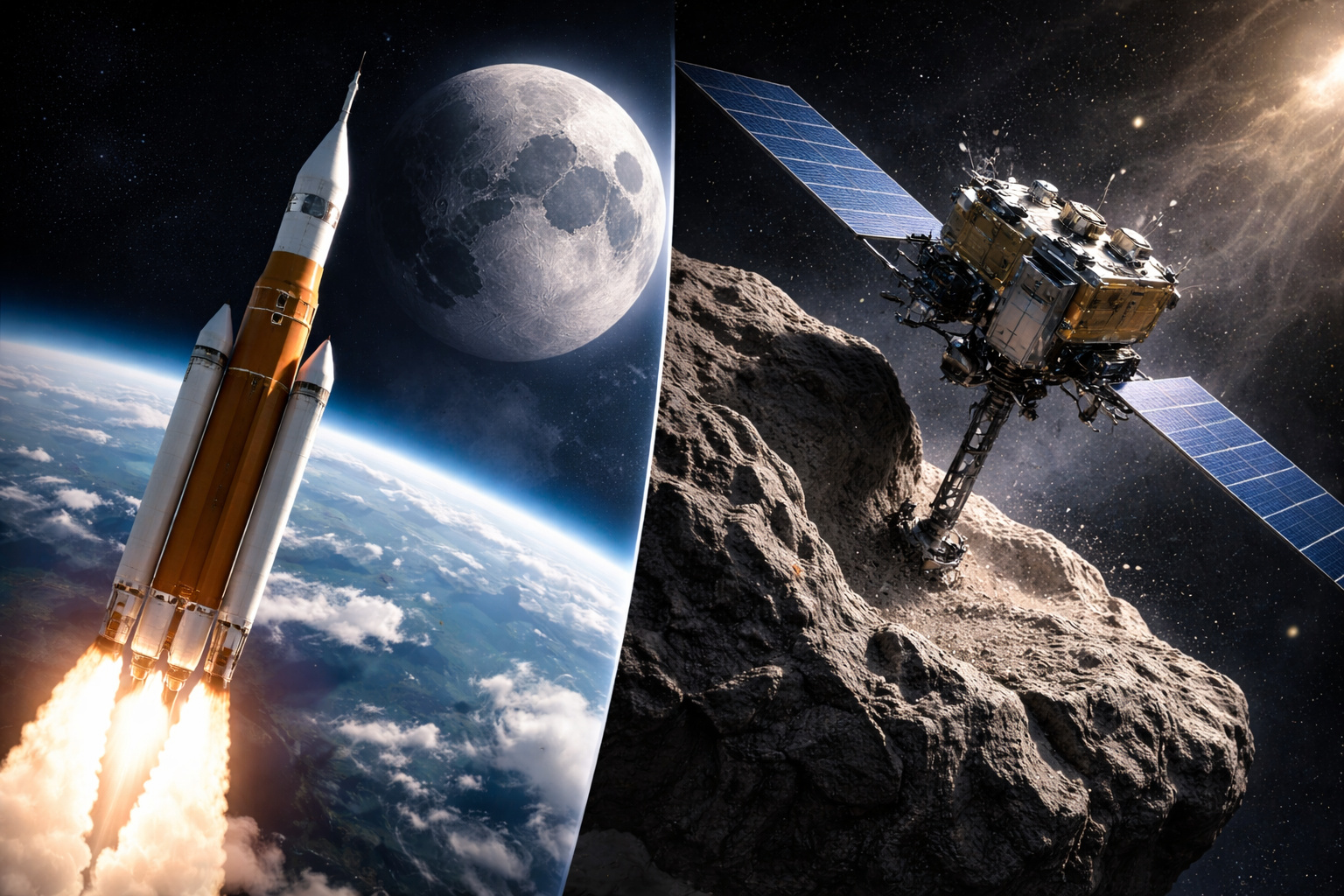
While NASA is completing its first crewed flight around the Moon in over 50 years with Artemis II, China has set in motion the Tianwen-2 mission to capture up to 1 kg of material from an asteroid possibly linked to the Moon and bring it back to Earth in 2027 on a 10-year journey to deep space.
To land, a separate module is necessary, a vehicle dedicated to descending from lunar orbit to the surface. The base text itself reminds us that this was also the case in Apollo: there was a command module, a service module, and a lunar module that descended and landed.
The lunar module is still not ready

In the architecture described for the mission, the landing module is being developed by two companies, SpaceX with the Starship and Blue Origin with the Blue Moon.
None of these options are ready for crewed flight, so there is no way to turn Artemis 2 into a landing.
The image used in the base is simple: the vehicle that takes you close to the Moon is ready, but the “elevator” that descends to the ground is still under construction.
Artemis 2 repeats the logic of Apollo itself


The text compares Artemis 2 with Apollo test missions to reinforce that passing by the Moon and returning is not a setback, it is a step.
Apollo 7 tested the capsule in Earth orbit. Apollo 8 went to the Moon and returned without landing, a format cited as equivalent to that of Artemis 2.
Then came tests of the lunar module: Apollo 9 in Earth orbit, Apollo 10 in lunar orbit without landing, getting about 15 km from the surface. Only in Apollo 11, after several preparatory missions, did the landing occur.
Why “repeating 1969” is not simple

The base argues that the infrastructure needed to be rebuilt from scratch after the end of the program. After Apollo 17, in 1972, NASA would have dismantled structures and followed other paths.
And there is a practical point: the technology of that time no longer exists in the same way, with Saturn V designs partially lost or obsolete, factories closed, and teams that have retired.
Another factor cited is budget and risk: in the Apollo era, NASA spent nearly 5% of the American federal budget. Today, it would spend less than 0.5%. Furthermore, the level of risk accepted in the space race of that time would be unacceptable today.
What the base cites as next steps
The text states that Artemis 3, scheduled for 2027, should test the docking between Orion and landing modules in Earth orbit.
And that Artemis 4, in 2028, would attempt the first lunar landing since 1972. The logic is slow, but presented as necessary for safety.
It is also mentioned that the splashdown of Artemis 2 is scheduled for April 10 in the Pacific Ocean, with reentry heating the thermal shield to 1650°C.
The cited evidence from Apollo: rocks, lasers, and confirmation from the “enemy”

The base lists different points as evidence of the Apollo landing.
382 kg of lunar rocks
The text states that Apollo missions brought back 382 kg of rocks and soil, distributed to laboratories around the world, and that Soviet scientists would have analyzed and confirmed extraterrestrial origin. It also states that the rocks would have a unique chemical composition, with no presence of water and signs of exposure to cosmic radiation and vacuum.
Reflectors that still work
Another cited proof is the retroreflectors left on the lunar surface, used to reflect laser beams sent from Earth. The base claims that scientists worldwide use these mirrors to measure the distance between Earth and the Moon, including in 2026.
Soviet monitoring during the Cold War
The text states that the Soviet Union monitored signals and transmissions and that if it were a hoax, it would have denounced it for geopolitical advantage. Instead, it would have officially recognized the American landing.
Satellite photos and the most repeated doubts on the internet
The base cites images from the LRO probe, launched in 2009, which would have photographed landing sites in high resolution, including modules and trails. It also states that probes from India and Japan photographed the sites, reinforcing that it would not be just one agency repeating the same version.
Regarding classic objections:
The “waving” flag
The cited explanation is that there was a horizontal wire sewn at the top to keep the flag stretched in the vacuum. It would only move when handled.
Lack of stars in the photos
The text points out that cameras adjusted for the sunlit surface would not capture stars, requiring a different exposure.
The central point: Artemis 2 is engineering, not conspiracy
The presented synthesis is this: Artemis 2 did not land because the landing module is still not ready, and not because someone “went back” on what has already been done. It is a design decision and a sequence of validation, as it would have been in the Apollo path itself.
To conclude, the base brings a phrase attributed to INPE scientist Antônio Prado, questioning whether a lie of this magnitude could last for decades without leaks among hundreds of thousands involved.
Do you believe that Artemis 2 proves that NASA is on the right track step by step, or do you think the mission should have attempted to land anyway?







Seja o primeiro a reagir!