





 Portuguese
  English
  Spanish
  5 min of reading
  0 comments


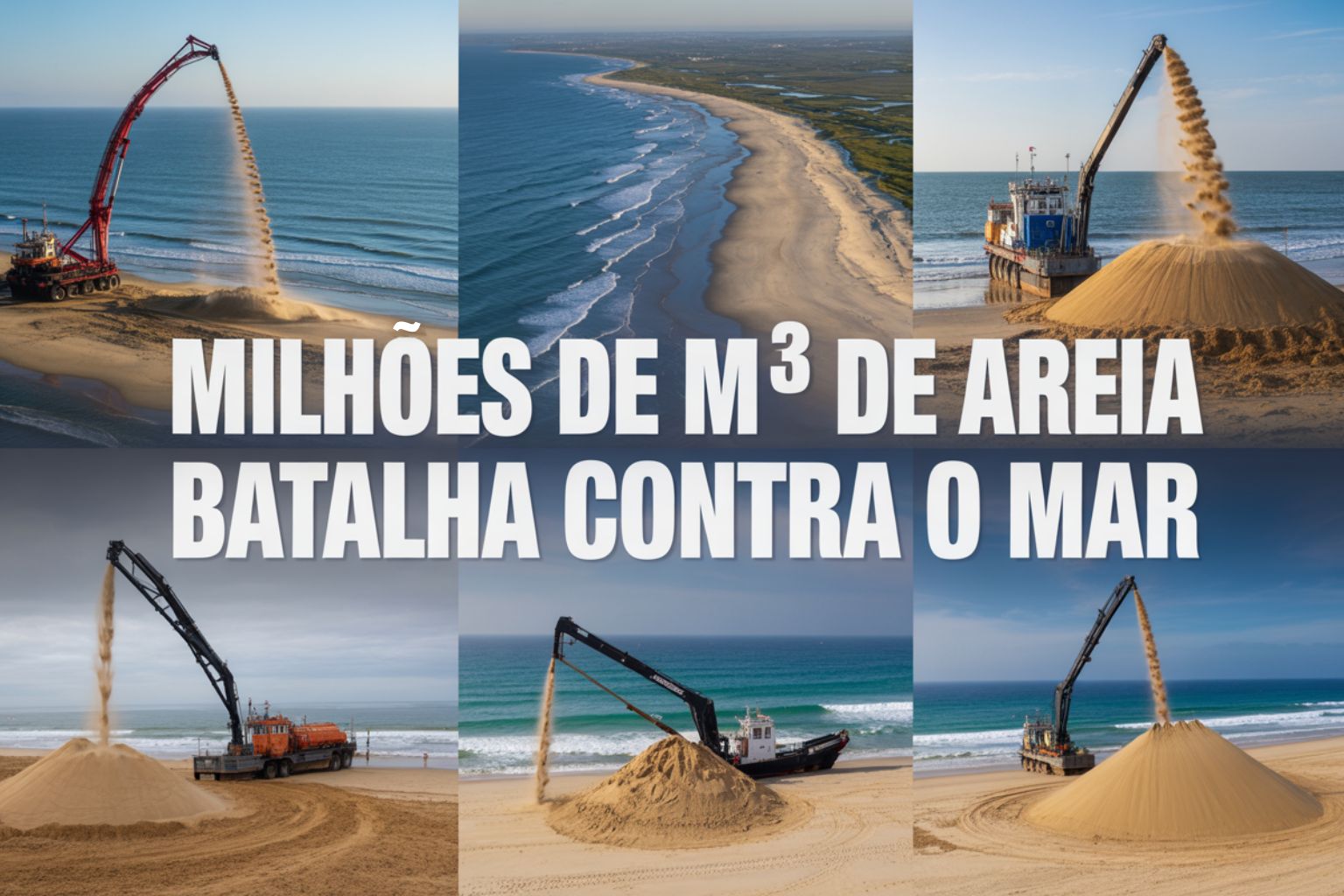
Countries Like the Netherlands, United States, Spain, Australia, and France Have Been Investing Billions in Artificial Beach Nourishment Projects, Dumping Tens of Millions of Cubic Meters of Sand to Curb Coastal Erosion and Buy Time Against the Rising Sea.
The rise of the sea has ceased to be a distant projection and has begun to directly interfere with the survival of coastal cities, ports, roads, tourist areas, and entire ecosystems. In response, some of the most exposed countries on the planet have adopted a solution as colossal as it is controversial: dumping sand in industrial volumes along the coastline, reshaping beaches, dunes, and entire coastal strips to curb erosion and buy time in the face of rising ocean levels.
This strategy, technically known as beach nourishment, already mobilizes tens of millions of cubic meters of sediment per year, involves ocean dredges the size of buildings, billion-dollar costs, and environmental impacts that are still being measured. The Netherlands, the United States, Spain, Australia, and France are among the countries that have systematically adopted the method, each with different approaches, scales, and objectives, but all facing the same dilemma: to protect the coast without a definitive solution in sight.
The Netherlands and the Experiment That Redesigned the North Sea Coastline
No country symbolizes this strategy as much as the Netherlands. With about 26% of its territory below sea level and more than half of the country vulnerable to flooding, the Dutch have transformed coastal engineering into state policy. The most emblematic case is the Sand Motor, a megaproject inaugurated in 2011 near The Hague.
-
He started running at 66 years old, broke records at 82, and is now a subject of study for having a metabolic age comparable to that of a 20-year-old, in a case that is intriguing scientists and inspiring the world.

-
Oldest tree on the planet reappears after 130 years of searches: Wattieza, 385 million years old, was 10 meters tall and had no leaves or seeds; Gilboa fossils in New York solved the mystery in 2007.

-
A 48-square-meter house assembled in hours with 4,000 bricks made of recycled plastic that does not absorb moisture, has natural thermal insulation, and costs less than 90,000 reais in a complete kit.

-
Luciano Hang revealed that Havan’s air fleet has already accumulated more than 20,000 landings, 10,000 flight hours, and 6 million kilometers traveled, and he says that without the planes, the company would never have grown so quickly.




In this experiment, the Dutch government dumped approximately 21.5 million cubic meters of sand all at once, creating a gigantic “artificial peninsula.” The idea was not to keep the sand fixed, but to allow currents, winds, and waves to naturally redistribute the sediment over the years, reinforcing adjacent beaches and dunes without the need for constant replenishment.
Studies conducted by institutions like Deltares and Dutch universities show that the Sand Motor managed to reduce the frequency of traditional dredging, strengthen natural defenses, and create new temporary habitats. At the same time, the project revealed clear limitations: the redistribution of sand is unpredictable, requires constant monitoring, and does not eliminate the need for future interventions as the sea level continues to rise.
United States Dumps Sand to Save Cities, Roads, and Tourism
In the United States, beach nourishment has ceased to be sporadic and has become routine, especially in Florida, California, North Carolina, New Jersey, and Louisiana. According to the U.S. Army Corps of Engineers (USACE), hundreds of active projects use marine dredging to restore beaches eroded by hurricanes, extreme tides, and increasingly frequent storms.
Florida alone has received more than 200 million cubic meters of sand over the past decades, with replenishment cycles ranging from 5 to 10 years. In Miami Beach, one of the most famous stretches of the American coastline, successive projects have consumed billions of dollars in federal, state, and municipal resources.
The central argument is economic: beaches support tourism, increase property values, and protect critical infrastructure. The problem is that studies by the US Geological Survey indicate that in many stretches, the added sand disappears within a few years, requiring new dredging, new contracts, and rising costs. In a scenario of continuous sea-level rise, the country faces the prospect of indefinitely sustaining an artificial coastline.
Spain Struggles to Maintain Tourist Beaches in the Mediterranean
In Spain, the problem is especially visible in the Mediterranean, where the combination of intense urbanization, river dams (which reduce the natural supply of sediment), and climate change has accelerated coastal erosion. Regions such as Catalonia, the Valencian Community, and Andalusia regularly resort to artificial nourishment to preserve urban and tourist beaches.
Reports from the Ministry for Ecological Transition indicate that millions of cubic meters of sand are deposited annually, often just before the summer season. In some municipalities, the same beach has already been “reconstructed” several times in less than two decades.
Spanish researchers warn that this dependence creates a vicious cycle: the more the coastline is artificialized, the more it loses natural resilience. Furthermore, dredging sand from the seabed or from underwater deposits can affect benthic ecosystems, local fisheries, and water quality.
Australia Uses Sand to Protect Cities and Coastal Infrastructure
Australia has also adopted beach nourishment as a strategic tool, especially in densely populated urban areas like Gold Coast, Sydney, and Adelaide. One of the better-known systems is the Gold Coast Sand Bypass program, which continuously transfers sediment to prevent beach collapse and protect urban and tourist areas.
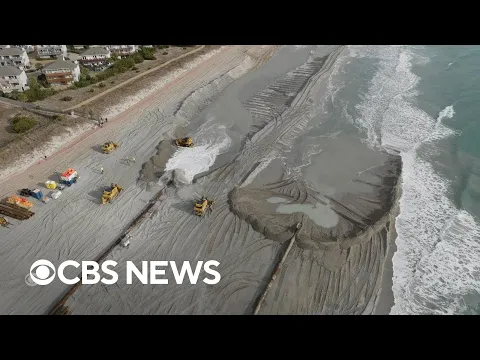
In this model, millions of cubic meters of sand are moved over decades, not as an emergency response but as part of a permanent coastal management system. Studies funded by the Australian government show that without this type of intervention, some urban stretches would suffer severe erosion within a few years.
At the same time, researchers from CSIRO warn that the effectiveness of the method diminishes as extreme events intensify, raising questions about the sustainability of the model in the long term.
France Bets on Coastal Reinforcement to Protect Historic Cities
In France, artificial nourishment projects are concentrated in both the Atlantic and the Mediterranean. Regions like Nouvelle-Aquitaine and Occitanie are facing accelerated coastal retreat, threatening cities, roads, and agricultural areas. The French government officially recognizes that thousands of buildings may become uninhabitable in the coming decades without intervention.
In response, France combines sand dumping, dune reconstruction, and, in some cases, planned retreat of urban areas. Government data indicates that millions of cubic meters of sediment have already been used in recent coastal projects, accompanied by rigorous environmental studies to reduce collateral impacts.
The Invisible Brine: When the Problem Is Not Just the Sand
Although artificial nourishment is often presented as a “natural” solution, organizations like the United Nations Environment Programme warn of invisible effects. Dredging alters seabeds, can release old contaminants, and modifies underwater habitats. Furthermore, the continuous maintenance of these projects consumes large amounts of energy, often associated with carbon emissions.
Reports published in scientific journals like Science Advances indicate that beach nourishment does not solve the root cause of the problem, only postpones its effects. As sea levels rise, increasingly larger volumes of sand will be needed to maintain the same protective effect.
Buying Time, Not Winning the Battle
The consensus among engineers, climatologists, and coastal managers is clear: dumping sand on the coast is not a definitive solution but a containment strategy. The Netherlands, the United States, Spain, Australia, and France are, in practice, buying time to adapt cities, infrastructure, and public policies to a transforming planet.
The big question that remains open is how long this race against the sea will be viable—technically, economically, and environmentally. Each cubic meter of sand dumped into the ocean is, at the same time, a temporary engineering victory and a reminder that the real battle occurs on a global scale, far beyond the beaches that seem safe today.








-

-

-

-

-

-

15 pessoas reagiram a isso.