





 Portuguese
  English
  Spanish
  5 min of reading
  2 comments


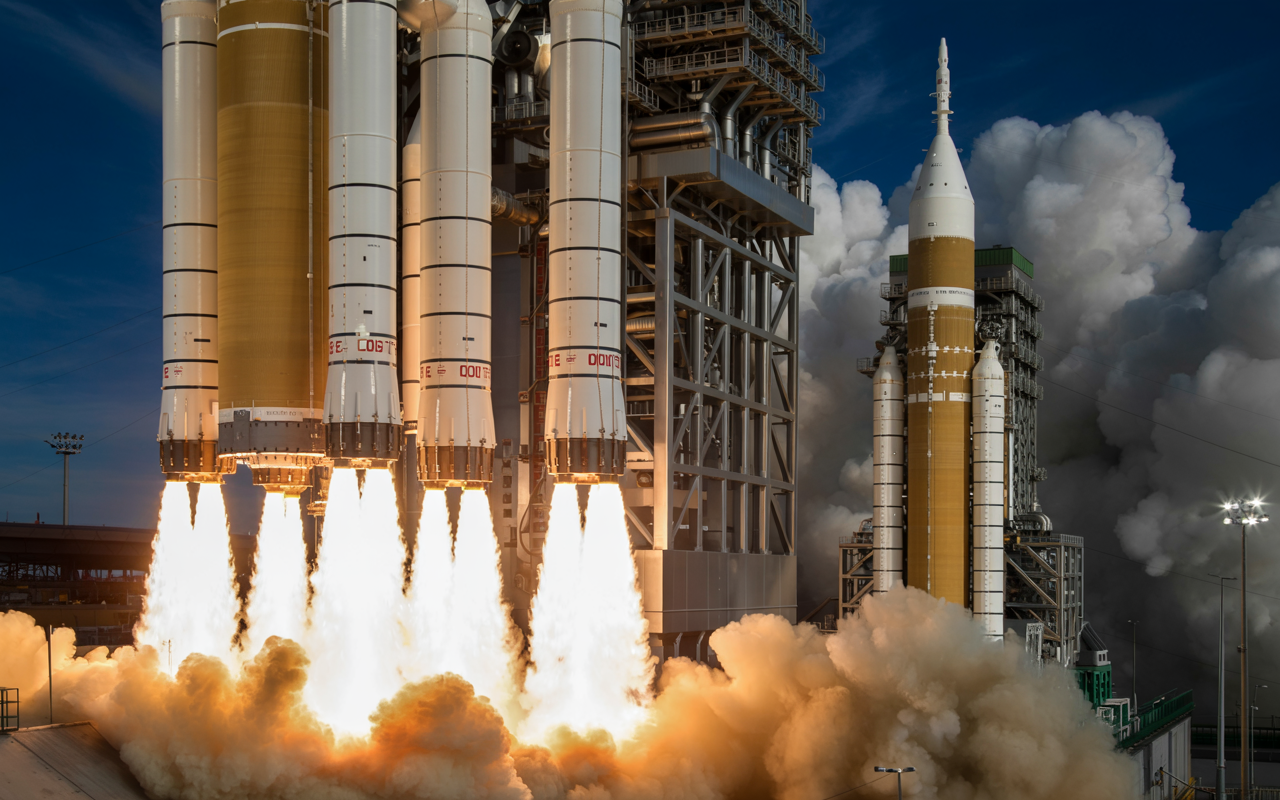


Discover How Rocket Turbopumps Work, Capable of Pumping Up to 56 Thousand Liters of Fuel per Minute to Generate the Necessary Thrust for Launch.
When we think of rockets, the image that usually comes to mind is that of fire shooting out at high speed from the base of the spacecraft. But behind this visual spectacle lies an invisible and equally impressive engineering feat: the rocket fuel pumps, responsible for feeding the engines with absolutely colossal volumes in fractions of a second.
During a launch, especially on historic missions like those of NASA with the Saturn V, the engines do not just burn fuel — they gulp down liters and more liters per minute, with an energy appetite that defies any comparison with conventional vehicles. And this is where the so-called turbopumps come in.
The Monster that Powered the Saturn V
The F-1 engine, used in the first stage of the Saturn V, is still considered the most powerful liquid fuel engine ever built. Each of its five engines was fed by a turbopump that pumped about 56 thousand liters of fuel per minute — the equivalent of emptying an Olympic-sized pool in just over 20 minutes.
-
With a cost per shot close to zero, the DragonFire laser could change naval warfare in 2027 and provide British ships with nearly unlimited defense against drones.

-
A British startup creates tires that generate electricity in electric vehicles when passing over potholes, speed bumps, and cracks.

-
Scientists have created robots made with living cells that have their own nervous system, swim on their own, explore the environment, and self-organize without any genetic engineering, and now they want to do the same with human cells.

-
Students create a solar-powered ambulance that operates without a plug, without fuel, and still keeps medical equipment running in remote areas.




And it wasn’t just liquid fuel. Each engine had to deal with refined kerosene (RP-1) and liquid oxygen (LOX), both cooled to extreme temperatures and kept under pressure. The turbopumps operated at insane rotations, with more than 5 thousand RPM, to ensure that the flow never stopped, not for a second.
The complete assembly, with five engines, achieved a total flow of about 280 thousand liters per minute — enough to supply an entire small town, if we were talking about water. But in this case, we are talking about cryogenic fuels being injected under pressure into combustion chambers the size of a car.
How Do These Gigantic Pumps Work?
Rocket fuel pumps are more accurately called turbopumps because they combine two critical functions: pumping and generating force. They are powered by a turbine driven by the gases generated by the partial combustion of fuel, which drives a high-speed centrifugal pump.
The challenge is twofold: maintaining a constant and extremely high flow without allowing any type of cavitation, failure, or oscillation, and also withstanding temperatures that range from -200 °C to over 3,000 °C, depending on the stage and type of propellant.
In simple terms: turbopumps are the heart that pumps the rocket’s “blood” — and if they fail, the mission ends right there, on the launch pad.
The Impressive Numbers of the RS-25
Even modern rockets still rely on monstrous turbopumps. The RS-25, used on the space shuttle and repurposed on the new SLS (Space Launch System), also feature high-performance turbopumps.
Each RS-25 has a turbopump that operates at more than 37 thousand RPM and generates over 70 thousand horsepower — just to move the fuel and oxidizer. For comparison, this is more than double the power of a modern locomotive.
This force is necessary to inject liquid hydrogen and liquid oxygen at extremely high pressures, ensuring that the mixture enters the engines with the correct flow and reacts in the precise manner.
The Challenge of Pumping Fuel in Space
Pumping fuel in a rocket is not like refueling a car. We are talking about a hostile environment, with almost zero gravity, extreme temperatures, and a constant risk of explosion. The turbopump cannot stop, jam, vibrate too much, or oscillate.
It must be compact, lightweight, and ultra-resistant, operating for minutes or hours under extreme conditions. Any minimal failure can mean a catastrophic explosion.
Therefore, many of the technologies applied in turbopumps have been refined over decades. Engineers need to balance power, weight, and stability, using advanced materials like titanium alloys, ceramics, and refractory composites.
Modern Innovations: SpaceX, Blue Origin, and Beyond
Companies like SpaceX and Blue Origin have also developed their own solutions to the turbopump challenge.
The Merlin engine from SpaceX runs on kerosene (RP-1) and liquid oxygen, and its turbopumps deliver high performance in series. The Raptor engine, which uses methane as fuel, features dual pre-combustion and turbopumps that operate at even higher pressures than NASA’s old engines.
In the case of Blue Origin, the BE-4 engine, powered by liquid methane, also utilizes high-performance turbopumps to supply the engines with hundreds of tons of propellant in just a few minutes.
The continuous evolution of these pumps has allowed for cost reduction, increased reliability, and even enabled the reuse of engines, something unthinkable just a few decades ago.
Why Are They As Important As the Engine Itself?
If the engine is the brute force, the turbopumps are the mechanical intelligence behind it. Without the constant and precisely calculated supply of fuel and oxidizer, the combustion chamber would not function stably.
Most rocket engines rely on what is called a closed or semi-open combustion cycle, where efficiency depends almost entirely on the turbopump working with exact pressure, precise timing, and constant rotation.
For this reason, turbopumps are tested and inspected more rigorously than any other component of the rocket. They are literally the component that determines whether the engine will be stable, explosive, or efficient.
When we see a rocket launching, with its columns of fire and smoke, we rarely think of the fuel pumps working silently inside the structure. But it is they — the turbopumps — that ensure that every drop of fuel reaches the engine with the necessary force and speed.
Be it the Saturn V, pumping 280 thousand liters per minute, or the modern RS-25 and Raptors, operating in complex cycles, these pumps represent engineering at the limit of the possible — a metallic heart that beats with thousands of liters per minute to overcome gravity and take humanity into space.








Taí uma poluição total em quanto esses país fica falando de meio ambiente eu vejo quê na verdade eles não estão nem aí com meio ambiente é ainda por cima fica enchendo o saco do Brasil nessa questão mas tá provado quê o presidente do Brasil e fraco e subalterno dos outros países quando eles vêm com a ladainha de poluição.!
Um vôo são Paulo – Paris em um 777 queima 60.000l de querosene, 160l por passageiro.
A aviação consome 6 milhões de barris de querosene por dia.
Um Falcon 9 queima míseros 186 toneladas de querosene, um a380 que voa aos montes diariamente pelo mundo leva 250 toneladas em um vôo típico.