





 Portuguese
  English
  Spanish
  3 min of reading
  0 comments


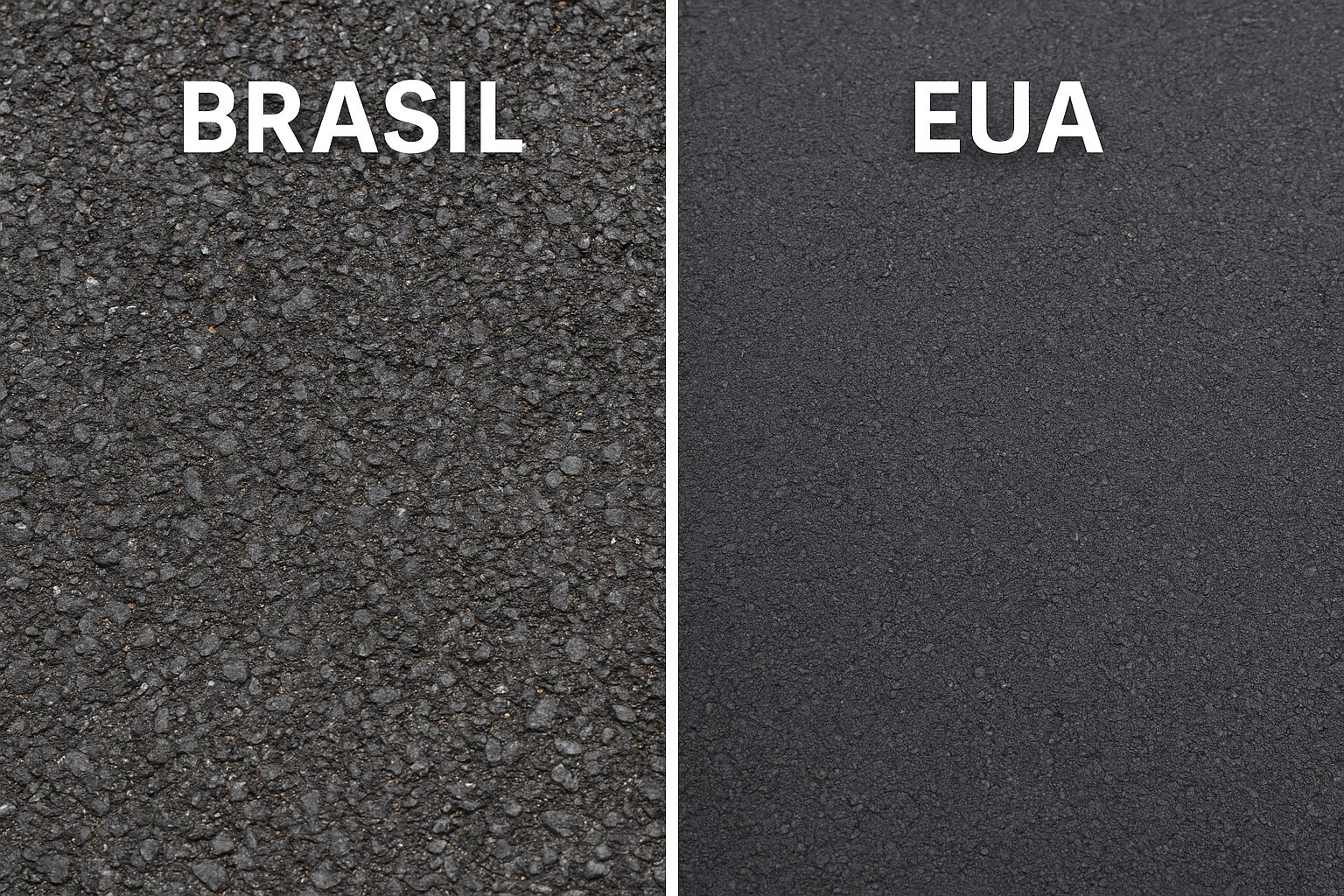
Brazil and United States Adopt Distinct Paving Methods: While the South American Country Follows Traditional Standards, North Americans Invest in Technology and Sustainability to Increase the Durability of Roads
Although asphalt may look the same under the tires, Brazil and the United States take different paths in paving their roads. The choice of materials and technologies directly influences the durability, cost, and maintenance of the roads. The two countries have significant differences that start with the composition of asphalt and extend to concerns about sustainability.
The Brazilian Model: CBUQ as Standard
In Brazil, the most common type of asphalt is CBUQ, which stands for Hot Mixed Bituminous Concrete. It is a flexible pavement made from a combination of mineral aggregates, such as gravel, sand, and stone powder.
The element that binds everything together is the Asphalt Cement (CAP), a byproduct of petroleum distillation.
-
China creates hypersonic engine that can make planes and missiles fly more than 6 times the speed of sound with less weight, more range, and without system change.

-
Mysterious object on Mars divides NASA and Harvard after Curiosity image reignites suspicions about what was really found on the planet.
-
Giant structures 14 meters beneath Egypt are revealed by satellites and expose a millennia-old secret buried in Buto.
-
Children have been making clay pieces for 15,000 years in Southwest Asia, and fingerprints preserved on 142 ornaments helped archaeologists prove this.
The structure of Brazilian pavement follows a layered model. The base starts with the subgrade, followed by the sub-base, the base itself, and finally, the wearing course. It is the latter that bears the direct impact of traffic and serves as protection for the other layers.
Although widely used, CBUQ faces challenges. The tropical climate, present in much of Brazil, accelerates the wear of asphalt. The high rainfall incidence and elevated temperatures cause cracks and potholes, requiring constant maintenance.
United States: More Technology and Reuse
In the United States, about 94% of highways also use asphalt as the main surface. The composition is similar to the Brazilian one, using mineral aggregates like sand, crushed stone, and gravel, bound by bitumen — another petroleum derivative.
The main difference lies in the applied techniques and the use of innovations. The pavement is also structured in layers, but there is more flexibility in adaptation according to local climate and traffic volume.
This allows for better performance in various regions of the country, which have more extreme temperature variations.
One hallmark of American asphalt is the investment in sustainable technologies. The country has already incorporated practices such as the use of recycled asphalt, contributing to waste reduction and cost savings. The application of specific additives also helps prolong the lifespan of the roads.
Comparison Reveals Different Paths
The comparison between the two models highlights how technical, environmental, and economic factors shape the choices of each country. Brazil still uses traditional methods, with a lower degree of technological innovation. In contrast, the United States invests in modernization and more sustainable practices.
This difference is also reflected in the challenges faced. While Brazil suffers from the premature wear of roads, the United States manages to maintain a more durable road network thanks to the use of new materials and techniques.
Future of Paving
With an extensive road network and increasing demands for maintenance and expansion, Brazil could benefit from observing the practices applied in other countries.
The choices made in paving impact not only the appearance of the roads but also safety, transportation costs, and the sustainability of infrastructure.
Understanding how each country deals with paving helps identify opportunities for improvement. The comparison highlights that there is room for evolution, especially towards more durable and environmentally conscious solutions.





Seja o primeiro a reagir!