





 Portuguese
  English
  Spanish
  6 min of reading
  10 comments


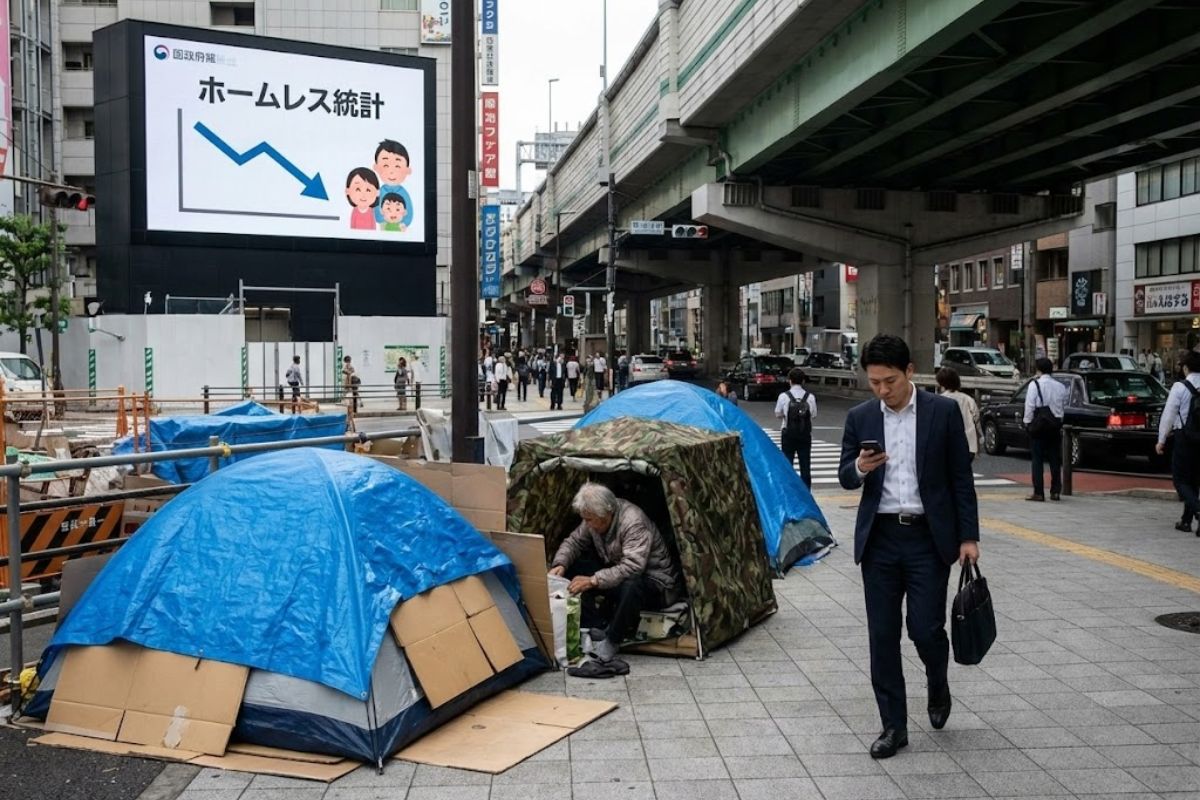


Narrow Legal Definitions, The Criminalization of Begging, and Strategies of Invisibility Push Homeless People to Parks, Riverbanks, Doya Rooms, and Cybercafés in Tokyo. With Low Official Statistics, the Homeless Category Excludes Shelters and Temporary Housing, Distorting the Real Size of Urban Poverty Over Decades.
In a country that projects efficiency and order, the public image suggests streets without tents and begging. Still, homeless people exist, but they are less visible than the housing crisis would suggest, because some are pushed out of sight and, often, out of the statistics.
In January 2025, the official record pointed to 2,591 homeless people in a country with about 124 million inhabitants. The contrast between this number and real life begins with the game rule: who is actually considered homeless and where that person might be to “count.”
A Definition That Shrinks the Problem

The Self-Support Law for the Homeless, enacted in 2002, adopts a specific definition: homeless refers to those living in public spaces like streets and parks.
-
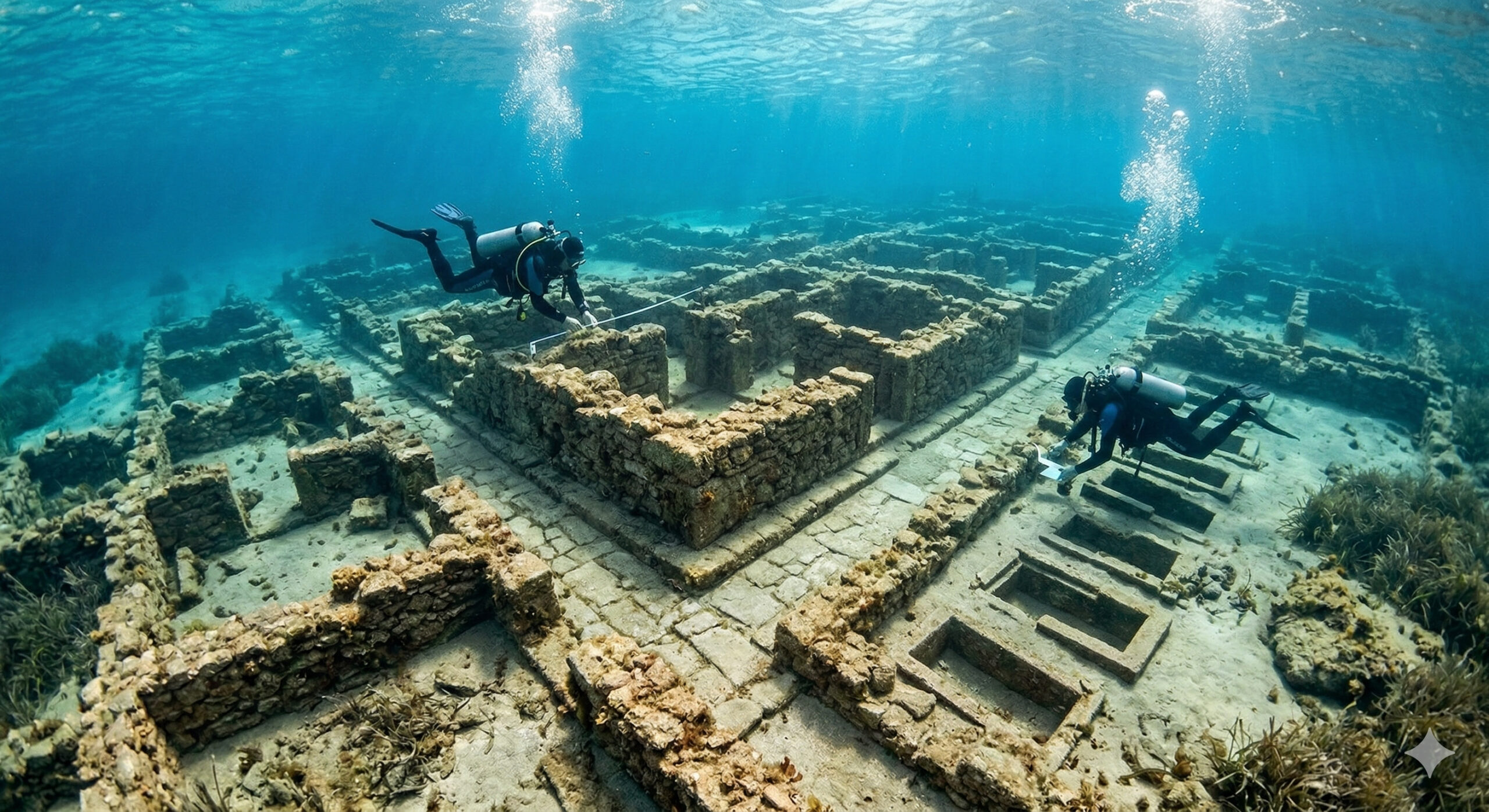
Discovered just 4 meters deep, a 5,000-year-old submerged city with streets, tombs, and trade signs with Crete reveals how one of the oldest civilizations in the world lived before disappearing beneath the sea.
-
The new “monster” submarine of the United States Navy weighs nearly 8,000 tons, is 115 meters long, does not require fuel, and can operate for long periods submerged; meet the USS Massachusetts (SSN-798), which arrives to strengthen the military power of the U.S. amid global tensions.

-
In Sweden, Embraer subjects the KC-390 to rigorous testing in extreme cold, conducts operations in the snow with 100% success, and expands its presence among NATO countries.

-
An 8-kilometer submerged city discovered 36 meters deep in the Arabian Sea may be 9,500 years old and, if confirmed, would be older than any known civilization and coincide with the legendary Dwarka described in Hindu texts.

People in shelters, temporary housing, or improvised solutions outside the street are excluded from the label and, consequently, from part of the statistics.
In practice, this creates a funnel.
The official number tends to reflect those who are visible during the day in parks and riverbanks, and not necessarily those who sleep hidden at night.
Homeless people may still exist in much greater numbers, but in forms that do not fall into the official categorization.
Kotobuki, Sanya, and Kamagasaki: Organized Poverty in “Doya”

In Tokyo, Yokohama, and Osaka, three districts of daily labor have become references: Sanya, Kotobuki, and Kamagasaki.
These places are associated with what many describe as “cities of suffering,” where older men move between minimal rooms and basic services.
A typical room in these districts looks like a micro-lodging: space equivalent to three tatamis, about 54 square feet, often occupied by a TV, refrigerator, utensils, mattress, and clothes.
In 2016, the reference cited for those living this way was 146,000 yen in government assistance, divided between rent and daily expenses.
Homeless individuals living there may not be counted as homeless people, precisely because they are not on the street or sidewalk.
Invisibility as Strategy and Pressure
There is a repeatedly described pattern: homeless people try to blend into the crowd.
They do not ask for change, avoid appearing dirty, and when they use cardboard boxes to sleep, they fold and hide them in the morning.
The goal is simple and harsh: to avoid drawing attention.
This behavior also interacts with cultural norms that disapprove of public exposure of difficulty.
Asking for help is seen as personal failure, and shame pushes the problem to less obvious corners of the city, far from what becomes recorded in the statistics.
The majority of this group consists of men, over 90% of the total described, and there is a perception that authorities tend to be more receptive to women in similar situations.
Begging is Prohibited and Cities Designed to Expel
In addition to social pressure, there is formal restriction: begging is prohibited and can be treated as a crime.
On top of that, urban planning makes it difficult to stop, sit, or sleep, with furniture and space design intended to prevent lingering.
The result is a continuous push. Homeless people report being expelled and directed to hide even when there are no people around.
At the same time, many say they are unaware of assistance programs, and those who know describe the application as excessively specific and detailed, reinforcing the barrier for those already fragile.
Shelters Exist, but Don’t Function as “Open Doors”
In Tokyo, the offer is described more as a long-term solution than as an immediate arrival shelter.
There are no locations in this context where someone simply shows up at night and sleeps, as occurs in other cities around the world.
The city has about 150 long-term shelters, managed by organizations with some public support, with approximately 4,000 people living in them.
The reputation, however, is difficult: decaying spaces, overcrowding, strict rules, and little privacy.
Homeless individuals may prefer the street or less exposed alternatives, which maintains the cycle of invisibility and distance from the statistics.
Cybercafés and the Category That Doesn’t Appear on the Street
One of the most striking shortcuts to escape stigma and registration is the use of cybercafés as housing.
The phenomenon became known as “cybercafé refugees,” people who spend nights in cabins with reclining chairs, thin dividers, and narrow corridors, paying by the hour.
The estimate cited for 2020 mentions about 15,000 people living in cybercafés just in Tokyo, roughly five times the total officially recognized in the country during that period.
Night packages of 6 or 9 hours could cost around 2,000 yen, approximately US$ 14, varying by city.
Many cybercafés offer showers, free drinks and soups, sell personal items, and even meals, creating a survival routine that remains off the radar.
Policies That Reduced Numbers but Did Not Eliminate Precarity
The decline in visible homeless people is attributed, in part, to initiatives from the late 1990s and early 2000s.
The law of 2002 was accompanied by self-help centers, temporary housing offers, and an expansion of shelters, with rehabilitation and social support services.
There was also the expansion of a livelihood protection program, with financial aid, rent subsidies, and living expenses.
This reduces time spent in parks and streets but does not address the root: the lack of affordable housing and the precarization that pushes people into doya and cybercafés, where the homeless label does not always apply.
Health, Addiction, and the Weight of Stigma
Another element cited to explain international differences is the drug use profile: in 2014, the cited percentage was about 1.6% of the population in Japan who had tried illegal substances, with a strong association to gangs due to illegality.
Still, many homeless people face alcoholism.
In mental health, the country has 269 psychiatric beds per 100,000 people, compared to 25 per 100,000 in the United States.
Hospitalizations keep some people off the streets but also reinforce the logic of reducing visibility instead of addressing the causes.
In the end, lower statistics do not automatically mean less suffering.
When the Economy Breaks, the Street Reappears
The modern crisis of homeless people is connected to the post-war period when bombings left nearly 9 million without a home.
The post-war economic miracle reduced the problem until the 1960s, but the bubble burst in the early 1990s, leading to the “lost decade,” with unemployment and a new wave of precarity.
In 2003, the national survey recorded 25,296 homeless people, with 23.4% in Tokyo and an average age of 56 years, generally older men.
Many were former construction workers or unskilled, without mobility to change careers, without savings, and without family support.
The label homeless carried enough shame to sever ties and reduce requests for help.
Pandemic and Pressure on Those Who Were Already at the Limit
There are signs of recent change.
Community kitchens that previously served about 100 people began to see lines of over 400 in 2022.
Another free food distribution, linked to a center described as Moy Cent, began attracting over 400 people a week, up from 60 before the pandemic.
During the same period, the number of people approved for public housing assistance would have increased 34 times since the onset of the pandemic.
When the state of emergency began in 2020 and cybercafés temporarily closed, Tokyo reserved several thousand rooms in business hotels to prevent an immediate spike in visible homeless people.
What Changes When the Country “Doesn’t See” Who Is There
The final picture is a paradox: the statistics may suggest a country almost without homeless people, while reality spreads across parks, riverbanks, doya, and cybercafés.
The word homeless becomes a narrow label, not a broad portrait of lack of housing.
When the city demands invisibility, part of poverty begins to function as background noise, tolerated as long as it doesn’t appear.
And when it doesn’t appear, the risk is direct: public policies tend to follow the number, not the need.
For you, what should be included in the statistics of homeless people: only those sleeping on the street or also those surviving in doya and cybercafés?








Certamente todos aqueles que não possuem moradia, um endereço, devem ser contados como PSR
Ainda assim, no Brasil a quantidade de morador de rua e muito maior. Muito maior mesmo!!
Estamos preocupados com o Japão?
É a imagem camuflada de um país 100% certinho, mas na verdade são piores na injustiça, pois camuflam essas pessoas e faz de conta que tá tudo bem. Mas a injustiça está lá…