





 Portuguese
  English
  Spanish
  5 min of reading
  0 comments



Recent Flyby of One of the Largest Asteroids Near Earth Reignites Attention on Space Monitoring and Risk Assessment Used by Scientists, Despite the Absence of Real Threat to the Planet During the Flyby Registered in January 2026.
A potentially hazardous asteroid made a close pass by Earth on January 12, 2026, but without posing any risk to the planet.
Named 2005 UK1, the celestial body has an estimated diameter between 0.6 and 1.4 kilometers and crossed space at about 12.4 million kilometers away, equivalent to approximately 32 times the average distance between Earth and the Moon, according to data released by trackers using information from the Jet Propulsion Laboratory’s (JPL) orbital dynamics system, NASA.
Despite being “close” in astronomical terms, the distance is considered completely safe by experts.
-
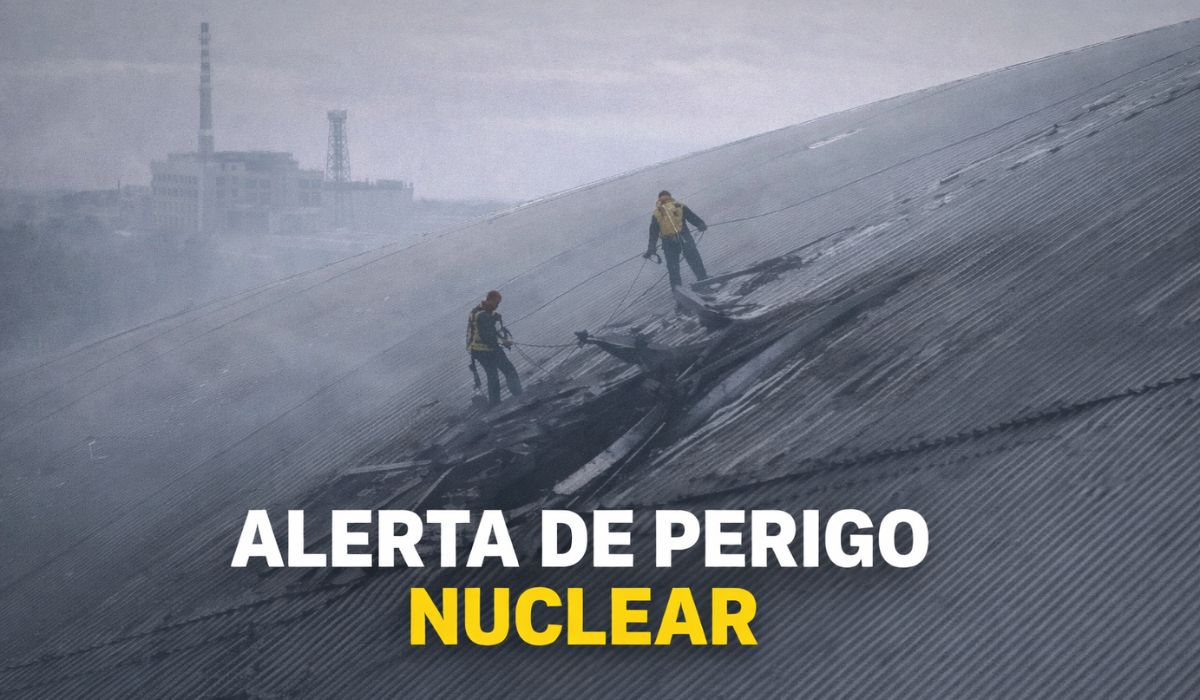
The gigantic steel shell built to contain Chernobyl for a century has been pierced by a drone, exposing a critical system and creating a hole that could cost over 500 million euros to repair.
-
Brazilian Navy reaches a new level by taking over an airport with a 1,600-meter runway used by 1,800 military personnel and autonomous attack drone testing.

-
The Himalayas continue to grow to this day, with tectonic plates advancing 5 cm per year, mountains rising up to 10 mm annually, and the 2015 earthquake that killed 9,000 people may have increased the risk of an even larger seismic mega-event.

-
At an altitude of 400 km by astronauts from the International Space Station, Paris transforms at night into a golden mesh so precise that it reveals the outline of the Seine River, avenues, and entire neighborhoods like a luminous map drawn over the Earth.


Objects of this size pass by much less frequently than smaller asteroids, which helps explain the attention surrounding the event.
Asteroid 2005 UK1 and the Approach to Earth in 2026
The 2005 UK1 is part of the group of near-Earth asteroids monitored by surveillance programs that calculate trajectories, uncertainties, and future approaches.
It was discovered on October 24, 2005, by a surveying team at Mount Lemmon, Arizona, and is cataloged as an object of the Apollo type, a category that includes asteroids whose orbits cross that of Earth.
The size estimate published in public databases and analyses associated with these trackers indicates a wide range, from approximately 0.6 to 1.4 kilometers.
This variation is common when there are no direct high-precision measurements of the diameter.
In many cases, the calculation depends on the brightness of the object and assumptions about how much its surface reflects light.

The exact time of the closest approach was reported differently in publications that rely on tables and tools from JPL, which can occur due to differences in time standards and rounding.
Nevertheless, all the references consulted converge on two main points.
The approach occurred on January 12, 2026 and the distance was around 12.4 million kilometers, without an impact scenario.
What It Means to Be a “Potentially Hazardous” Asteroid
The term “potentially hazardous” does not indicate an imminent collision.
It is a technical label used to prioritize monitoring of objects that combine two main factors.
The first is a sufficient size to cause significant damage in the event of an impact.
The second involves trajectories that can bring the asteroid close to Earth below a defined threshold in monitoring criteria.
In the case of 2005 UK1, orbital projections indicate it may pass at closer distances at other times.
This, in itself, does not represent an immediate threat.
In this specific flyby, the encounter was far beyond the critical threshold, and there was no need for additional measures beyond routine tracking.
Meanwhile, terms like “planet-killer” frequently appear in outreach content to draw attention to the energy potential of a large-scale impact.
In practice, scientists and agencies treat such nicknames as informal, as the severity of the effect depends on variables such as composition, entry angle, and collision location.
Comparison with Chelyabinsk and Other Historical Events
The estimated size of 2005 UK1 places it well above objects associated with notable episodes from recent history.
The meteor that exploded over Chelyabinsk, Russia, in 2013, had an estimated diameter of around 18 to 20 meters, according to analyses released by NASA at the time.


Nonetheless, the shockwave that followed broke windows and caused thousands of injuries, mainly due to shrapnel.
The episode showed that even relatively small objects can generate significant impacts when the entry occurs over populated areas.
The 2005 UK1 is also often associated, in historical comparisons, with the Tunguska event, which occurred in 1908 in Siberia.
This episode is frequently cited as an example of a high-energy airburst.
The central difference is again the scale.
An object with hundreds of meters to over a kilometer in diameter carries much greater potential energy than a meteor of tens of meters.
This, however, does not indicate a likelihood of collision at present.
Possible Impacts and Continuous Monitoring
The original text indicates that 2005 UK1 would be large enough to cause significant regional damage and that an impact could have global consequences.
This assessment helps explain the use of the term “planet-killer” in outreach materials.
The general understanding among scientists is that size is one of the main determinants of destructive potential.
Still, there is no indication that 2005 UK1 is on a collision course with Earth.
In this flyby, researchers assert that the object would not cause any significant gravitational or physical effect, precisely because the recorded distance was wide.
The continuous monitoring of near-Earth asteroids is used to reduce uncertainties and update orbital parameters as new observations enter the databases.
Therefore, even in approaches considered safe, records receive attention.
Each additional measurement improves the map of future possibilities and reduces margin of error.
Why a Safe Approach Becomes News
Even without risk, a flyby like that of 2005 UK1 draws attention for encompassing factors that spark public interest.
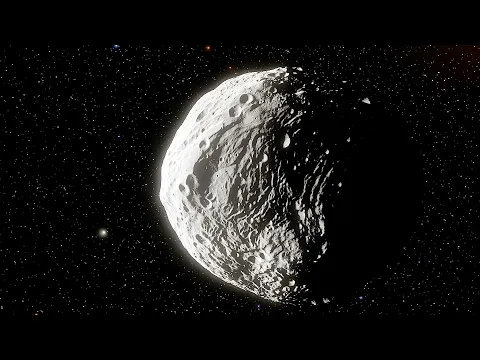
Among them are the unusual size, the technical classification that sounds alarming, and a distance that, while great, is small in astronomical scale.
The comparison with events like Chelyabinsk, which remain in collective memory for occurring unexpectedly, also contributes to the reverberation.
The difference between a flyby miles away and a real impact, however, is decisive.
Astronomy works with tracking, probability, and constant data updating, and most approaches do not translate into immediate danger.
If objects of this size can pass “close” to Earth without posing a threat, how to communicate these events to the public without creating panic and without downplaying the importance of space monitoring?







-

-

-

5 pessoas reagiram a isso.