





 Portuguese
  English
  Spanish
  3 min of reading
  38 comments


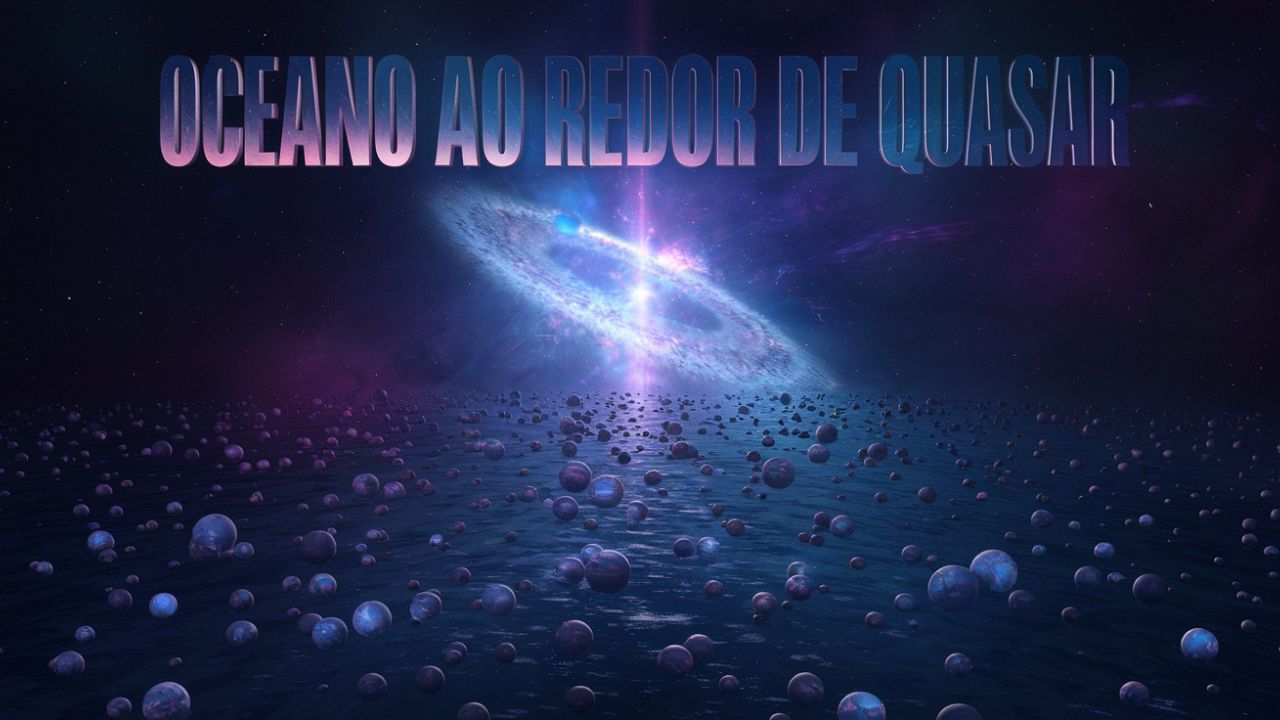


A Quasar More Than 12 Billion Light-Years Away Holds the Largest Reservoir of Water Ever Found by Astronomers: 140 Trillion Times the Amount of All of Earth’s Oceans, Orbiting a Black Hole 20 Billion Times Bigger Than the Sun.
Think about the amount of water that fills all of Earth’s oceans. Now imagine that amount multiplied by 140. That is exactly what astronomers discovered around a distant quasar located over 12 billion light-years away. This astonishing discovery not only sparks curiosity but also offers new clues about how the universe, in its early days, already presented conditions for the emergence of fundamental elements necessary for life.
But what exactly is a quasar? Think of them as cosmic beacons, emitting light and energy at extraordinary levels. At the heart of the quasar APM 08279+5255, astronomers detected something remarkable: enough water to make us rethink our place in the universe.
The Quasar APM 08279+5255: A Cosmic Treasure
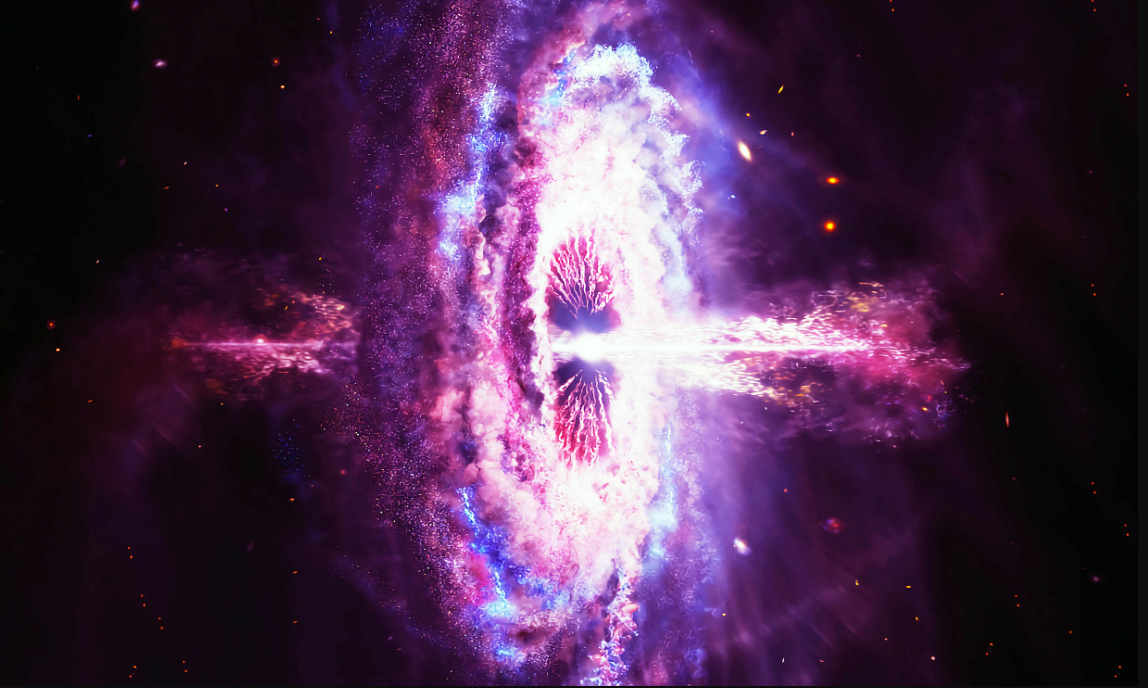
This quasar is a true cosmic gem. Orbiting a supermassive black hole, whose mass is about 20 billion times that of the Sun, it emits energy equivalent to one trillion suns. Amid this chaotic dance of matter and radiation, a huge amount of water vapor has been detected.
-
Something is happening around the Earth: Inside the huge explosion of fireballs in 2026

-
A hot air bubble coming from Argentina expands over Brazil, causing thermometers to exceed 38 degrees with a thermal sensation of 40 degrees in late March, affecting 6 states at once.

-
The radish leaf that almost everyone throws away has more polyphenols, flavonoids, and fiber than the consumed root, and a 2025 study showed that the leaf contains compounds that protect the intestine, combat inflammation, and may inhibit the growth of cancer cells.

-
A planet that seemed to defy the laws of physics has intrigued scientists for decades, until the James Webb revealed what is really affecting Saturn’s rotation.

This water is located in a region spanning hundreds of light-years around the quasar, at a temperature of approximately -63 °F, and is denser and hotter than the gas found in common galaxies like the Milky Way. An unusual environment, but crucial for understanding how fundamental molecules can arise in such extreme scenarios.
How Astronomers Made the Discovery
The feat was only possible thanks to cutting-edge technologies and collaborative work. The team led by Matt Bradford used instruments like Z-Spec at the Submillimeter Observatory in Mauna Kea and CARMA in California. These tools detected the chemical signatures of water, revealing its quantity and location.
Another group of scientists, using the Plateau de Bure Interferometer in the French Alps, confirmed the findings. This global scientific partnership demonstrates how exploration of the cosmos relies on the union of efforts and technologies.
Why Is This Discovery So Important?
Water, one of the fundamental building blocks for life as we know it, is not just a common molecule. Its presence around the quasar reveals that even in the first billion years of the universe, essential elements were already forming. This means that the ingredients for life may be much more widespread than we ever imagined.
This discovery gives us clues about how the first galaxies evolved. Water vapor helps us understand the physical and chemical conditions at a time when the universe was still young and full of possibilities.
What Lies Ahead in Cosmic Exploration
Each new discovery brings us closer to understanding the origins of the cosmos. The detection of this massive water reservoir opens doors for future research on how complex molecules can influence the formation of stars, planets, and, perhaps, even forms of life.
The deep space holds incredible secrets, and astronomers have barely scratched the surface. New missions and technologies promise to reveal more about our universe—and perhaps about ourselves. After all, we are all part of this vast cosmic tapestry.
The discovery of water around the quasar APM 08279+5255 is a reminder of how extraordinary and full of possibilities the universe is. With astronomers unraveling mysteries billions of light-years away, who knows what else awaits us in the depths of the cosmos?







” É fantástico, senão ainda desprovido de utilidade prática: a distância em anos‐luz é absurdamente pequena ante as diminutas potências humanas de auferir vantagem real dessa informação. “
A ciência e a religião não são opostas, em minha humilde interpretação elas se encontram em algum ponto. Mas enquanto houver desrespeito por parte dos dois lados … nada feito..
Entendo sua perspectiva de que a ciência e a religião podem se encontrar em algum ponto e que não há respeito entre os dois lados. No entanto, é incrível ver como a descoberta do quasar APM 08279+5255, com seu reservatório de água de 140 trilhões de vezes a quantidade dos oceanos da Terra, abre portas para entendermos como o universo já apresentava condições para o surgimento de elementos fundamentais para a vida. Essa pesquisa nos ajuda a descobrir mais sobre como o cosmos se formou e como as moléculas complexas influenciam a formação de estrelas, planetas e, talvez, formas de vida. É um lembrete do quão extraordinário e cheio de possibilidades é o universo e de que há muito a aprender mais.
“Pense na quantidade de água que preenche todos os oceanos da Terra. Agora imagine essa quantidade multiplicada por 140.” É 140 ou 140 bi de vezes? A diferença de 140 para 140 bi é astronômica.