





 Portuguese
  English
  Spanish
  4 min of reading
  0 comments


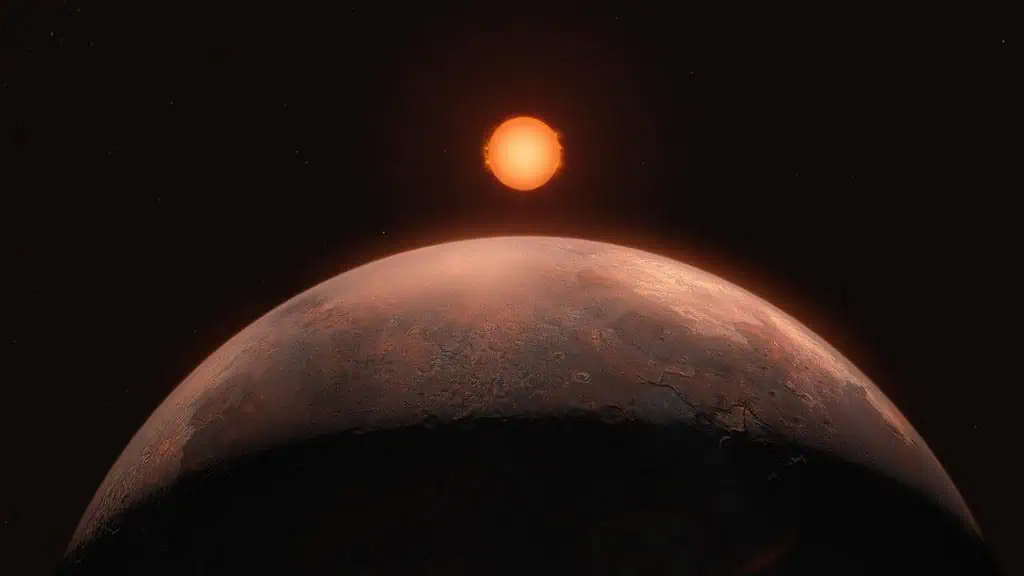
A New Planet Has Been Found by Astronomers Orbiting the Closest Star to Earth, Just Six Light-Years Away. Learn More About This Fascinating Discovery and the Impact It Could Have on the Search for Habitable Planets.
Astronomers have made a new impressive discovery: an exoplanet orbiting the star Barnard, the closest star to our Sun. Using the Very Large Telescope (VLT) from the European Southern Observatory, a team of scientists revealed the existence of Barnard b, a planet that has just over half the mass of Venus and completes its orbit in just 3.15 Earth days.
This intriguing discovery occurred just six light-years away from Earth, a remarkable achievement in the search for exoplanets in our vicinity.
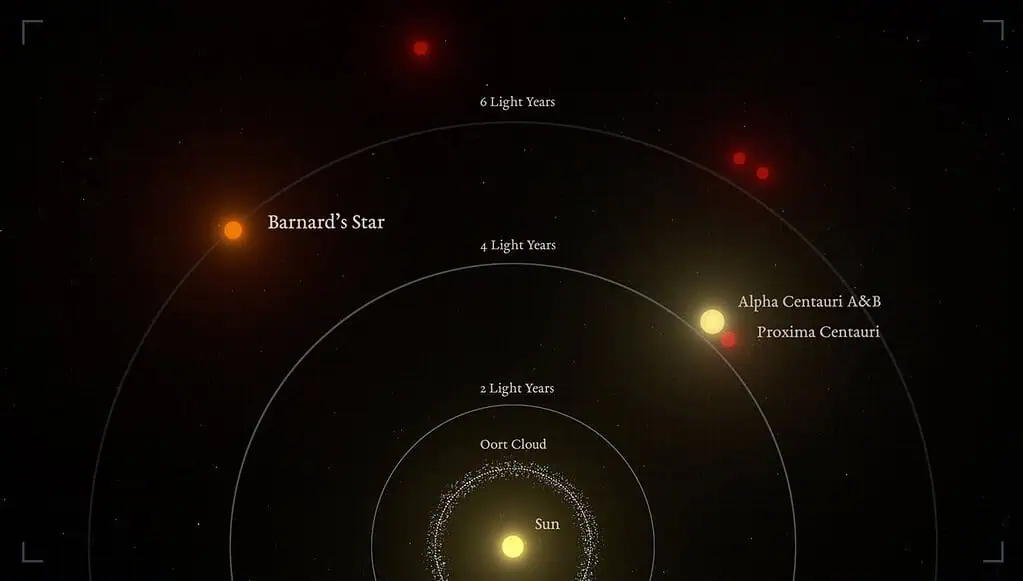
Barnard’s star is a red dwarf and ranks second among the closest star systems to Earth, right after the triple system Alpha Centauri.
-
100% Brazilian technology transforms agricultural waste into a meat-scented ingredient using fungi from the Amazon rainforest. The process does not use excessive water or chemicals, and it also increases the nutritional value of the final product.

-
Psychology reveals that adults who avoid conflicts at all costs are not balanced individuals, but rather children who learned in the worst way that expressing emotions brought punishment and now live paralyzed by the fear of expressing themselves.

-
Goodbye pet hair on clothes: a washer with an internal filter promises to remove up to 5 times more hair than regular machines and uses an XL trap dryer system to capture what remains.

-
The most overlooked waste in the electricity bill doesn’t come from the refrigerator or the air conditioner; it escapes through almost invisible cracks in doors and windows, operating all day long and can steal up to 20% of the energy used for climate control, while a low-cost seal takes just a few hours to eliminate this loss.


The Alpha Centauri system is composed of two main stars, Alpha Centauri A and B, and a third star, Proxima Centauri, which is the closest to us.
Although Proxima Centauri is just 4.24 light-years away, Barnard’s star is the closest single star, located just six light-years away.
Years of Suspicions and the Confirmation
For many years, astronomers speculated about the existence of a planet orbiting Barnard’s star, but they had not been able to confirm it until now.
Jonay González Hernández, a researcher at the Institute of Astrophysics of Canarias, described the long search for planets around this star.
According to Hernández, the initial goal was to explore Barnard’s habitable zone, where a planet with Earth-like characteristics could exist. However, the team ultimately discovered a sub-Earth planet with a mass of about half that of Venus.
Barnard b is significantly smaller than Earth and much closer to its star than Mercury is to the Sun—about 20 times closer.
Despite Barnard’s star being cooler than our Sun, the extreme proximity causes the temperature on the surface of the exoplanet to reach 125°C (257°F), a scorching heat that makes the existence of liquid water, one of the fundamental ingredients for life as we know it, impossible.
An Elusive Planet and the Radial Velocity Technique
Barnard b is an intriguing world, but little like Earth. Its discovery was made possible thanks to the radial velocity technique, which measures the oscillation of the star caused by the gravitational influence of the planet.
The team used the ESPRESSO instrument, one of the most precise available, capable of detecting subtle changes in the star’s speed of up to 10 cm/s.
This precision was crucial to distinguish the planet’s signal amidst stellar activity, which can often mask the oscillations caused by exoplanets.
The data provided by other instruments, such as HARPS and CARMENES, reinforced the team’s conclusions.
Although earlier reports of a planet around Barnard surfaced in 2018, these observations could not be confirmed by the more recent data, until now. The capability of ESPRESSO to isolate the signal of Barnard b is a milestone in the study of smaller exoplanets.
Additional Planets and Future Possibilities
Despite the extreme conditions of Barnard b, the discovery of this planet opens the door to other possibilities.
The study suggests the presence of up to three additional exoplanets orbiting Barnard’s star. These planets could offer more opportunities for astronomers to explore the formation of planetary systems around low-mass stars, such as red dwarfs.
Barnard’s star, while magnetically active, is relatively quiet compared to other M-dwarfs. However, the effects of stellar activity are still approximately 10 times greater than the signal produced by Barnard b, making the detection of these small planets a significant challenge for astronomers.
Expansion of the Exoplanet Catalog
The discovery of Barnard b adds to a growing catalog of exoplanets located near Earth. Among them are the planets Proxima b and d, which orbit Proxima Centauri, the closest star to the Sun.
Each new discovery brings astronomers closer to understanding how small, rocky planets are distributed throughout our galaxy.
Although Barnard b is not a habitable planet, its detection reinforces the importance of continuing to investigate nearby stars.








Seja o primeiro a reagir!