





 Portuguese
  English
  Spanish
  6 min of reading
  0 comments


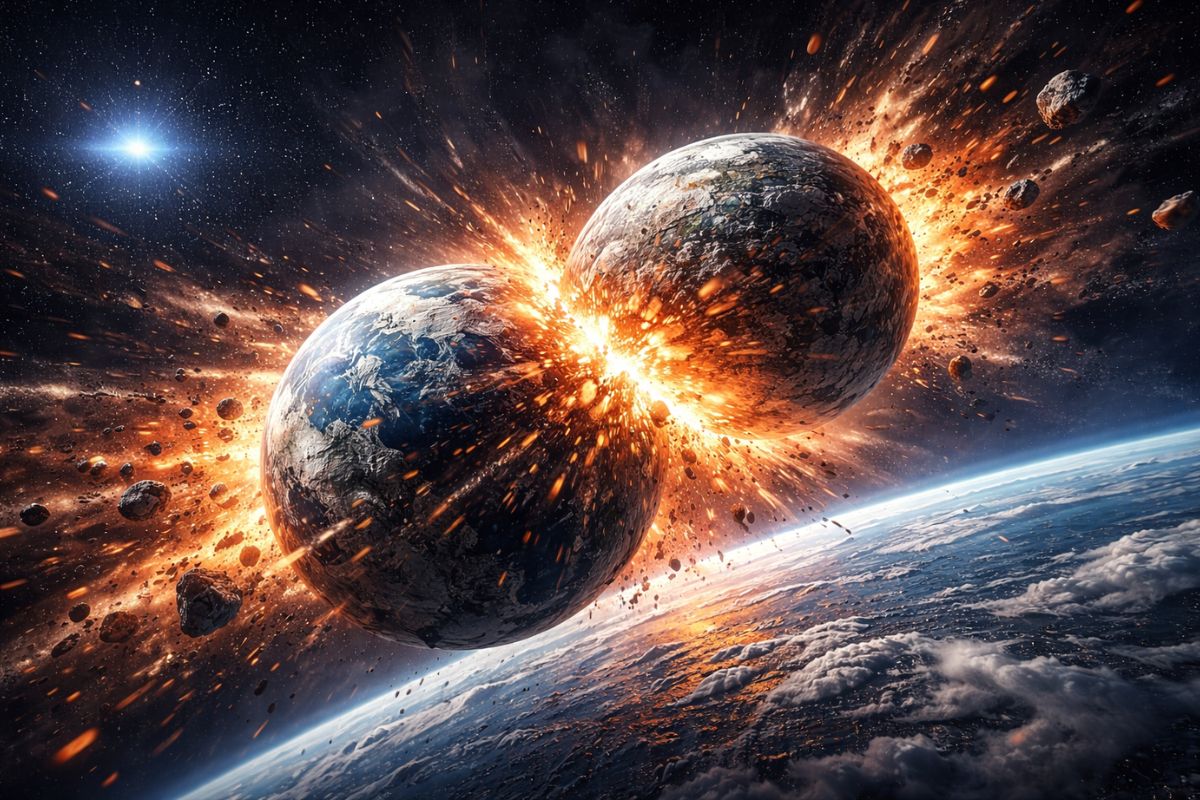
The Possible Collision Between Planets Observed Around a Stable and Distant Star May Help Astronomers Better Understand How Systems Like Earth and Moon Form, While Also Revealing a Rare Type of Cosmic Catastrophe That Is Difficult to Capture in Real Time.
The planets may be at the center of one of the rarest observations in recent astronomy. About 11,000 light-years from Earth, an apparently common star started showing sharp and erratic changes in brightness, unusual behavior for a star of its kind. After analyzing the data, scientists arrived at the strongest hypothesis yet: two worlds may have collided violently, scattering dust, rocks, and hot debris throughout the system.
This possible encounter between planets is notable not only for the violence of the event but also for what it may teach us about the formation of worlds like ours. Researchers believe that the scene observed may resemble the impact that gave rise to the Earth and the Moon, opening a rare opportunity to observe, nearly in real time, a process that is typically reconstructed through theoretical models.
Sun-Like Star Started to Behave Abnormally
The case began when PhD student Anastasios Tzanidakis reviewed archived observations and noticed something strange about the star Gaia20ehk. It is located near the constellation Puppis and is described as a stable main-sequence star, similar to the Sun.
-
Something is happening around the Earth: Inside the huge explosion of fireballs in 2026

-
A hot air bubble coming from Argentina expands over Brazil, causing thermometers to exceed 38 degrees with a thermal sensation of 40 degrees in late March, affecting 6 states at once.

-
The radish leaf that almost everyone throws away has more polyphenols, flavonoids, and fiber than the consumed root, and a 2025 study showed that the leaf contains compounds that protect the intestine, combat inflammation, and may inhibit the growth of cancer cells.

-
A planet that seemed to defy the laws of physics has intrigued scientists for decades, until the James Webb revealed what is really affecting Saturn’s rotation.
This detail is crucial because stars of this kind usually maintain a constant and predictable brightness. However, Gaia20ehk completely deviated from this pattern.
Since 2016, it has recorded sharp drops in brightness, and by around 2021, its behavior became even more chaotic. To astronomers, this was a clear signal that something unusual was happening in the system.
The first reaction was to investigate whether the problem lay with the star itself. But as the data progressed, the team began to realize that the explanation likely stemmed from something orbiting around it, rather than the star itself.
The Strongest Hypothesis Points to a Collision Between Planets
After better analyzing the phenomenon, researchers concluded that the dimming of the star was caused by large amounts of dust and rocky material passing in front of it, blocking part of the light on its way to Earth.
This trail of material led to the most likely explanation: a planetary collision between two large bodies. Instead of a simple stellar oscillation, the system is being obscured by hot debris produced after the impact.
It is precisely this cloud of scattered material that would explain both the loss of brightness in visible light and the different behavior in other parts of the spectrum.
According to researchers, such events are likely not rare in the universe. The issue is that they almost never occur in a position favorable enough to be detected from Earth.
Hot Debris Completely Altered the Reading of the Phenomenon
One of the most decisive points of the analysis arose when the team compared observations in visible light with infrared data. The result was surprising. While the visible light from the star diminished and flickered irregularly, the infrared readings surged.
This contrast indicated that the material passing in front of the star was not just cold dust. It was hot enough to glow intensely in the infrared. This strengthened the idea of a recent and energetic collision capable of heating vast amounts of debris scattered throughout the system.
The scientists’ reading is that this behavior aligns better with a large-scale impact than with simpler explanations. In other words, the star was not failing. It was being partially obscured by a hot cloud generated by a catastrophic event.
Smaller Impacts May Have Occurred Before the Major Collision
The team also considers an interesting possibility to explain the observed drops in brightness before 2021. Instead of a single sudden impact, the two bodies may have undergone a gradual approach, with grazing impacts before the main collision.
In this scenario, the planets would have gradually moved closer, producing smaller disturbances up to the moment of the great destruction.
These initial impacts would not generate much infrared emission but could already start scattering material throughout the system. Then, when the catastrophic collision occurred, the heat and volume of debris increased significantly.
This hypothesis helps explain why the system exhibited staggered changes over several years. The event may not have been an isolated instant but the peak of a violent approach between two worlds.
The Case May Help Explain the Origin of the Earth and Moon
One of the reasons why this discovery attracts so much attention is the possible similarity to one of the most significant episodes in the history of our own system. Researchers see indications that this collision may resemble the impact that, according to the most accepted hypothesis, formed the Earth and Moon about 4.5 billion years ago.
The cloud of debris observed in Gaia20ehk appears to orbit the star at approximately one astronomical unit, a distance comparable to that which separates the Earth from the Sun. This makes the case even more interesting, as it suggests an environment similar to that of the region where our planet consolidated.
If this material cools and begins to cluster again, it may form new bodies in the future. This means that astronomers may be witnessing not only the destruction of worlds but also a stage that could precede the birth of others.
Planet Formation Is a More Chaotic Process Than It Seems
The study reinforces a central idea in planetary astronomy: the formation of systems does not happen in a calm and organized manner. Around young stars, dust, gas, ice, and rocks accumulate, collide, and reorganize for millions of years.
In this process, some bodies grow and stabilize while others are destroyed, deflected, or expelled from the system. For this reason, collisions between planets and protoplanets are part of the natural history of many solar systems. What changes is our ability to observe these episodes.
From a scientific perspective, tracking such an event is valuable because it offers direct clues about a process that can typically only be inferred. It is like witnessing a rare stage in the construction and destruction of worlds happening right before telescopes.
Future Telescopes May Find Many Other Similar Cases
For now, this possible collision remains a rare and precious case. But researchers believe this may change in the coming years with the entry into operation of more advanced instruments.
The Simonyi Survey Telescope at the Vera C. Rubin Observatory is seen as a key piece for this new phase.
The expectation is that it will be able to identify around 100 similar collisions in the next decade. If confirmed, astronomy will have a much richer foundation to understand how planetary systems evolve.
Further observations of this type may also help answer a question that is of interest even to astrobiology: how often do events like the one that formed the Earth and Moon occur in the universe?
Answering this means advancing not only in the history of planets but also in understanding conditions that may favor the emergence of life.
What This Possible Collision Changes in Astronomy
Even though more years of observation are still needed to understand the final fate of the debris cloud, the case already stands out for showing how data accumulated over time can reveal slow and complex cosmic stories.
The discovery suggests that seemingly discrete phenomena, such as small variations in brightness in a stable star, may conceal immense processes involving planets, dust, heat, and orbital reorganization.
This expands the value of long-term observations and shows that there is still much to be discovered in existing astronomical archives.
Ultimately, the episode of Gaia20ehk attracts attention because it combines colossal scale, observational rarity, and theoretical relevance.
If the hypothesis is correct, astronomers may have witnessed one of the best clues ever seen about how worlds break apart, reform, and perhaps give rise to systems similar to ours.
In your opinion, observing collisions between planets could be the key to better understanding how the Earth and the Moon formed?





-

Uma pessoa reagiu a isso.