





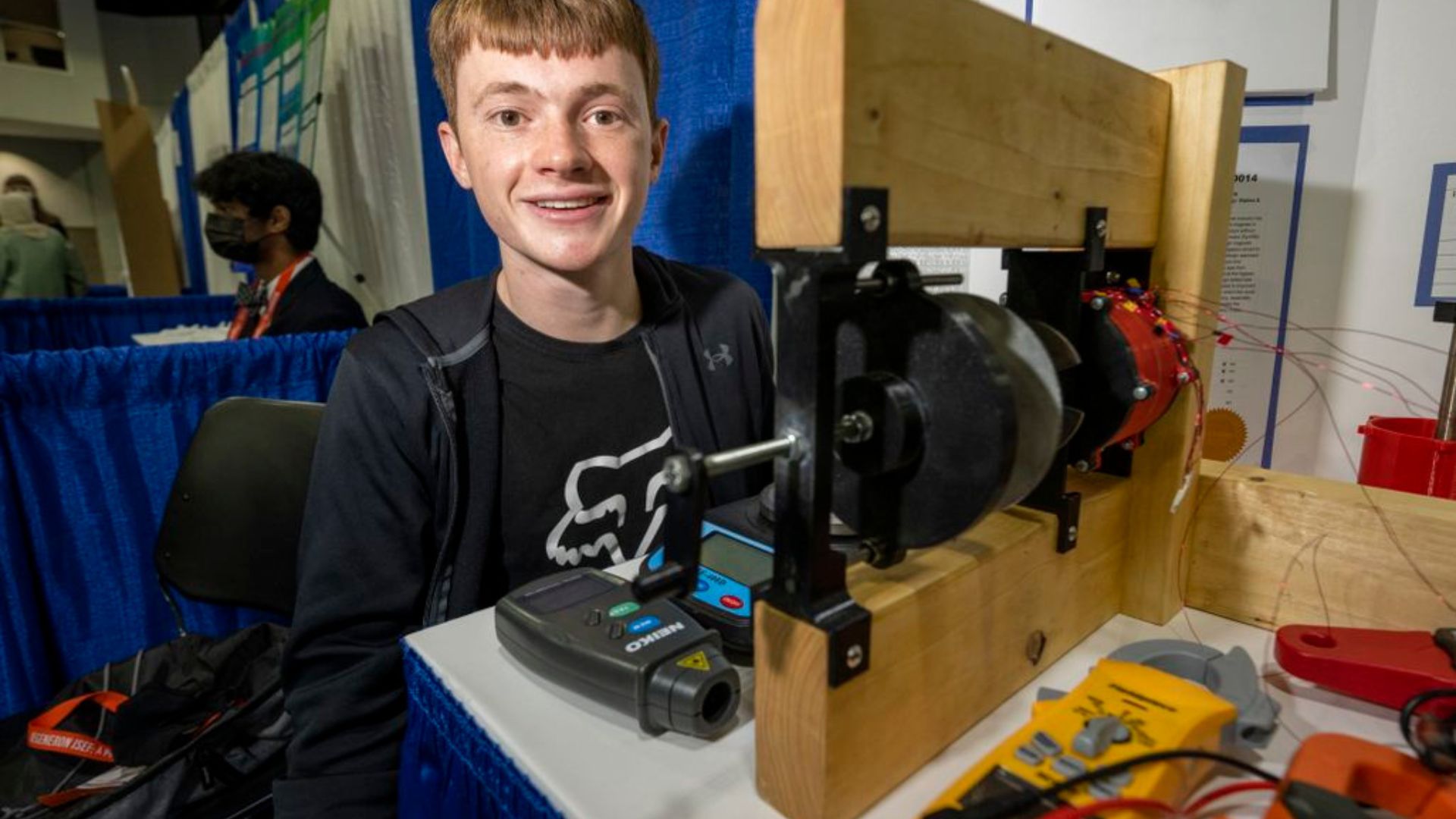

A 17-year-old student created a prototype of an electric motor without rare earth magnets, improved torque and efficiency, and won a $75,000 prize at ISEF.
In 2022, student Robert Sansone, then 17 years old, won the top prize at the Regeneron International Science and Engineering Fair, one of the world’s largest pre-university scientific competitions, with a project focused on the future of electric motors.
The young man from Fort Pierce, Florida, received the George D. Yancopoulos Innovator Award, worth $75,000, for research exploring high-efficiency alternatives for motors used in electric vehicles. The Society for Science itself reported that the 2022 edition brought together 1,750 young scientists from 49 U.S. states and 63 countries, regions, and territories.
The most striking point of the project was a technical question with enormous economic and environmental impact: would it be possible to improve the performance of electric motors without relying on permanent magnets made from rare earth elements?
-
Automatic, imposing, and equipped like a higher category car: with a 2.0 engine of 165 hp, six-speed transmission, six airbags, stability and traction controls, and 18-inch wheels, this used Kia sedan appears as a less remembered alternative to Fusion, Sonata, and Azera; meet the 2015 Kia Optima.

-
Boasting a 2.0 turbo engine with 272 hp, 35.7 kgfm of torque, an eight-speed automatic transmission, and 4Motion all-wheel drive, this German SUV returns to Brazil as the most powerful Tiguan ever sold in the country: meet the Volkswagen Tiguan R-Line 2026.
-
It costs around R$ 63,000, has a 1.0 naturally aspirated flex engine, six airbags, stability controls, and a fuel consumption of up to 14.6 km/l; find out if it’s worth buying a used 2023 Hyundai HB20 Sense.
-
With a revenue increase of 11.3% and selling 8.4 billion units, the pharmaceutical market in Brazil grew in 2025, with revenue rising much faster than the quantity of medicines sold in the country.


The hidden problem inside electric motors
Electric cars are often presented as a lower direct emission alternative compared to combustion vehicles. But the manufacturing chain still faces significant bottlenecks, and one of them is the materials used in the motors.
Many high-performance motors use permanent magnets made from rare earth elements like neodymium, samarium, and dysprosium. These materials are valued because they help produce intense magnetic fields in compact and efficient equipment.

The problem is that the extraction and processing of these elements can involve high environmental costs, geopolitical concentration of supply, and supply difficulties. The Society for Science states that Sansone’s research aimed to contribute to electric vehicles that do not rely on magnets made from strategically important rare earth elements.
This was the environmental axis of the project. It was not just about creating a different motor, but investigating a route capable of reducing dependence on a sensitive mineral chain for the expansion of electric vehicles.
The Bet on a Synchronous Reluctance Motor
The path chosen by Robert Sansone was to study the synchronous reluctance motor, known by the acronym SynRM.
This type of motor does not use permanent magnets in the rotor. Instead, it relies on the rotor’s tendency to align with the rotating magnetic field created by the stator. The Smithsonian Magazine explains that, in synchronous reluctance motors, a steel rotor with air gaps aligns with the rotating magnetic field, producing torque.
The advantage is clear: the motor can operate without rare earth magnets. The challenge lies in performance.
According to the technical summary of the project published in the Society for Science database, SynRM motors have limited applications in electric vehicles because they generally do not have the high magnetic saliency needed to match the performance of motors with permanent magnets.
In simple terms, magnetic saliency is related to the difference in magnetic behavior within the rotor. The greater this difference useful for the motor’s operation, the greater the torque that can be produced under certain conditions.
What the Student Tried to Change in the Project
Sansone did not create the category of synchronous reluctance motor. The differential of the work was to propose a new approach to increase magnetic saliency and, thus, improve torque and efficiency characteristics.
The ISEF technical summary states that the investigation’s objective was to evaluate how torque and efficiency of SynRMs would be affected by a new way of creating magnetic saliency. The experimental motor was tested with different rotor geometries and at various rotational speeds. Then, it was reconfigured as a traditional SynRM for comparison.


The project was not presented as a commercial motor ready to equip cars. It was an experimental investigation comparing a new configuration with a traditional configuration, within the limits of a student prototype.
Even so, the results drew attention because they indicated gains in torque and efficiency in the tested range.
3D Printed Prototype, Copper Wires, and Steel Rotor
The Smithsonian Magazine reported that Sansone built a prototype using 3D printed plastic, copper wires, and a steel rotor. The assembly was tested with meters to evaluate power and a laser tachometer to determine the motor’s rotational speed.
This combination shows the actual scale of the project: it was a bench prototype, not a finished automotive piece. The student himself stated that he had to make a smaller scale version because he didn’t have the resources to manufacture advanced engines in industrial size and materials.
The process was also marked by trial and error. According to the Smithsonian report, several prototypes were needed to reach a functional version. Sansone stated that only on the 15th engine did he manage to create a working prototype.
This data reinforces the experimental nature of the research. The progress came less from an instant discovery and more from a persistent cycle of building, failing, adjusting, and retesting.
The results that led the project to the $75,000 award
In the tests described by Smithsonian Magazine, the experimental engine outperformed a traditional synchronous reluctance configuration in torque and efficiency.
The report states that, at 300 revolutions per minute, Sansone’s design showed 39% more torque and 31% more efficiency. At 750 revolutions per minute, the efficiency gain was 37%.
Smithsonian itself notes that Sansone was unable to test the prototype at higher revolutions because plastic parts could overheat. The report also mentions that commercial automotive engines can operate at much higher revolutions, as in the case of engines used by Tesla.
Why eliminating rare earth magnets can matter so much
The dependence on rare earths is one of the sensitive points of electrification. Although these elements are not necessarily rare in geological abundance, their extraction, separation, and refining are complex, expensive, and concentrated in specific industrial chains.
Motors without permanent magnets can reduce the pressure on this chain. They can also decrease exposure to price fluctuations and supply limitations.

The Society for Science described synchronous reluctance motors as robust, efficient, and magnet-free alternatives to traditional motors with permanent magnets. The entity also highlighted that Sansone’s research improved torque and efficiency in this type of motor.
If technologies of this type advance, they could contribute to electric vehicles being less dependent on critical materials. But this still requires additional testing, manufacturing improvements, cost analysis, durability, electronic control, and large-scale validation.
The bottleneck is still in manufacturing
The Smithsonian interviewed Heath Hofmann, a professor of electrical and computer engineering at the University of Michigan, who stated that Sansone was looking at the problem the right way.
At the same time, he pointed out that synchronous reluctance motors can be complex and difficult to manufacture, which makes production cost a barrier to widespread use.
Sansone also acknowledged this limitation. According to the Smithsonian, he stated that technologies like additive manufacturing, including 3D printing, could facilitate the construction of more complex geometries in the future.
In other words, the project directly engages with two technological fronts: rare-earth-free motors and advanced manufacturing.
More than 1,000 hours dedicated to the project
After the victory at ISEF, Sansone stated in an interview with the Society for Science that he dedicated more than 1,000 hours to the project presented in the competition, from the initial concept to the finalized study.
This data helps explain why the research stood out. Despite being conducted by a high school student, the work involved method, experimental comparison, test repetition, and technical presentation at an international fair.
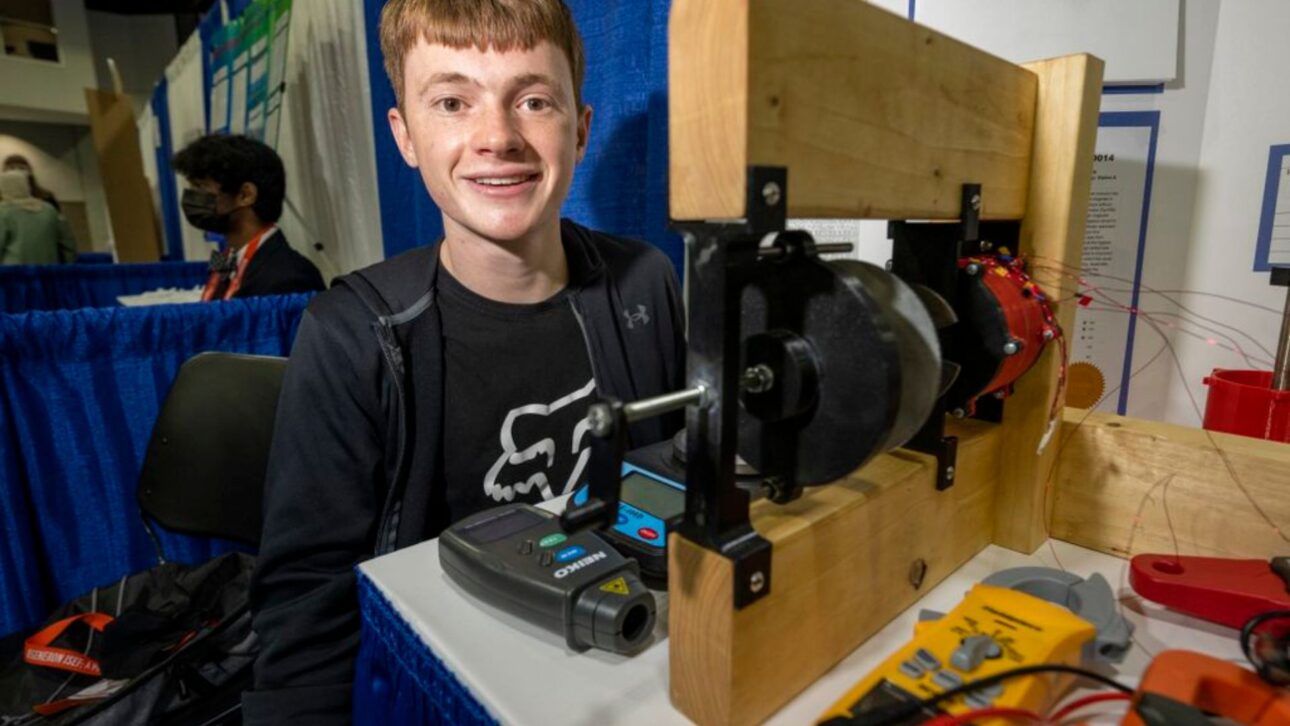
ISEF does not only reward flashy ideas. Finalists are evaluated for creativity, innovation, and level of scientific investigation. In the 2022 edition, the prizes totaled almost $8 million, according to the Society for Science.
In this context, Sansone’s project stood out for tackling a real problem of the energy transition with a technically specific solution.
The next step was to test more robust versions
After the award, Sansone continued working on the topic. In an interview published by the Society for Science in 2023, he stated that he had gained access to electromagnetic simulation software and was learning to use it to conduct simulated experiments on the motor design.

This step is essential for any engine project. Simulations allow the study of magnetic fields, losses, torque, heating, rotor geometry, and performance before the physical manufacturing of new versions.
The Smithsonian also reported that Sansone was working on calculations and 3D modeling for version 16 of the engine, with plans to build it in more resistant materials to test higher speeds.
A small invention in the face of a gigantic industry
The automotive industry operates on a massive scale. An engine used in electric vehicles needs to withstand vibration, heat, load variations, intensive use cycles, and strict safety standards.
Therefore, a student prototype does not automatically replace decades of automotive engineering. But it can open a line of investigation, propose an alternative geometry, and draw attention to a weakness in the current chain.
This was precisely the value recognized by the ISEF. Sansone presented an experimental approach to improve synchronous reluctance motors, compared the performance with a traditional configuration, and demonstrated measurable gains in the prototype.
The research does not end the debate, but it raises a relevant question for the industry: if magnet-free motors can be improved, to what extent can they reduce environmental costs and dependence on critical materials in the future?
An international award for an idea that targets the future of electrics
Robert Sansone won the Regeneron ISEF 2022 because his project connected applied science, engine engineering, and sustainability.
At 17 years old, he developed a synchronous reluctance motor prototype, tested a new way to increase magnetic saliency, and presented torque and efficiency gains compared to a traditional configuration. The research received the top prize of $75,000 in a competition that brought together students from dozens of countries.
The case shows that electrification does not depend solely on more powerful batteries or faster chargers. It also involves less visible components, such as motors, magnetic materials, internal geometries, and manufacturing processes.
If new versions can maintain performance at higher rotations, industrial materials, and scalable production, the idea could contribute to a generation of motors less dependent on rare earth magnets.


