





 Portuguese
  English
  Spanish
  3 min of reading
  0 comments


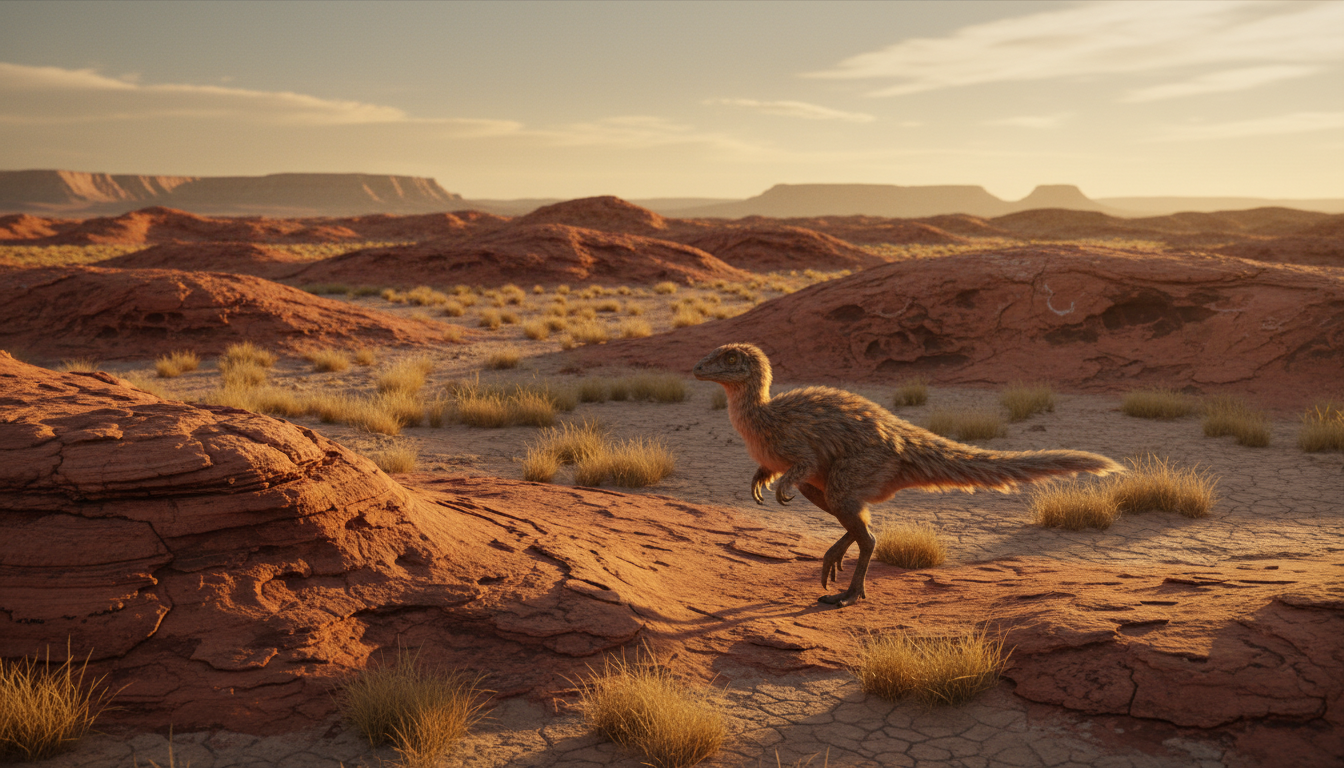
Alnashetri cerropoliciensis measuring 70 cm, weighed less than 1 kg and was detailed in a nearly complete skeleton published in Nature in 2026, filling a decades-long gap in the evolutionary tree of dinosaurs
The first fragments appeared in 2012, during an excavation in Argentine Patagonia. Pieces of bones so small they seemed to belong to a lizard — not a dinosaur. More than a decade later, science finally pieced together the fragments. The smallest non-avian dinosaur ever documented has just gained a nearly complete skeleton, published in the journal Nature in early 2026, and what it reveals about reptile evolution has surprised even the most experienced paleontologists.
The Alnashetri cerropoliciensis lived 95 million years ago, measured only 70 centimeters in length and 40 centimeters in height, and weighed approximately 1 kilogram. For comparison, it was smaller than a modern domestic chicken. As reported by the Diário do Comércio, the find reignites fundamental debates about how miniaturization shaped entire lineages of prehistoric reptiles.

From forgotten fragments to nearly complete skeleton: the long journey of the smallest dinosaur
The story of Alnashetri begins with frustration. In 2012, paleontologists found fragmented bones at a site in Patagonia, but the material was insufficient for a complete description. The pieces were cataloged and awaited further excavations.
-
The 18-year-old football star who earns nearly R$ 200 million a year bought a 2,000-square-meter mansion that once belonged to Shakira and Piqué and will now turn it into a private sports center.

-
PhD student transforms turntable into an unlikely electronic drum, uses metal spheres, sensors, and creates a mechanical sequencer that is as brilliant as it is impractical.

-
A Brazilian city 50 km from São Paulo combines quality of life, preserved nature, safety, and infrastructure, standing out among the best in the country; discover Jundiaí.

-
What seemed like just dirty ice in Antarctica turned into a global alert when a research vessel discovered an island measuring 130 meters, confirmed the actual coastline, and forced a revision of nautical charts.

Only in 2026, with the publication in Nature, was the nearly complete skeleton presented — including leg bones, arm bones, and body fragments that allowed for the animal to be reconstructed for the first time. Microscopic analyses of the bones confirmed that at least one specimen was a fully developed adult, ruling out the hypothesis that the fossils belonged to juveniles of another species.
Thus, the tiny size of Alnashetri was not a result of immaturity — it was a stable evolutionary trait of the species. Researchers found at least five distinct individuals at the site, reinforcing that miniaturization represented a consolidated reproductive strategy.
Other recent discoveries have also rewritten chapters of paleontology. In China, 190-million-year-old dinosaur embryos preserved even rare proteins in the bones, something that could change what is known about life before hatching.

What the smallest dinosaur reveals about the evolution of alvarezsaurs
Alnashetri belongs to the group of alvarezsaurs — bipedal carnivorous dinosaurs that gradually reduced their arms over millions of years. However, the specimen from Patagonia shows a primitive phase of this lineage, with proportionally long arms and large teeth, the opposite of what is observed in more recent alvarezsaurs.
As published by ScienceDaily, this discovery positions Alnashetri as a kind of “missing link” between conventional carnivorous dinosaurs and the specialized alvarezsaurs that came later.
Additionally, evolutionary modeling indicates that miniaturization occurred independently in different groups of dinosaurs around the world:
- Alnashetri (Patagonia) — carnivore, 70 cm, 95 million years
- Foskeia pelendonum (Spain) — bipedal herbivore, 50 cm, 120-125 million years
- Muttaburrasaurus (Australia) — herbivore related to Foskeia, several meters
Therefore, tiny dinosaurs were not exceptions — they were an evolutionary strategy that emerged repeatedly on different continents, both in carnivores and herbivores.

What still needs to be answered about miniature dinosaurs
Despite the progress, researchers acknowledge significant limitations. The skeleton of Alnashetri is still not 100% complete — parts of the skull are missing that could reveal details about the animal’s diet and senses. Additionally, the material is concentrated in a single site in Patagonia, and it is still unknown whether the species had a broader distribution.
The debate about why some dinosaurs shrank while others grew remains open. One hypothesis suggests that miniaturization allowed for the exploration of ecological niches inaccessible to larger predators — such as burrows, dense vegetation, and insect hunting. However, there is a lack of data to confirm whether Alnashetri actually occupied these micro-habitats.
In South Africa, 132-million-year-old footprints hidden beneath the tide show that the diversity of dinosaurs in the southern hemisphere was much greater than science had imagined. Each new discovery — whether a 1-kilogram fossil in Patagonia or tracks on an African beach — adds a piece to a puzzle that will take decades to complete.





Seja o primeiro a reagir!