





 Portuguese
  English
  Spanish
  3 min of reading
  2 comments


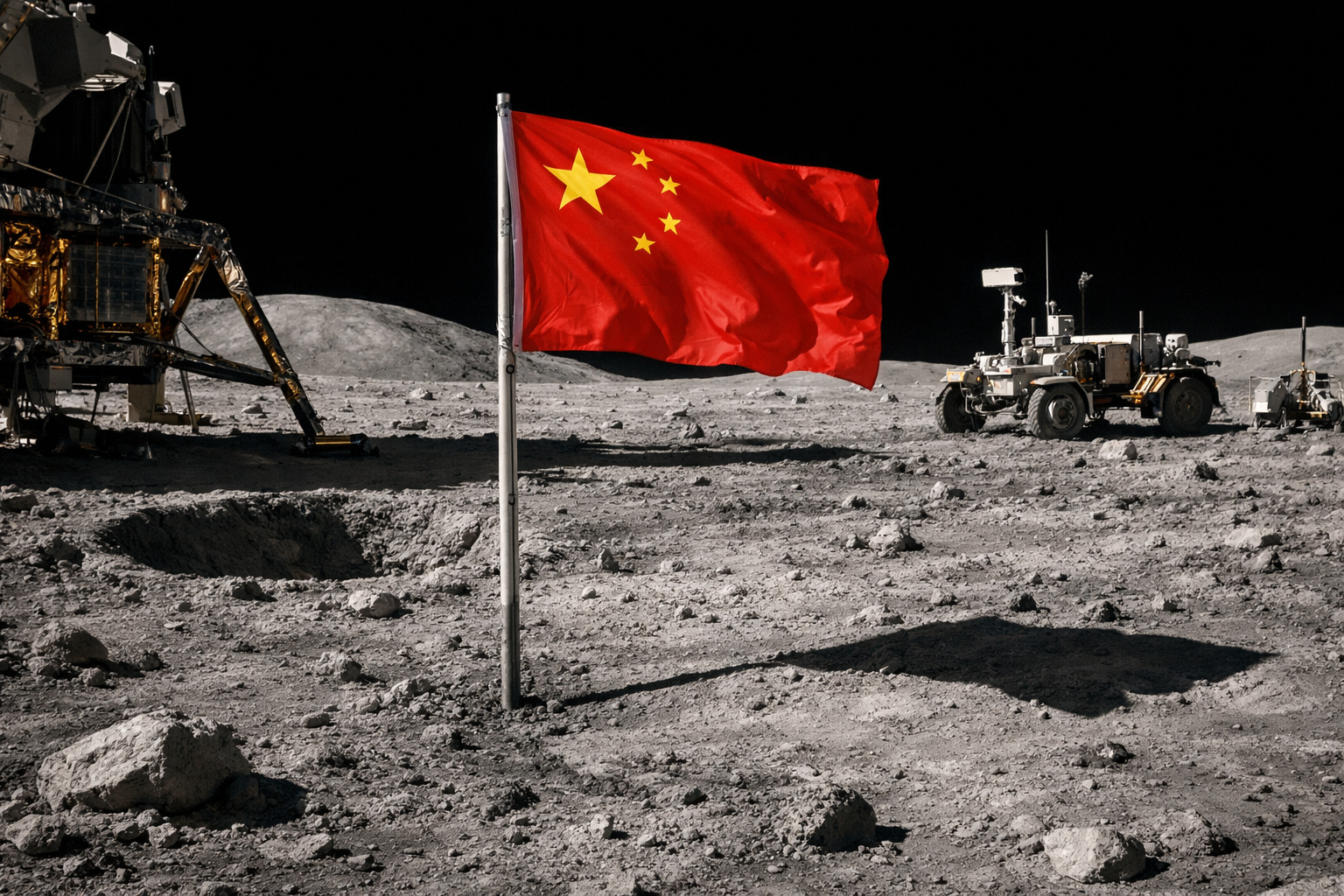


Chinese strategy with satellites at strategic points redefines space communication and challenges historical limits of missions on the lunar far side
Communication with the far side of the Moon has always been one of the greatest challenges faced by space missions over the past decades. This occurs because, when a spacecraft crosses this region, the Earth’s natural satellite completely blocks the radio signal, interrupting any direct contact with ground control centers, according to BBC News. However, amid an increasingly intense space race, China emerges with an innovative solution that could definitively change this scenario.
The information was released by China National Space Administration (CNSA) and reinforced by recent analyses of Chinese technological advancements, highlighting the country as one of the world’s major military and space powers. In this context, investment in space technology has proven strategic not only for scientific exploration but also for consolidating global influence.


Relay system with satellites puts China ahead in the space race
To overcome this historical limitation, China has implemented a system based on highly strategic relay satellites. The equipment known as Queqiao-1 and Queqiao-2 act as intermediaries between space probes and Earth, ensuring continuous communication even when there is a direct line-of-sight blockage.
-
Scientists reanimated a 48,500-year-old virus in the laboratory that had been frozen in the Siberian permafrost since before the extinction of the Neanderthals, and it was still capable of infecting living organisms after tens of millennia dormant in the ice.

-
The oldest nuclear aircraft carrier still in operation in the world is currently on Brazilian soil making its final journey before retirement, and two American military planes landed in Salvador and Fortaleza to support the mission.
-
WhatsApp is about to eliminate one of the app’s biggest annoyances; soon a single screen will show all online contacts at the same time without needing to open each conversation individually to find out who is available.
-
Scientists have discovered that the Earth recycles its own continents in the depths, dragging pieces of crust down during plate collisions and returning them later as magma, in a mechanism called relamination that has helped build the continents for billions of years.




These satellites are positioned in extremely specific regions of space called Lagrange points—areas where gravitational balance allows them to remain practically stable. This way, they can maintain simultaneous visibility for both Earth and the far side of the Moon, something that represents a significant technological leap.
Moreover, this model has already been successfully applied in recent robotic missions conducted by China, demonstrating not only technical feasibility but also operational efficiency. Consequently, the country positions itself ahead of other nations that still face periods of silence during lunar missions.

Technological difference exposes limitations of other space powers
While China advances with sophisticated solutions, many international missions still suffer from temporary communication interruptions when crossing the far side of the Moon. This type of limitation results in silence windows that can compromise critical operations, in addition to reducing the efficiency of sending and receiving scientific data.
On the other hand, the Chinese system eliminates this problem by ensuring a constant communication bridge. Thus, even during flybys in regions not visible from Earth, the probes continue to transmit information in real-time. This technological edge reinforces China’s position as an emerging power that directly challenges the historical dominance of the United States in the space sector.
Ambitious plan aims for complete space network by 2030
In addition to current advancements, China is already projecting an even more ambitious future. The country intends to expand this system by creating a broader network of satellites, which will not only maintain communication but also provide support for navigation and monitoring in deep space.
The expectation is that this infrastructure will be fully consolidated by 2030, aligning with the Chinese government’s plans to send astronauts to the Moon. With this, the country will be able to establish a continuous and strategic presence in the lunar environment, further expanding its technological and scientific influence.
Thus, the Chinese advancement represents not only a technical solution to an old problem but also a strategic move that could redefine the balance of power in the new global space race.






These days, bold words in publications aren’t enough. Talk is cheap—relevance is earned through action. The real proof is in doing. Now we wait to see China turn its promises on paper into reality by 2030.
Totally agree. Ultimately, the acid test is getting people to the moon and proving these claims. Factually, China hasnt sent anyone to the moon unlike the States. In fact, the recent Artemis mission is a mere updated reprisal of what they did in the Apollo program of the 60s, early 70s.