Portuguese
  Spanish


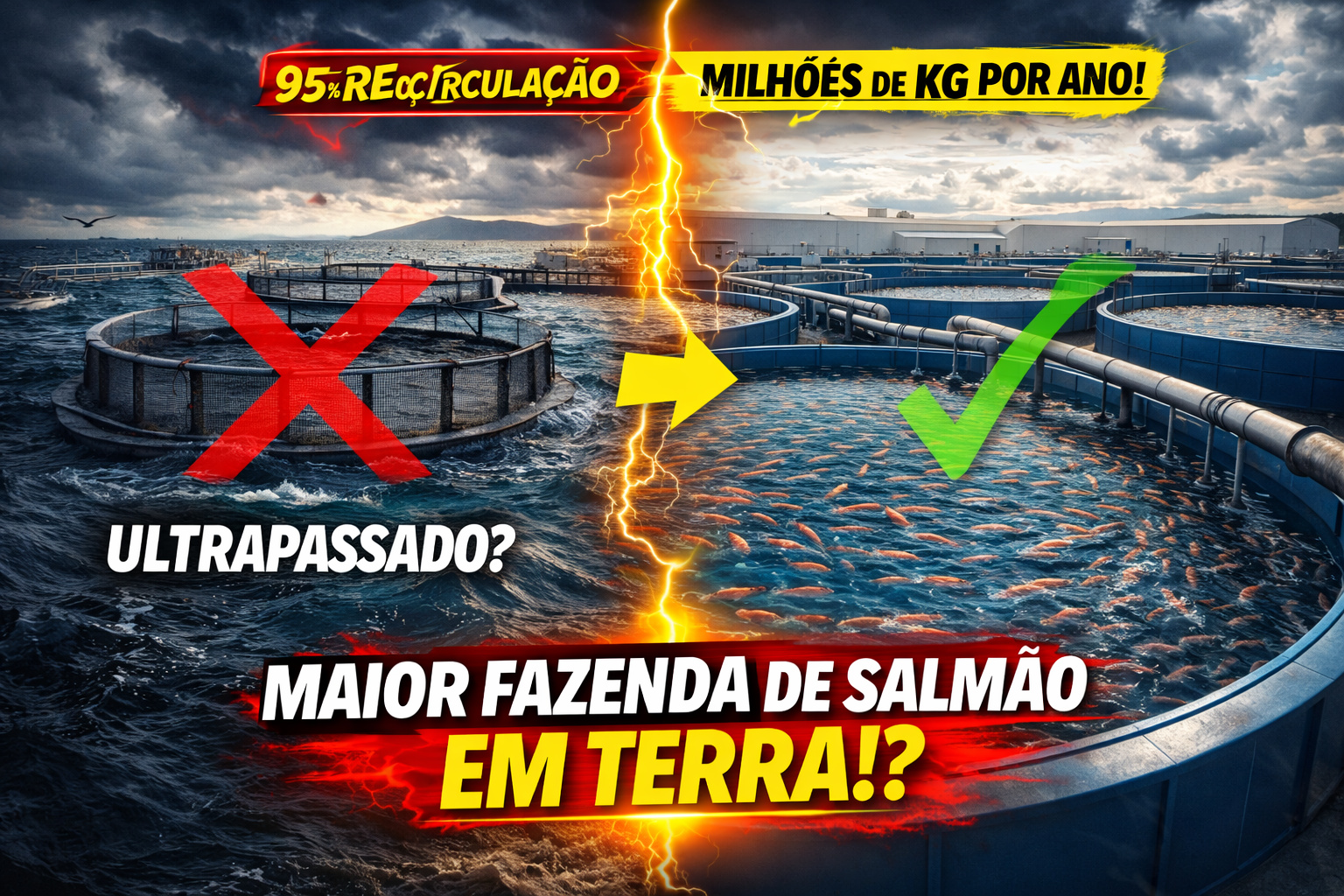


Atlantic Sapphire Operates The Largest Land-Based Salmon Farm In Florida With RAS System, Recirculating 99% Of The Water And Producing Millions Of Kilograms Per Year.
In 2020, the Norwegian company Atlantic Sapphire officially began commercial production at its Bluehouse facility, located in Homestead, South Florida, United States. The project quickly attracted attention from the global aquaculture sector for one objective reason: to grow Atlantic salmon far from the ocean, using closed recirculating water systems known as RAS (Recirculating Aquaculture System), with recycling of up to 99% of the water used in the process.
The proposal is not only innovative from an environmental perspective. It alters the historical logic of salmon production, traditionally concentrated in open marine cages in Norway, Chile, Scotland, and Canada. Atlantic Sapphire bets on industrial infrastructure on land to reduce sanitary risks, fully control the farming environment, and bring production closer to major consumer markets.
The Context Of Aquaculture And The Limits Of The Oceanic Model
Open-sea salmon farming has established itself in recent decades as one of the main global sources of high-value animal protein. Countries like Norway and Chile lead global production, based on floating structures installed in fjords and protected coastal areas.
-
Cashew Becomes Billion-Dollar ‘Superfood’ in Ivory Coast: 1.6 Million Hectares of Monoculture Encroach on Forests as Families Trade Food for Nuts

-
In Rural Brazil, José Sirval Operates a Water-Powered Mill Grinding 125 Kilograms of Corn Daily Using His Great-Grandfather’s Century-Old Monjolo
-
From Market Stall to Agribusiness: Patagonian Fruit Grower Owns 550 Hectares and Processes 18 Million Kilos of Pears and Apples Annually, Exporting Directly to Brazil
-
At 93, Brazilian Farmer Restores 56 Hectares of Forest and Revives Spring in the Amazon, Installs First Climate Tower in the Region


However, this model faces increasing technical challenges. Parasites such as sea lice, bacterial diseases, fish escapes into the natural environment, and environmental impacts associated with waste accumulation under the cages pressure regulators and consumers. Furthermore, environmental restrictions and limits on coastal expansion impose barriers to production capacity growth.
It is in this scenario that RAS systems have gained relevance. By moving production to closed environments on land, direct contact with the ocean is eliminated, reducing exposure to external pathogens and allowing for strict control of temperature, oxygenation, water quality, and population density.
Atlantic Sapphire was one of the companies that decided to take this logic to the extreme: to produce salmon on an industrial scale in Florida, thousands of kilometers away from the Norwegian fjords.
The Operation Of The RAS System And The Engineering Behind The Recirculation Of 99% Of The Water
The RAS system used in Bluehouse is based on a closed water circuit that goes through multiple stages of filtration and treatment before returning to the rearing tanks.
The process involves mechanical filtration to remove solids, biofilters that convert ammonia into nitrate through nitrifying bacteria, degasification to remove carbon dioxide, precise control of dissolved oxygen, and adjustments of pH and temperature. The water is constantly monitored by automated sensors that measure chemical and physical parameters in real-time.
The 99% recirculation rate means that only about 1% of the water is replaced daily. This rate drastically reduces water consumption compared to conventional continuous flow systems.

In addition to water control, the structure includes large diameter circular tanks, designed to optimize hydraulic flow and allow waste to be automatically directed to collection systems. The stocking density is calculated based on oxygenation capacity and the removal of metabolic wastes, avoiding excessive stress on the fish.
This engineering transforms salmon farming into a high-precision industrial operation, more akin to a chemical processing plant than a traditional farm.
Applied Technology, Sanitary Control And Industrial Standardization
One of the strategic pillars of the project is sanitary control. In open marine systems, disease outbreaks can spread rapidly among farms connected by the same ocean environment. In a closed system, biosecurity is reinforced by physical barriers, access control, and disinfection protocols.
Atlantic Sapphire also artificially controls the water temperature, allowing continuous growth throughout the year. In natural environments, seasonal variations directly impact the production cycle. In RAS, salmon grows under stable thermal conditions, accelerating predictability and planning for harvest.
Another differentiator is the proximity to the North American consumer market. By producing in Florida, the company reduces the need for air transport of fresh salmon coming from Europe or Chile, decreasing delivery time and emissions associated with international logistics.
This strategy is part of a larger movement toward regionalizing food production, seeking to reduce long and vulnerable supply chains.
Production Scale, Industrial Numbers And Economic Impact
The Bluehouse unit was designed in phases. The company’s disclosed goal for the total capacity of the project is around tens of thousands of tons annually when fully expanded. In the first years of commercial operation, production was gradually scaled, reaching millions of kilograms per year.
It is essential to differentiate effective annual production from projected installed capacity. The announced final capacity refers to maximum potential after all expansion phases are completed. In contrast, annual production figures reflect volumes effectively harvested and marketed in each fiscal year.

The construction of the plant involved investments of hundreds of millions of dollars, becoming one of the largest investments in land-based aquaculture in the world. The project has also generated local jobs and positioned the United States as an emerging player in land-based farmed salmon.
However, the proposal is not limited to volume. It aims to redefine the technological standard of the industry, demonstrating that it is possible to produce high-value marine protein without directly depending on the ocean.
Technical Challenges, Risks And Limits Of The Model
Despite the technological promise, large-scale RAS systems are not without risks. Electrical failures, pumping problems, or biofiltration system failures can quickly compromise water quality. In high-density environments, minutes can be decisive.
Additionally, energy consumption is high. Pumps, oxygenation systems, thermal control, and continuous monitoring require a constant supply of energy. This raises questions about the carbon footprint and energy efficiency of the model, depending on the energy matrix used.

Another challenge is the initial cost of implementation. The CAPEX of a large-scale RAS facility is significantly higher than that of a conventional marine farm. Financial returns depend on operational efficiency, mortality control, and market stability.
There is also the biological factor. Salmon is a migratory species adapted to complex natural environments. Artificially reproducing ideal conditions requires continuous adjustments, genetic research, and specialized technical management.