





 Portuguese
  English
  Spanish
  5 min of reading
  1 comment


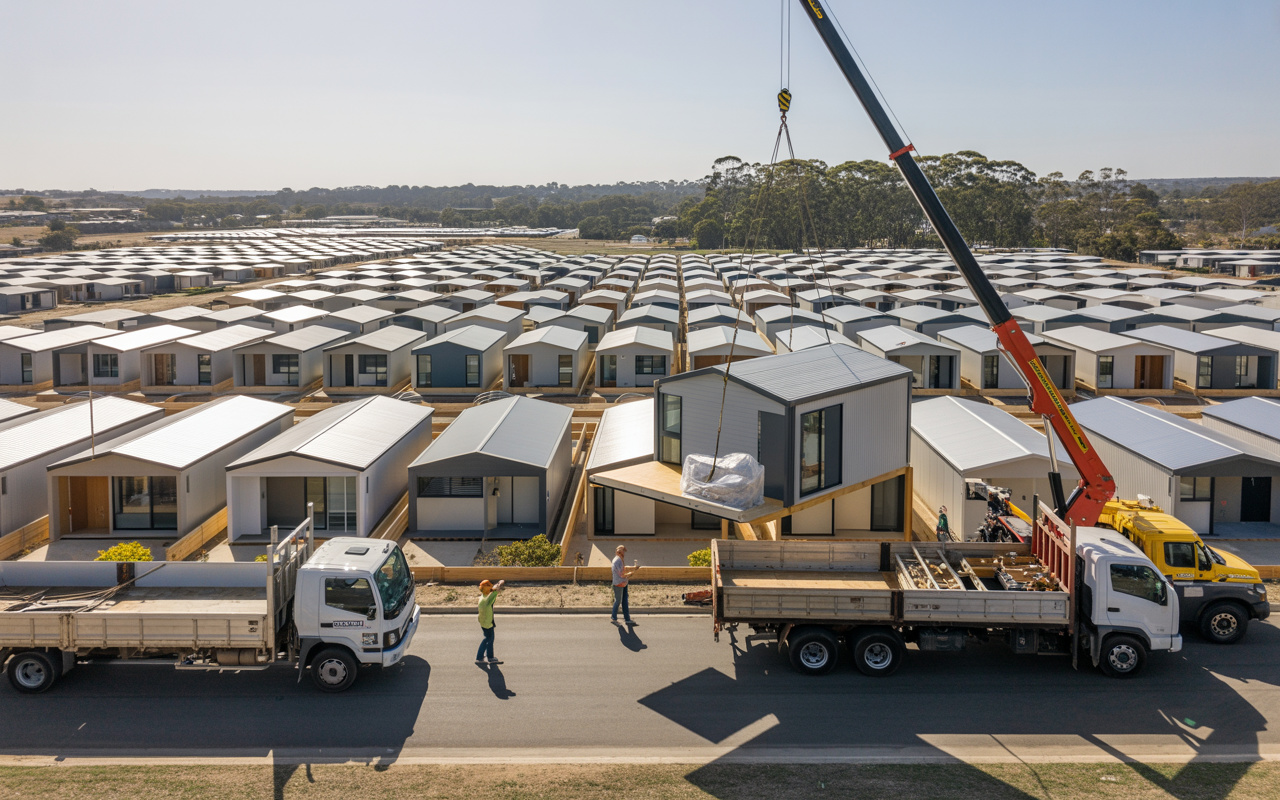


Australia Bets on Modular Homes Delivered by Trucks and Installed in Up to 48 Hours to Reduce Costs, Accelerate Construction, and Address the Housing Crisis with Entire Neighborhoods Standardized in Factories.
In 2023 and 2024, state housing agencies in Australia, such as the Department of Families, Fairness and Housing (Victoria) and the NSW Land and Housing Corporation (New South Wales), announced that modular homes have become part of real housing expansion programs in Melbourne and Sydney. Portals like ABC News, The Guardian Australia, and the official government website of Victoria reported that residential modules are being built in factories, transported by trucks, and assembled in a matter of days, as part of a strategy to reduce costs, increase delivery speed, and circumvent labor bottlenecks in traditional construction. This is not a prototype or a promise: these are homes occupied by families, assembled in complete neighborhoods, and standardized through industrial lines.
Controlled Environment Manufacturing and Reduction of Construction Variables
The central principle is to move construction from the street to inside industrial warehouses. Instead of brick, mortar, and improvisation on-site, assembly lines emerge that standardize structure, plumbing systems, electrical work, thermal insulation, and finishing. In the case of the programs in Melbourne and Western Sydney, the structure is assembled in modules that can include everything from complete environments to independent units that fit into the final terrain.


This model reduces dependence on weather, eliminates unproductive periods due to rain, and allows for quality control similar to that of the automotive industry. While a traditional construction project may take months to reach the stage of plastering and installations, the modular unit is already ready for transportation, with closed walls, installed frames, and some systems functioning.
-
The lack of welders, electricians, and operators becomes a structural threat in 2025, with the construction industry and manufacturing already suffering from delays, cost pressures, and labor shortages in Brazil.
-
Brazil and Paraguay are just 46 meters away from a historic union on the bioceanic bridge that promises to revolutionize trade between the Atlantic and the Pacific.

-
With 55 km over the sea, a cost of US$ 20 billion, and enough steel to build 60 Eiffel Towers, China’s largest project has connected Hong Kong, Zhuhai, and Macau in a colossal bridge that defies the logic of engineering.

-
A trick with joint compound transforms a Styrofoam ceiling into a plaster-like ceiling: leveled panels, wires and mesh at the joints, sand, paint, and change the environment while spending little today.

Logistics: Trucks, Cranes, and Fitting on Site
After they are manufactured, the homes are loaded onto special trucks with escorts, following pre-planned routes to designated neighborhoods. In the deployment areas, the land already has foundations adapted to receive the module, accompanied by urban infrastructure such as energy, water, and paving. Cranes lift the modules and position them, while technical teams make the final connections.
From this point comes the most impressive part: once the lot is ready, the structural assembly can take about 48 hours, transforming what would be a noisy and time-consuming construction site into a quick, almost surgical intervention. This speed is especially important in social housing projects, where delays are not just financial but human.
A Model in Response to the Australian Housing Crisis
According to data from the Australian Bureau of Statistics and state housing reports published between 2022 and 2024, Australia is facing one of the greatest real estate pressures of recent decades, driven by population growth, supply limitations, and rising material costs. In Victoria, the government classified the deficit of social housing as “critical.”
In this scenario, the use of modular homes is not a technological trick but a direct response to the problem: reducing the time between design and delivery. In traditional logic, the construction of a housing unit can take 9 to 18 months, depending on the type and the city. In the modular format, the on-site construction time is reduced to days, and parallel manufacturing allows for the waiting list to be addressed simultaneously rather than sequentially.
Standardization Does Not Mean Architectural Monotony
One common argument against industrialized systems is the risk of creating uniform neighborhoods without visual identity. However, the projects in Melbourne and Sydney adopt variations in façades, frames, and color palettes, creating visual diversity even in sets of dozens of units similar in structure. The modular standard also facilitates future renovations, panel replacements, and accessibility adaptations.
In terms of efficiency, the fact that the entire structure is designed in a digital environment makes planning more precise, including for thermal and acoustic issues, which are important in a country exposed to extreme weather and increasing urban noise.
Labor and Industrial Impact
Another strategic side effect is the industrialization of the labor force. Modular construction requires specialized technicians, machine operators, production engineers, and logistics, reducing dependence on artisanal trades and exposing the sector to the same productive leap that manufacturing experienced in the 20th century. This also reduces the margin for errors, rework, and hidden costs.

The model also allows the same factory to supply multiple cities, increasing scale and lowering unit cost. It is a cultural shift: switching from the logic of “construction” to the logic of “product.”
Entire Neighborhoods Coming Out of the Factory
It is important to emphasize that this is not just about isolated houses. Some entire lots in Western Sydney are receiving complete sets with streets, lighting, and landscaping, forming structured neighborhoods that integrate into the existing urban fabric. The advantage is that while the neighborhood is prepared on the ground, the houses are being born in the factory, and both processes run in parallel.
This contrasts sharply with the traditional method, where each stage only begins when the previous one is completed, creating waits and bottlenecks.
What Australia Is Testing for the Future
By observing the programs in Melbourne and New South Wales, it becomes clear that a national experiment is underway: transforming construction into advanced manufacturing. This can not only reduce the housing deficit but also reposition Australia as an exporter of construction technology, as European and Asian countries are monitoring the progress of this industry.
In a global scenario where major cities suffer from housing accessibility, urban logistics, and lack of land, the Australian solution is not exotic but pragmatic. Modular homes delivered by trucks, installed in 48 hours, and standardized in factories are ultimately an attempt to do with housing what containers did for trade: standardize to gain scale.









Uma solução inteligente, melhor do que conviver em favelas.