





 English
  Francês
  Alemão
  Italiano
  Japonês
  Norueguês
  Portuguese
  Spanish
  4 min of reading
  0 comments


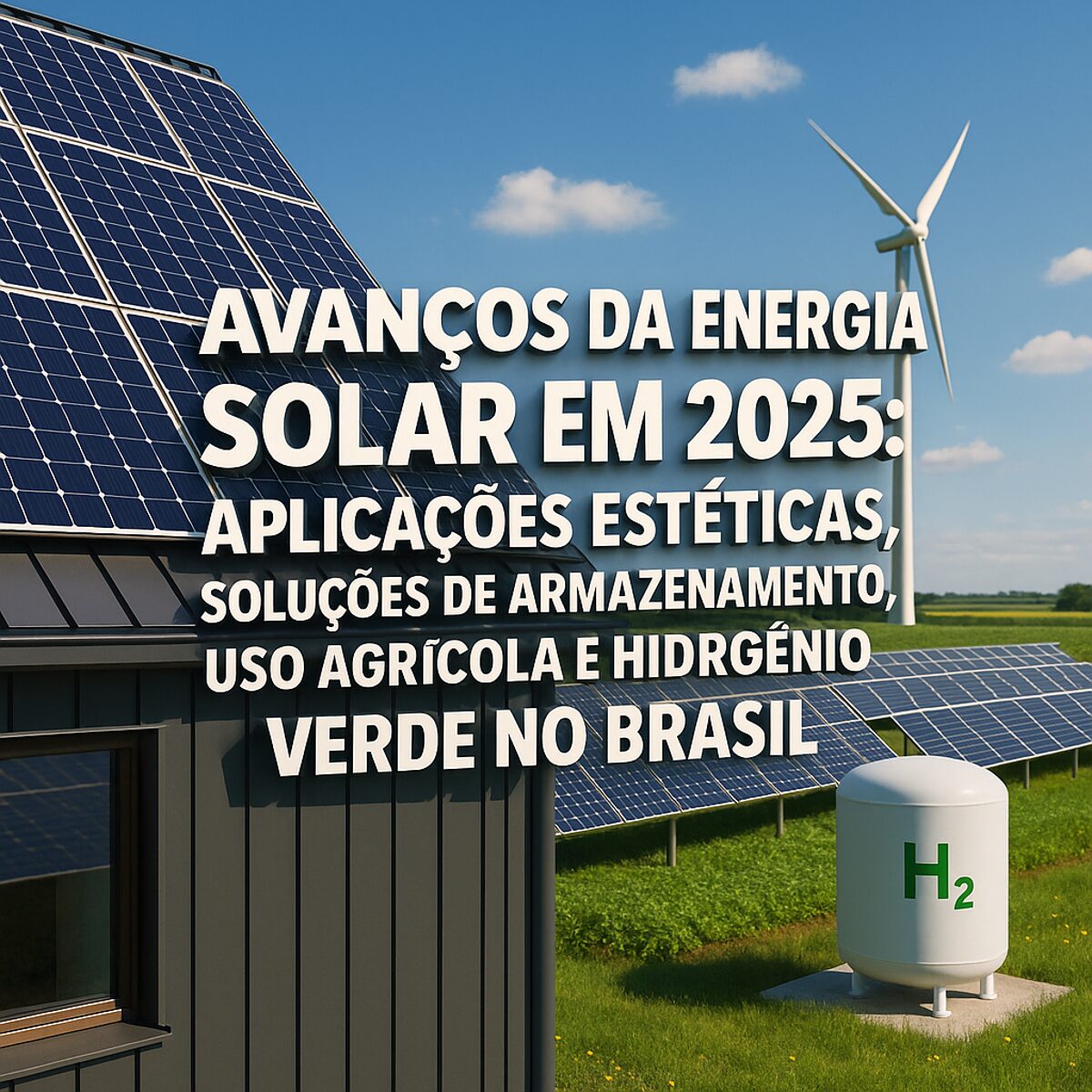
General Overview of Solar Energy in 2025 in Brazil
In 2025, solar energy remains one of the most dynamic renewable sources in the country. According to the Brazilian Association of Photovoltaic Solar Energy (ABSOLAR), the sector has maintained continuous growth since 2023. Among the main highlights are solar panels with innovative visual applications; furthermore, highly efficient domestic and commercial storage systems are emerging. The advancement of the agrivoltaic model is also noteworthy, as it integrates agricultural production and solar energy in an intelligent, productive, and sustainable way. Finally, the first steps towards consolidating the production of green hydrogen from solar sources are also gaining momentum in this promising scenario. Regulatory debates, private sector investments, and public actions accompany these developments and reinforce the importance of solar energy in the Brazilian electric matrix.
Solar Panels with Architectural Design Gain Space in the Market
Urban architects began to incorporate, starting in the second half of 2023, solar panels with differentiated coloring into their projects. Inspired by the optical structure of the Morpho butterfly, these modules allow for aesthetic variations without affecting electrical performance. Manufacturer DAH Solar and the national integrator CorSolar formed a partnership in November 2023 to market this technology in Brazil. Designers have primarily used these modules in facades, brises, and building roofs, which offers more possibilities for aesthetic customization in photovoltaic generation projects.
Solar Energy Storage Starts to Include Consumers in the Management Model
Since the beginning of 2024, the concept of bidirectional storage has begun to be debated at events organized by ABSOLAR and the Ministry of Mines and Energy. These systems allow consumers to store solar energy generated during the day and use it at night or during peak hours. In some pilot projects, the possibility of reselling surplus energy in the regulated market is under discussion. Although commercialization by end-users depends on regulatory advancements, there are expectations for progress, as indicated by the National Electric Energy Agency (ANEEL), which has been discussing the topic since March 2024. Additionally, technologies such as solid-state batteries and flow cells have been highlighted by Diário do Nordeste in April 2024 as safer and more efficient alternatives than lithium-ion systems.
-
Renewable energy advances over protected areas in Brazil, and a survey by the Energy Transition Observatory reveals silent impacts that challenge environmental conservation and pressure sensitive traditional territories.

-
Rio Grande do Sul accelerates energy transition: State invests in renewable technologies and consolidates decarbonization strategies and pathways to attract billions in new industrial investments.

-
With 160,000 m² of collectors, an area larger than 20 football fields, Silkeborg, in Denmark, hosts a solar thermal plant that heats 19,500 homes and could become the largest solar heating plant in the world.

-
A study reveals the expansion of renewable energy procurement in Brazil and shows how companies are taking advantage of opportunities to reduce expenses, ensure energy efficiency, and strengthen strategic environmental commitments.

Agrivoltaic Advances in Rural Properties with Technical Support and Gradual Integration
The agrivoltaic model, which allows for the simultaneous use of land for agricultural cultivation and solar energy generation, began to gain greater adoption in Brazil starting in 2024. During the Brazilian Solar Energy Congress, held in May 2024, experts pointed out that the technology is viable, especially in small and medium-sized properties seeking income diversification. Projects implemented in the South and Southeast show increased productivity and reduced energy costs, especially in vegetable and grain crops. The National Institute of Clean Energy, in an interview with Diário do Nordeste, stated that the expectation is for agrivoltaic to represent around 10% of rural solar generation by the end of 2025.
Green Hydrogen Production Advances with Studies and Pilot Projects
Since 2023, the National Hydrogen Program, coordinated by the Ministry of Mines and Energy, has been promoting studies on the production of green hydrogen from renewable sources. According to a report published in August 2024, more than 30 projects are in the planning phase. Electrolysis with solar energy has been considered one of the most viable routes for producing the fuel. Companies such as Unigel, Neoenergia, and Eneva announced initiatives in the second half of 2024, in line with the program’s guidelines. Although large-scale commercial production still requires investments and regulatory stability, the institutional expectation is for gradual progress by 2030, without unrealistic forecasts.
Consolidated Numbers of the Solar Sector in Brazil in 2024
In December 2024, ABSOLAR published consolidated data for the photovoltaic solar sector. Brazil ended the year with 52.2 gigawatts (GW) of installed operational capacity, an increase of 14.3 GW throughout the year. About 72% of this total comes from distributed generation, predominantly in residential and commercial systems. The recorded investment volume was R$ 54.9 billion, representing a 30% increase compared to 2023, according to data from the National Bank for Economic and Social Development (BNDES). This data places Brazil among the five countries with the highest installed capacity in the solar segment, behind China, the United States, India, and Japan.
Realistic Perspectives for the Sector Until 2030
In January 2025, ABSOLAR launched its strategic plan for the horizon of 2030. The forecast is that solar energy will represent up to 20% of the Brazilian electric matrix, considering regulatory advancements, institutional support, and the introduction of new technologies. The plan also considers the evolution of electric mobility, the expansion of hybrid projects, and the participation of end consumers in managing their own energy. It is not a promise of instant transformation but a projection based on already announced investments, international trends, and technical feasibility. Therefore, Brazil continues on a consistent trajectory, aligning growth with regulatory, technical, and environmental responsibility.







Seja o primeiro a reagir!