





 Portuguese
  English
  Spanish
  5 min of reading
  0 comments


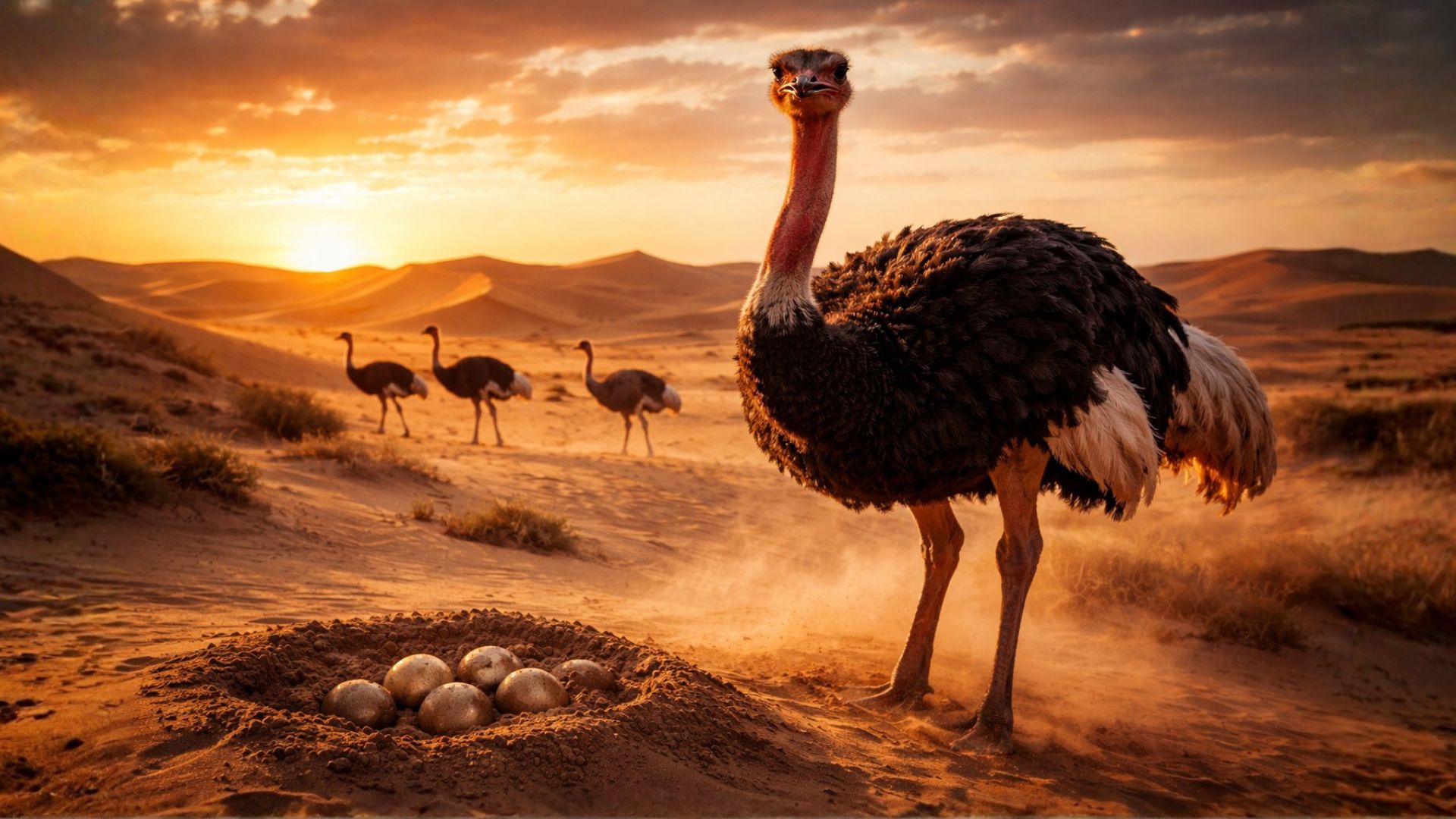
Rare Return to the Tunisian Sahara Reignites One of the Region’s Most Symbolic Conservation Projects, with Release in Protected Area, Field Monitoring, and Quick Signs of Adaptation to the Desert Environment, Including Records of Nests and Eggs Indicating Real Permanence.
A group of North African ostriches, one of the rarest forms of the world’s largest bird, has returned to roam an arid landscape in southern Tunisia after more than a century without records in the country.
The reintroduction took place in a protected area in the desert, and signs of adaptation appeared rapidly: within a few months, nests and eggs were observed in the environment where the species had disappeared, according to a technical conservation report released by Marwell Wildlife.
The episode drew attention for bringing together three uncommon elements in the same project: the return of a species historically associated with the Sahara, the release in a national park with extreme climate, and the documentation of initial results by field monitoring teams.
-
He started running at 66 years old, broke records at 82, and is now a subject of study for having a metabolic age comparable to that of a 20-year-old, in a case that is intriguing scientists and inspiring the world.

-
Oldest tree on the planet reappears after 130 years of searches: Wattieza, 385 million years old, was 10 meters tall and had no leaves or seeds; Gilboa fossils in New York solved the mystery in 2007.

-
A 48-square-meter house assembled in hours with 4,000 bricks made of recycled plastic that does not absorb moisture, has natural thermal insulation, and costs less than 90,000 reais in a complete kit.

-
Luciano Hang revealed that Havan’s air fleet has already accumulated more than 20,000 landings, 10,000 flight hours, and 6 million kilometers traveled, and he says that without the planes, the company would never have grown so quickly.


The return was seen as a step in a broader program to restore Sahelo-Saharan fauna and habitats in the country, involving management, veterinary monitoring, and the establishment of a founding population.
North African Ostrich and Adaptation to the Desert


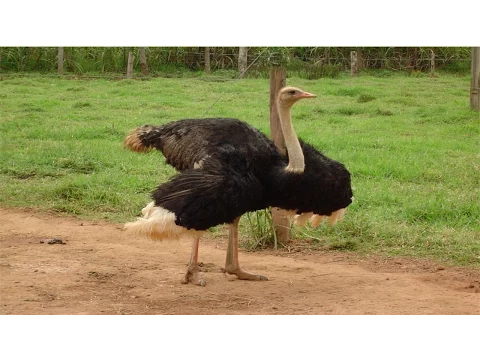
The ostrich in question is known as the North African ostrich, also described in conservation initiatives as “red-necked ostrich,” a reference to the reddish coloration of the skin in parts of the body.
It is a large terrestrial bird, adapted to open and warm environments, capable of covering long distances and exploring areas with low resource availability.
The report highlights that, despite the ostrich as a species being widely distributed in other regions, there was no consolidated specific assessment for this North African form, associated with a history of significant reduction in distribution.
Why the Species Disappeared in Tunisia
In Tunisia, the presence of the ostrich in the southern part of the country is regarded as part of the natural past of the territory.
Conservation documents state that the bird was abundant in the region but disappeared after intense exploitation, with the last local record indicated in the late 19th century.
The loss was historically attributed to human pressure on fauna, which included the capture and persecution of large animals in open and easily accessible areas.
Founding Population and Management Before Release
The strategy adopted to try to reverse this disappearance did not rely on “introducing” an animal from another region but on forming a set of birds compatible with the goal of reestablishing the presence of the North African form in the country.
The report describes that a founding population was built with birds coming from different management origins, including specimens associated with a nucleus established in Souss Massa National Park in Morocco and animals linked to a wildlife research center in Saudi Arabia.
The combination had an explicit goal: to support a repopulation with greater diversity and viability.
Before the release in an open environment, the work included breeding and management in enclosures, training local teams, and close monitoring of group behavior.
The logic behind this type of project is to reduce initial risks, ensure that the birds can form socially stable groups, feed, and respond to threats.
The technical report describes the work of professionals linked to Marwell Wildlife in the field, including a conservation biologist and veterinarian responsible for monitoring groups at different points in the program.
Dghoumes National Park and the First Signs of Reproduction
It was in this context that the most symbolic stage of the plan occurred: the release of ostriches in Dghoumes National Park, a conservation unit in southern Tunisia.
The report records that nine birds were released from the management enclosure to the broader area of the park, marking the first step of a large-scale reintroduction.
The timeline is relevant for understanding what came next, but the central aspect of the case lies in what was observed afterward, when the presence of the birds began to produce concrete evidence of permanence.
According to the document, still in the same year of the release, two nests and several eggs were recorded in Dghoumes.
In reintroduction projects, this type of evidence is important because it goes beyond displacement or immediate survival: it indicates reproductive behavior in the environment and suggests that the birds began to use the territory as a living area.
The report also mentions that the park and the local team intervened in specific situations involving chicks during extreme weather events, such as floods that affected areas of the park and required emergency management.
Network of Protected Areas in Southern Tunisia
The effort, however, was not limited to a single location.
The proposal described in the report pointed to a network of protected areas in southern Tunisia, aimed at supporting the species’ presence at more than one point in the territory and reducing the vulnerability of a small population.
In addition to Dghoumes, there is reference to actions related to Sidi Toui National Park and Orbata Wildlife Reserve, which would serve as additional cores for management, reproduction, and preparation for new releases.
Institutions Involved and Field Monitoring
Another highlighted point is the role of the Tunisian institutions involved.
The report cites the Direction Générale des Forêts as the statutory authority responsible for wildlife and protected areas in the country, in addition to other governmental structures linked to regional agricultural development and veterinary services.
This coordination appears as part of the project design, which depends both on wildlife management and local capacity to monitor and respond to field problems.
Conservation in the Sahara and the Challenge of Returning Large Species
At the same time, the document places the Tunisian initiative within a larger conservation landscape in the Sahara and neighboring regions, mentioning reintroduction experiences in other countries and the use of different founding populations in previous projects.
The approach reinforces a recurring point in the conservation of large species in arid areas: when fauna disappears, the return does not happen spontaneously, and reintroduction requires logistics, planning, and continuous monitoring.
The case of Dghoumes gained prominence precisely because it brought together a strong and verifiable narrative: a species absent for more than a century, release in a desert landscape, and the observation of nests and eggs in a short time, recorded in a technical report.
In a scenario where many conservation actions are invisible to the public, the sequence of events offers a tangible indicator that the reintroduction has moved from paper to translating into biological signs on the ground.
If such a large animal with demanding territory can return to reproduce in a protected desert area, what other Sahara species could have their return measured by unmistakable signs like nests and eggs?








-

-

-

5 pessoas reagiram a isso.