






 Portuguese
  Spanish


The 18-thousand-ton mansion was lifted, separated from the original foundation, and moved in Baku on steel and concrete tracks, in an operation carried out between April 23 and 27, 2013, to make room for road expansion and preserve the historical structure built in 1908 in eastern Azerbaijan.
An 18-thousand-ton mansion was moved without its masonry walls being dismantled or demolished in the Nizami district of Baku, the capital of Azerbaijan. The operation transferred the historic building approximately 10.5 meters to make space for the expansion of an urban road.
The Guinness World Records notes that the move took place between April 23 and 27, 2013, and recognizes the property at 39 Fizuli Street as the heaviest structure ever moved intact. Azernews reported on May 2 of that year that the work was completed in four days, with about 40 effective hours of movement.
Mansion was built in Baku in 1908

The mansion was built in 1908 by oil businessman Isa Bey Hajinski. Built in stone masonry, the property measures approximately 52 meters in length, 20 meters in height, and extends about 35 meters from the street.
-
Goodbye, masonry: a trend gaining strength in Brazil transforms construction sites with steel frame, walls that arrive ready-made from the factory, deadlines up to 50% shorter, reduced debris, and a concept inspired by the industrialized construction of the United States, Canada, and Australia.

-
Asian country uses 10 million sandstone blocks to build the world’s largest religious temple, a project that took 37 years, mobilized 300,000 workers and 6,000 elephants, and transformed the Cambodian jungle into a global tourism hotspot.
-
Sustainable engineering unveils a plant-based brick made with flax fibers that improves thermal insulation of homes, enhances energy efficiency, and offers an innovative alternative for more comfortable and environmentally responsible constructions.

-
One hundred trucks per day will enter and exit the new distribution center that Casas Bahia has just opened, a 16,000 square meter structure with 120 workers, created to keep stock closer to the customer and speed up deliveries in São Paulo.


The construction is also mentioned in local sources as the house of the Hajinski brothers. Its architectural and historical value was one of the reasons presented for choosing the complete relocation instead of demolition, even in light of the need to expand the avenue.
Road expansion required freeing part of the land
The movement had two stated objectives: to preserve the historic building and to make room for the widening of the road. Trend reported before the operation that the structure would be raised a few millimeters during the preparatory process.
No details were provided about the width added to the avenue or the complete road project. The confirmed fact is that the mansion encroached on the area needed for the intervention and was set back without losing its architectural configuration.
New supports were inserted in the basement
Before starting the relocation, the teams installed new structural elements on the basement walls. These supports were designed to bear the weight of the building when it ceased to rely on the original foundation.
The preparation was considered the most difficult part of the operation, because it required precise calculations to distribute thousands of tons without causing deformations, cracks, or collapse during the transfer to the temporary system.
Tracks combined steel and concrete


Under the new supports, the team constructed a set of steel and concrete tracks. This base formed the rigid path used to guide the mansion to its new position.
Once the system was ready, the connection with the original foundation was carefully removed. The weight then transferred to the supports and tracks, allowing the structure to be moved as a single block.
Hydraulic jacks pushed the building
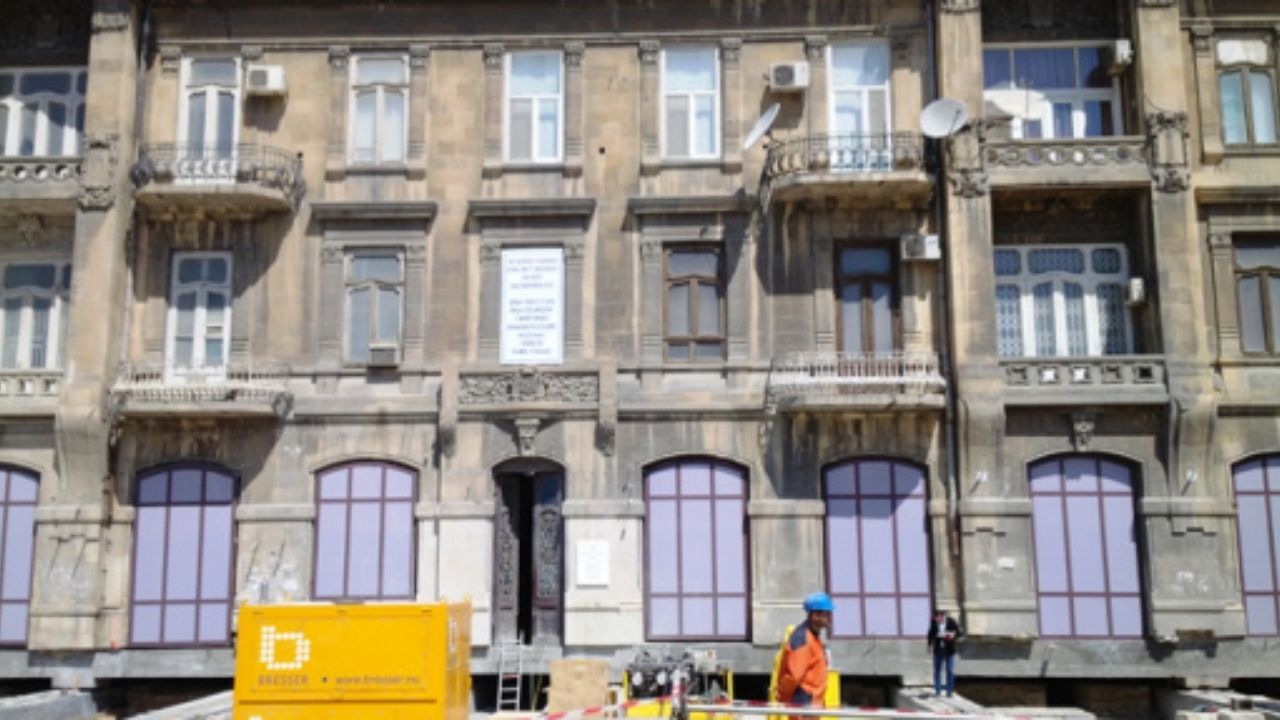
According to the Guinness World Records, nine hydraulic jacks were used to slowly push the mansion back in relation to the previous street alignment. The speed needed to be controlled to maintain uniform movement.
Additional sources report that the preparation involved raising the structure by a few millimeters, but do not confirm the use of 210 hydraulic jacks. Therefore, this number cannot be treated as an established fact based solely on the provided documentation.
Displacement reached approximately 10.5 meters

Guinness records a distance of 10.5 meters, while Azernews published 10.6 meters. The small difference may result from rounding or different measurement criteria used by the sources.
The movement began on April 23 and ended on April 27, 2013. Leon Sweegers, then executive director of Bresser Eurasia BV, stated that the work was completed in four days, one less than the initial forecast.
More than 100 professionals participated in the operation
Azernews reported that more than 100 people worked on the project. The movement was carried out by the Dutch company Bresser, in partnership with local contractors and specialists.
Bresser already had about 30 years of experience in building transfers and had participated in approximately 35 previous operations. Even so, the mansion in Baku was presented as the largest structure ever moved by the company.
New foundation received the historic building
After the displacement, the mansion needed to be installed on a new foundation. Herman Bresser, founder of the company, stated that about two additional weeks would be needed to complete this stage.
The new base was described as more solid than the previous one. The local report also informed that the calculations considered the building’s resistance to an earthquake of magnitude eight during and after the movement.
Residents would return after completion
The then mayor of Baku, Hajibala Abutalibov, declared that residents could return to the apartments a few weeks later. The source does not inform how many families occupied the building nor how the temporary removal occurred.
This detail shows that the construction was not just a monument without use. The project needed to reconcile architectural preservation, structural safety, urban planning, and future reoccupation of the property.
Operation was accompanied by time-lapse images
The process was recorded on video and presented through time-lapse images. The documentation allowed for tracking the gradual movement of a structure that, when observed without visual reference, seemed to remain stationary.
Azernews stated that the broadcast could be seen in different parts of the world. The recording also helped demonstrate that the building was transferred whole, without dismantling walls or demolishing the main part.
Guinness recognized the record weight
The Guinness World Records recognized the mansion as the heaviest building moved intact. The official weight reported is 18,000 metric tons, equivalent to approximately 19,840 short tons in the American system.
The record was not based solely on the distance traveled. The central element was moving a historical construction of this weight without dismantling it, preserving its form and transferring it to a new foundation.
Engineering avoided choice between avenue and demolition
The operation created a third alternative between keeping the mansion exactly in the same spot and destroying it to clear the way. The building was moved back, while its main architecture remained preserved.
In your opinion, should cities invest in complex operations to move historical buildings when new avenues and urban projects require space? Share in the comments if preserving heritage justifies the cost and challenge of relocating an entire building.


