





 Portuguese
  English
  Spanish
  5 min of reading
  0 comments


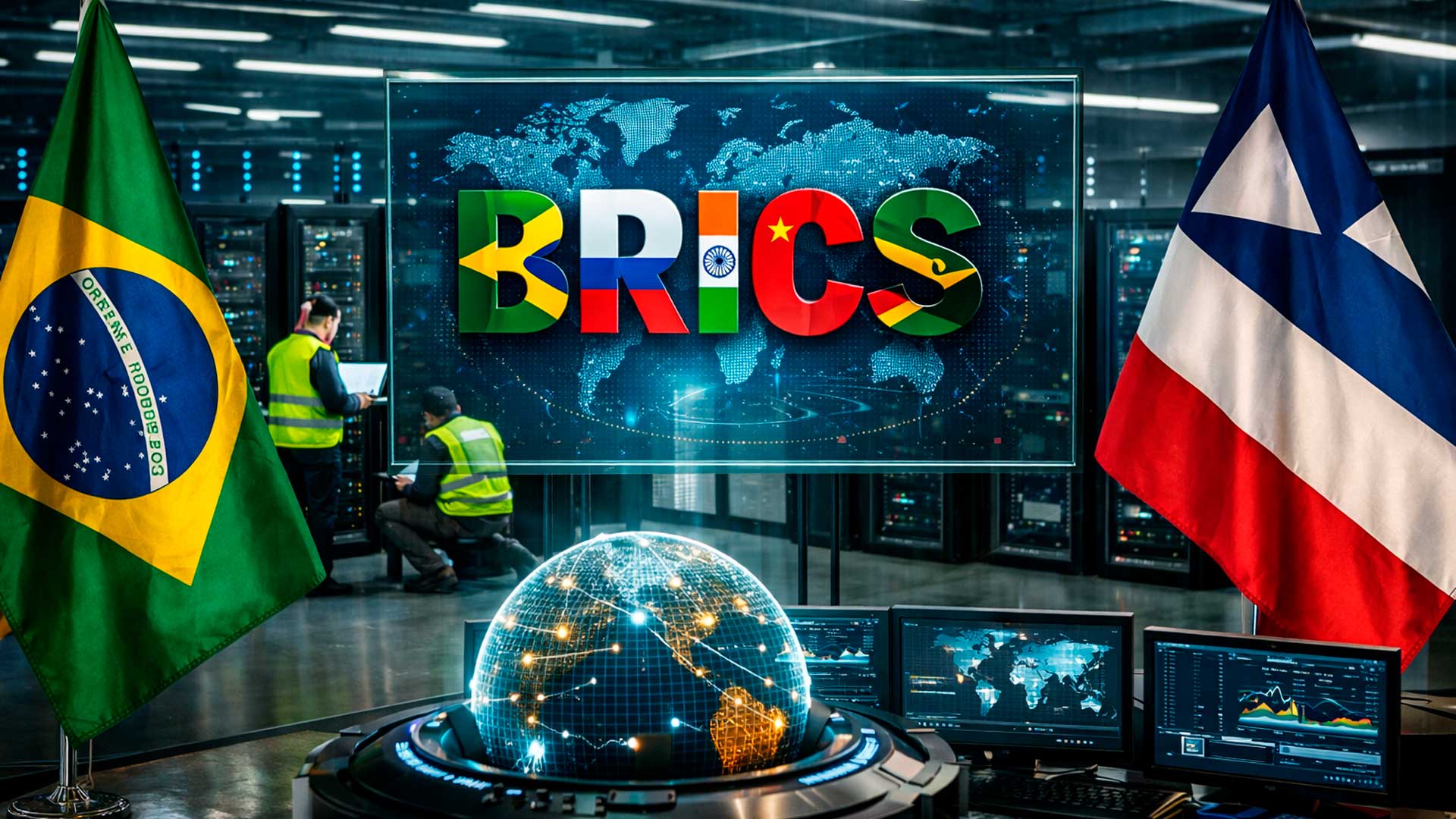
Initial project places Brazil at the center of a strategic dispute over digital infrastructure, data sovereignty, and technological capability
BRICS has begun to articulate the creation of a sovereign datacenter in Brazil, in a move that could change the country’s role in the global digital economy. The initiative is in its early stages but already shows a clear objective of reducing dependence on foreign servers and large international platforms.
The project is led by GoBRICS, an organization recently established in New Delhi, India, in partnership with ESDS Software Solution Ltd. and with the support of the Bahia government. The proposal gained visibility on April 5, 2026, when the first public details began to circulate.
In practice, the idea is to build a national base for data storage and processing for cloud services, artificial intelligence applications, government platforms, fintechs, and digital commerce. If it progresses, the project could position Brazil not only as a consumer of technology but as part of the critical infrastructure of the Global South.
-
NASA engineer creates project for a “nearly theoretically viable” engine capable of reaching 99.99% of the speed of light, but this problem must be solved first.

-
Giant and invisible structure that has been around for decades emerges near the Solar System and could change what astronomy knows about the birth of stars.

-
Research gives new weight to the quipu and suggests that the Inca Empire developed an advanced method for organizing and processing data, with a structure of knots and strings that now brings the artifact closer to logics used in computing.

-
Scientists use artificial intelligence to create nearly indestructible steel that does not rust and could change the way industrial energy and oil parts are produced.

The topic gained extra weight because the race for datacenters has ceased to be just an agenda of the technology sector. Today, this type of structure is treated as a strategic asset, on par with energy, logistics, and payment systems.
GoBRICS, ESDS, and the Bahia government lay the foundation for a partnership that still depends on definitions regarding investment and timeline
The articulation involves three main fronts. On one side is GoBRICS, created to stimulate international collaborations within the bloc; on the other, ESDS, a technology company that works on building digital infrastructure; and, at the local level, the institutional support of the Bahia government.
Despite the political and business advancements, the project has not yet disclosed investment amounts or a finalized implementation timeline. The next announcements are expected in the coming months as technical structuring and institutional alignments progress.
The CEO of GoBRICS, Colonel Pawan Josh, summarized the focus of the proposal by stating that the initiative aims to develop digital sovereignty for the future. In the group’s view, Brazil, and especially Bahia, has the potential to become a strategic portal within the BRICS ecosystem.
According to ESDS, the CMD & Chairman Piyush Somani reinforced the vision that sovereign digital infrastructure is the foundation of a nation’s technological future. Meanwhile, director Amit Sisodia highlighted that collaboration in Brazil could create a long-term foundation for innovation and national growth.
Bahia emerges as a strategic choice for logistics, energy, and geographical position to become the digital gateway to Latin America
The choice of Bahia was not treated as casual. The state has logistical, energy, and geographical conditions that position it as a strong candidate for a regional digital hub, especially for cloud operations, data processing, and advanced AI solutions.
Previous plans by Indian companies had already pointed to the state as a possible gateway for digital infrastructure in Latin America. This helps explain why the current articulation targets Bahia as the focal point of cooperation between Brazil and India.
There is also a practical component to this decision. Datacenters require reliable access to energy, robust connectivity, strategic location, and expansion capacity, factors that directly impact the competitiveness of the venture.
The ambassador of GoBRICS in Brazil, Leonardo Attuch, stated that the country is on the brink of a new digital era. For him, the articulation reflects an attempt to develop independent technological capabilities at a time of reorganization of global economic power.
Sovereign datacenter can reduce external dependence in public services, financial system, and artificial intelligence applications
A sovereign datacenter functions as an in-house infrastructure to store, process, and protect sensitive data within the country. This directly affects areas such as public services, the financial system, government platforms, digital defense, and artificial intelligence tools.
Today, a large part of digital operations depends on structures controlled by large foreign companies. This dependence limits national autonomy over strategic data and exposes governments and businesses to operational, regulatory, and geopolitical risks.
With a national base integrated into BRICS, Brazil would gain more control over critical information and could enhance security in data exchange among emerging economies. The proposal also envisions that the future datacenter will support sovereign cloud and high-scale business solutions.
This movement fits into a global trend. Those who control data infrastructure expand their capacity to develop their own technology, sustain productive chains, and compete in the new digital economy.
Therefore, the discussion goes beyond the physical construction of a data center. What is at stake is the country’s ability to participate more autonomously in technology, AI, and advanced digital services markets.
Global race for digital infrastructure is already pressuring Brazil, and the Chamber approved a regime with a tax waiver estimated at R$ 7 billion
The advancement of the datacenter agenda in Brazil does not happen in a vacuum. The Chamber of Deputies approved a special regime aimed at the sector, with an estimated tax waiver of R$ 7 billion, in an attempt to attract investments and strengthen the country’s digital infrastructure.
This figure helps to gauge the ongoing dispute. Datacenters have come to be seen as central pieces to sustain social networks, financial systems, public platforms, e-commerce, and generative artificial intelligence models.
On the economic front, projects of this magnitude typically attract capital, generate skilled jobs, and stimulate local technology ecosystems. On the strategic front, they enhance the national capacity to develop proprietary solutions and reduce infrastructure bottlenecks.
If the BRICS project comes to fruition, Bahia could gain prominence in a high-value-added chain. And Brazil could consolidate a more relevant position in a sector that currently defines competitiveness, autonomy, and technological power.
Integration among BRICS countries transforms data, energy, and payments into a new axis of geopolitical power
The proposal for the Brazilian datacenter connects to a broader BRICS strategy to seek autonomy in areas considered critical. In this framework, data, energy, and payments form a new tripod of power, with a direct impact on trade, finance, and innovation.
The project also deepens the alignment between Brazil and India in digital economy, infrastructure, and innovation ecosystems. As India will host the annual BRICS summit in 2026, the topic is likely to gain even more political relevance throughout the year.
If the articulation advances, Brazil could take on a more robust role in technological integration among emerging countries. This opens up space for secure data exchange, shared cloud services, and new digital cooperation platforms among the bloc’s members.
The challenge now is to transform strategic intent into a viable project, with clear scale, financing, and governance. The discussion has begun, but the real weight of the initiative will depend on the definitions made in the coming months.
And you, is Brazil lagging in the race for digital sovereignty or is there still time to turn this game around with the support of BRICS and Bahia? Leave your comment and say whether a sovereign datacenter can really reduce dependence on big techs or if the promise is still too far from reality.









Seja o primeiro a reagir!