





 Portuguese
  English
  Spanish
  7 min of reading
  0 comments


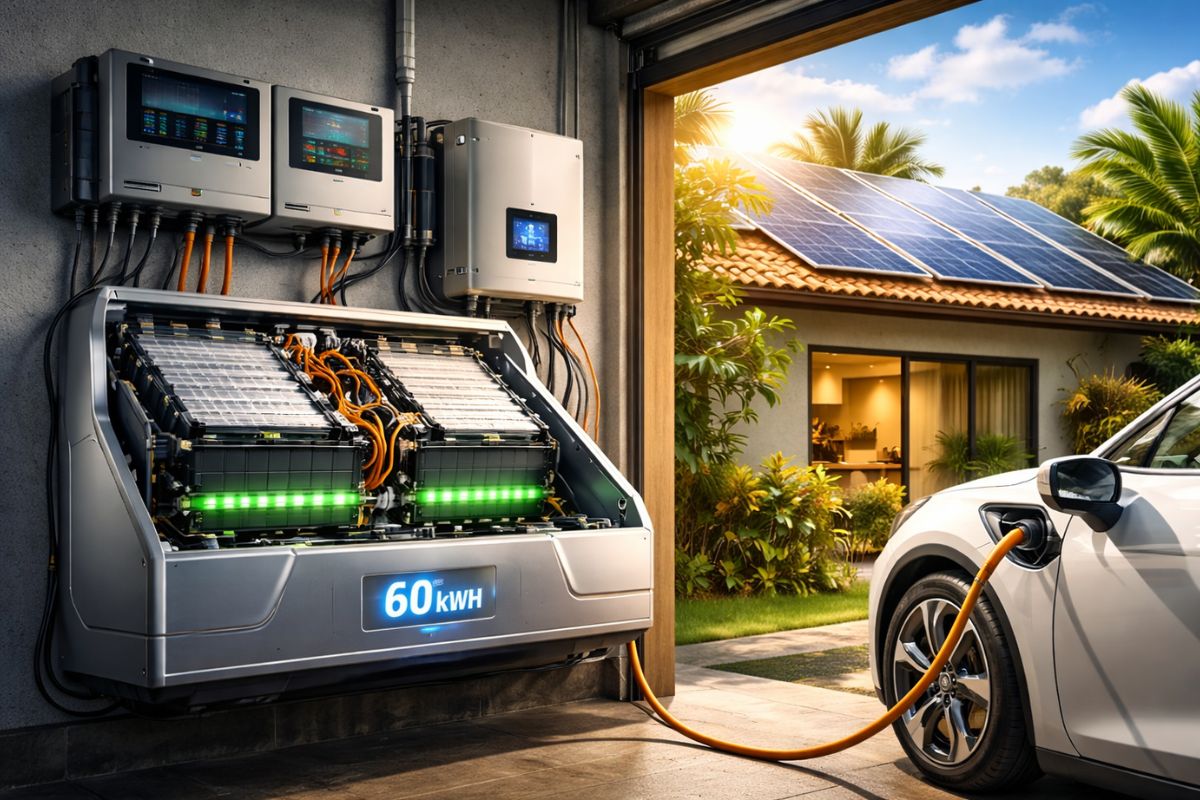
In Ceará, Electric Car Battery Repurposed as Residential Battery Integrates Hybrid Solar System and Off-Grid System, Demonstrating the Potential of Battery Second Life.
In Ceará, a 60 kWh electric car battery taken from a wrecked vehicle became a sort of 440 kg “wall power bank,” integrated into a hybrid solar and off-grid system that practically powers an entire house.
The pilot project, installed in the metropolitan area of Fortaleza, shows how the electric car battery can gain a second life as a residential battery, reducing waste, cutting energy costs, and increasing the home’s autonomy. At the same time, the case makes one essential point clear: it is not a DIY project, it requires specialized engineering, standards that do not yet exist in Brazil, and a lot of care regarding electrical safety.
What Happens to the Electric Car Battery After the End of the Car
The question that opened the project is simple and powerful: what happens to the electric car battery when the car ends? Does it go to waste or can it be repurposed?
-
“No one will make us change the Pix,” says Lula after the US report.

-
Lula responds directly to Trump and says that Pix is from Brazil and will not change under pressure from anyone, after a report from the United States pointed out the Brazilian payment system as an American trade barrier.

-
Amazon has just announced a new fee on all deliveries, and your online purchases will become more expensive starting April 17, including for those buying from the United States here in Brazil.

-
He sold his share for R$ 4 thousand, saw the company become a giant worth R$ 19 trillion, and missed the opportunity of a lifetime.

With the popularization of electric vehicles, many people fear that the electric car battery will become an environmental problem.
It was exactly this concern that led the homeowner to seek a battery second life solution.
He began to search for batteries in junkyards and in ads for wrecked cars, until he found an entire unit available for purchase.
The first experience was with a battery of approximately 45 kWh, removed from a wrecked car. Later, the project evolved to the current battery, of 60 kWh, also from a wrecked vehicle, purchased for R$ 19 thousand.
The idea has always been to prove that the electric car battery does not need to go to waste. It can become a residential battery, functioning as a UPS or energy bank for the home.
From Junkyard to Residential Battery in Hybrid Solar System

Instead of buying a traditional battery bank for solar energy, the owner decided to use an electric car battery as the core of a hybrid solar system.
He compared costs. An equivalent battery, purchased as a ready-made storage solution for a photovoltaic system, could cost between R$ 90 thousand and R$ 120 thousand, depending on the project.
The repurposed electric car battery, on the other hand, cost R$ 19 thousand, representing a significant reduction in the cost of energy storage.
This residential battery receives energy from a solar power plant installed on the roof, with 36 photovoltaic modules.
During the day, the panels generate energy for the house. The excess generation goes to the electric car battery, which is charged while the sun is strong.
With the battery charged, during the night it powers the residence. Under normal conditions, the 60 kWh electric car battery can keep the house running all night, even with air conditioning units, as long as consumption is managed.
In the event of a power outage from the utility, the system allows reducing the use of some equipment and prolonging autonomy until the sun returns to recharge everything the next day.
In practice, the system operates as a partial off-grid system. The homeowner can, at many times, live almost independently of the grid, combining a hybrid solar system, second-life residential battery, and the utility grid only as backup.
How the Electric Car Battery Powers an Entire House

Learn more in the VE Channel video or by clicking here.
At the center of the project is a high-capacity three-phase inverter, described by the owner as the brain of the entire system. It manages the energy coming from the solar panels, the electric car battery, and the utility grid.
The basic operation is as follows:
- during the day, the 36 solar panels power the house and, when there is excess, the hybrid solar system directs part of that energy to charge the battery
- when the battery is fully charged and the home consumption is low, the excess goes back to the grid, generating credits with the utility
- at night, when there is no solar generation, the electric car battery kicks in, powering the house through the inverter
- when the battery charge reaches about 50 percent, for safety, the system starts consuming from the utility to preserve a reserve in case of a power outage
The house has about 14 air conditioning units, distributed across VRV central systems, as well as other typical equipment of a high-consumption residence.
Even so, the electric car battery supports nighttime operation, as long as usage is managed with care.
An interesting point is that, despite all this infrastructure, the house’s electric vehicle chargers are not connected to the battery. They are powered directly by the utility grid, for an energy logic issue.
It would not make sense to charge 60 kWh in the residential battery only to use that same energy to charge a vehicle with a much larger battery.
Engineering, Protections, and Risks: Why It Is Not DIY
The channel that presented the project makes an explicit alert: it does not recommend that anyone simply copy this installation at home.
The system works with approximately 440 V in direct current and 380 V in alternating current, in a three-phase arrangement.
This level of voltage and power is more than sufficient to kill a person if there is a design or installation error.
Therefore, the project incorporates a series of mandatory and additional protections:
- breakers sized for the system
- surge protection devices
- RCDs for shock protection
- phase sequencer and protection against phase loss, as the whole system is three-phase
In addition, the electric car battery has its own internal brain, the BMS, which controls the charge and discharge of the cells, monitors temperature, and ensures everything stays within safety limits.
The inverter and the BMS communicate all the time, adjusting the operation to preserve the durability and integrity of the residential battery.
The channel emphasizes that such a connection cannot be made by someone without technical knowledge of electrical systems and high-voltage systems. According to the content itself, there are still no specific regulations in Brazil that detail this type of repurposing of electric car batteries as residential batteries.
To address the issue seriously, those responsible for the video claim to have sought input from the battery manufacturer, normalization entities such as ABNT, and manufacturers of the equipment used in the installation. However, by the time the content was finalized, there had been no official response from these brands and institutions.
For this reason, the project is presented as a real, experimental case, not as a step-by-step guide for the public to replicate at home.
Cost Savings, Returns, and Battery Second Life in Daily Life
Even being a pilot project, with some parts more expensive than standard, the owner estimates a total investment of about R$ 100 thousand for the entire installation, adding the electric car battery, inverter, solar power plant, and protections.
At first glance, the amount is shocking. But the context of the house makes a difference. The owner has four electric cars and uses all of them frequently.
The comparison is direct with the fuel that would be spent if they were combustion vehicles. According to him, the solar power plant paid for itself in about five months just by comparing the refueling costs of the cars with energy instead of gasoline.
In the last year, the declared savings in gasoline reached about R$ 150 thousand, resulting from the intense use of the four electric vehicles combined with the solar system and the repurposed electric car battery as a residential battery.
From an environmental standpoint, the project is also a practical example of battery second life. Instead of discarding a wrecked car battery, the system transforms it into fixed storage, extending the useful life of the component and reducing the volume of waste generated before the cell end of life.
At the same time, the channel itself reinforces that battery second life is still not a ready solution for the general public in Brazil.
Lack of regulations, lack of standards, lack of clear safety protocols. The message is clear: it is a promising idea, but still in an embryonic phase.
Trend or Underestimated Risk?
The Ceará case shows that the electric car battery can indeed become a residential battery, integrated into a hybrid solar system and even as part of a partial off-grid arrangement, with real savings and autonomy gains.
But it also shows that this depends on serious engineering, adequate protection, and respect for technical limits, not improvisation.
As long as there are no clear regulations and standardized procedures, each installation of this type will remain a custom project that requires experience and responsibility.
Do you think that the second life of the electric car battery as a residential battery in a hybrid solar system and off-grid system will become a trend in Brazil, or is there still a lack of many safety regulations for it to become something common in homes?








-

3 pessoas reagiram a isso.