





 Portuguese
  English
  Spanish
  5 min of reading
  0 comments



Images of a Child Smoking Dozens of Cigarettes Daily Shocked the World, Revealed Loopholes in Tobacco Regulation, and Led Indonesian Authorities to Intervene. The Episode Gained International Repercussion, Sparked Debates on Public Health, and Became a Symbol of the Risks of Early Addiction in Childhood.
Images of a two-year-old boy smoking, with reports of consumption of up to 40 cigarettes a day, circulated globally in 2010 and put Indonesia at the center of a global debate on child smoking, access to tobacco products, and regulation.
The case, attributed to Ardi Rizal, gained international attention after videos went viral and sparked outrage, pushing authorities to offer specialized support to stop the addiction.
The sequence of recordings exposed, at the same time, the fragility of barriers to prevent children from coming into contact with cigarettes in everyday environments and the normalization of smoking in part of Indonesian society, where the product was widely available.
-
How an innovative city combines high technology, well-being, and sustainability to become the largest reference in clean energy on the planet.

-
Couple buys 1846 church in ruins for R$ 660,000, invests R$ 3.2 million in renovations, transforms it into a millionaire mansion, and even preserved a historic cemetery with over 300 graves.

-
He started running at 66 years old, broke records at 82, and is now a subject of study for having a metabolic age comparable to that of a 20-year-old, in a case that is intriguing scientists and inspiring the world.

-
Oldest tree on the planet reappears after 130 years of searches: Wattieza, 385 million years old, was 10 meters tall and had no leaves or seeds; Gilboa fossils in New York solved the mystery in 2007.


At the time, the story also reached the Brazilian public through television reports that closely followed the family’s routine and the impact of addiction on a baby.
International Repercussion and the Impact of the Images
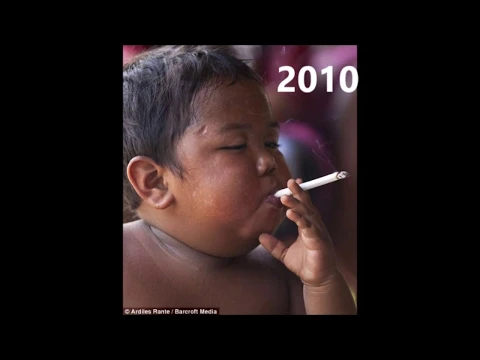

The case became known outside Indonesia when videos and photographs circulated on the internet and were reproduced by broadcasters and newspapers in various countries.
The outrage was amplified by the contrast between the child’s age and the way smoking was integrated into the routine, without the immediate reaction of interruption from the adults around.
In Brazil, the repercussion occurred in journalistic programs that treated the episode as an extreme example of childhood vulnerability.
A report by “Domingo Espetacular,” from TV Record, sent reporter Catarina Hong to Indonesia and described the routine of the boy who “plays like a child and smokes like an adult,” in a narrative that reinforced the public health dimension of the case and the difficulty of controlling the sale and access to tobacco.
Although the story was portrayed with strong visual impact, the central point was less about the unusualness and more about what it revealed.
A small child was able to obtain cigarettes and develop a dependence, without legal and practical barriers being sufficient to prevent it.
Social Environment in Sumatra and the Beginning of Addiction
Ardi Rizal lived on the island of Sumatra, pointed out in journalistic reports at the time as the place where the behavior began and intensified.
In reports attributed to international agencies, the consumption was described as an escalation.
From initial contact by imitating adults to a pattern that solidified into dependence.
The dynamics of the surroundings are an important part of understanding why the episode was not restricted to the family context.
In places where cigarettes circulate easily and the habit is socially accepted, the exposure of children tends to occur at an early age.
The case gained global attention precisely because it showed the most extreme outcome of this scenario.
A baby showing clear signs of addiction.
Treatment, Government Intervention, and Clinical Challenges

With the global repercussions, Indonesian authorities began to offer support to the boy, described in reports at the time as intensive treatment and specialized support.
The dependence was treated as a real condition, with withdrawal symptoms and the need for changes in the home environment to prevent relapses.
In June 2010, a report citing an official social assistance source stated that the child had reduced consumption, with an approach centered on therapy and age-appropriate activities, such as structured play.
However, progress was not described as straightforward.
The process required continuous monitoring and actions that directly depended on the behavior of responsible adults.
Among them, removing cigarettes from reach and stopping the offering or purchase for the child.
Months later, records attributed to child welfare authorities indicated that the boy had managed to quit smoking after specialized care.
The result was treated as a clinical victory, but also as a warning.
Experts highlighted the risk of relapse if the environment exposed the child to tobacco again.
Tobacco Regulation and Exposed Structural Failures
The story opened up a structural problem.
The combination of widespread availability of cigarettes and weak controls, especially regarding sales to minors and the presence of the product in spaces frequented by children.
Even when laws exist, their effectiveness depends on regulation, penalties, and commercial practices that truly cut access.
Analyses of tobacco control policies in the country indicate that Indonesia has formal rules regarding sales to minors under 18 years old.

Still, it faces implementation difficulties and gaps in oversight.
The debate on advertising and promotion also came onto the radar.
Academic studies indicate that, starting in 2012, the government began to adopt stricter rules for advertising, promotion, and sponsorship of tobacco products.
Nonetheless, various forms of publicity remained permitted.
Years later, new measures were announced to reduce early initiation.
Among them, raising the minimum age for purchase, restrictions on the sale of loose cigarettes, and limitations on advertising, including in digital environments.
Life After Media Exposure
The trajectory of Ardi Rizal after the peak of media attention has been portrayed more discreetly.
Specific information published over the years indicated that he attended school and had quit smoking with government support.
Later reports referred to the case as a striking example of childhood smoking.
According to these publications, the boy adopted a routine considered normal for his age, without known addictions.
As these reports vary in detail and do not substitute formal medical evaluations, the most consistent data remains that there was a successful intervention to stop the consumption.
Upon revisiting this episode, the question that remains is how a child managed to achieve such high consumption.
And, above all, what real barriers does society establish between addictive products and early childhood when regulation, culture, and access move in the opposite direction.






-

-

-

-

-

13 pessoas reagiram a isso.