





 Portuguese
  English
  Spanish
  4 min of reading
  0 comments


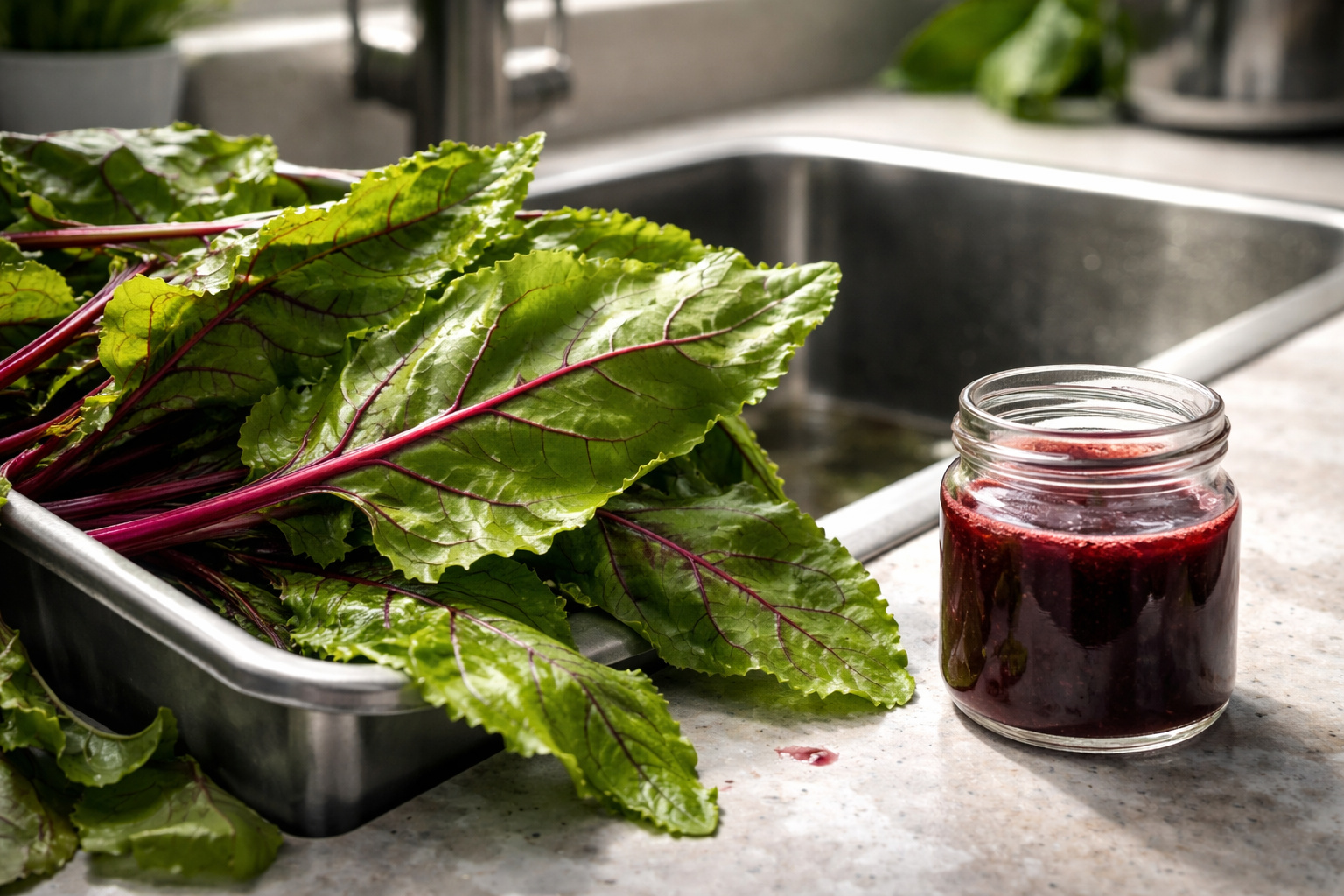
Beetroot leaf has antioxidants and a 2025 study shows that microparticles increase its functional activity and technological potential.
In 2025, a study published in the scientific journal of the American Chemical Society analyzed the potential of beetroot leaves, a material often discarded in the food chain. According to an article published in the journal ACS Engineering Au, conducted by Leonardo de Freitas Marinho and collaborators from the State University of Campinas (UNICAMP) and the University of Salerno, the researchers investigated the production of microparticles from extracts of these leaves, evaluating their antioxidant behavior.
The most relevant finding is that, after the encapsulation process by assisted atomization, the microparticles exhibited antioxidant activity superior to that of the pure extract in laboratory tests. According to the authors themselves, the encapsulation of bioactive compounds increased the stability and antioxidant efficacy of the material, indicating potential for applications in food, pharmaceuticals, and cosmetics.
This result positions beetroot leaf as a resource of interest not only nutritionally but also technologically, especially within the context of repurposing agro-industrial waste and developing functional ingredients.
-
Something was orbiting Earth before any human launched a satellite into space: scientists have found thousands of unexplained flashes in old photos of the sky, and a NASA researcher says the evidence points to non-human intelligence.

-
There is a gap of hundreds of kilometers between weather observation points in the United States, and now drones flying at 6,000 meters altitude in strong winds are filling this gap to predict tornadoes before they kill.

-
The most famous volcano in the world could paralyze one of the largest metropolises on the planet: Japan accelerates emergency plans for the eruption of Mount Fuji, which could bury Tokyo in ash for over two consecutive weeks.

-
The United States has a serious problem with its F-35s: China is already producing fighters at a pace that exceeds American capacity and could manufacture up to 300 aircraft per year before the end of the decade, shifting the global military balance.


Why beetroot leaf is discarded even though it is rich in nutrients
Beetroot is widely consumed in Brazil, but almost always only its root is utilized. The leaves, although edible, end up being discarded due to a lack of knowledge about their nutritional and functional value.
Recent studies on food waste utilization show that leaves and stems are often considered by-products, even though they have relevant composition. This pattern of disposal creates a direct contrast with the chemical potential of the leaves, which concentrate important bioactive compounds.
Moreover, the waste of edible parts of vegetables is a recurring problem in the global food chain, reinforcing the interest in solutions that allow for the complete repurposing of food.
Antioxidants in beetroot leaf explain scientific interest
The beetroot leaf contains a variety of bioactive compounds, especially polyphenols, flavonoids, and chlorophylls, which are associated with antioxidant activity.

These substances act by neutralizing free radicals, unstable molecules that can cause cellular damage. The presence of these compounds places the leaf among vegetables with relevant functional potential, even though it is little explored in everyday consumption.
Laboratory studies have already demonstrated that extracts from beetroot leaves exhibit strong antioxidant activity, which explains the growing interest of food science in this material.
2025 study shows advancement with beetroot leaf microparticles
The study published in 2025 evaluated a more advanced approach: the transformation of the leaf extract into microparticles through encapsulation techniques.
This process allows for:
- protect sensitive compounds
- increase stability
- improve functional performance
The results showed that the obtained microparticles exhibited greater antioxidant activity than the pure extract, indicating a real gain in efficiency. This type of technology is widely studied in the food and pharmaceutical industries, as it allows for controlled release and preservation of bioactive compounds.
How microparticles work in preserving antioxidants
Microparticles are microscopic structures that encapsulate active substances, protecting them from degradation.
In the case of beetroot leaf, this technology helps to:
- avoid oxidation of compounds
- prolong stability
- maintain antioxidant activity

This advancement shows that vegetable waste can be transformed into high-value ingredients, with real industrial applications.
Difference between beetroot leaf and root in nutritional composition
The root of the beetroot is primarily known for its betalains, natural pigments with antioxidant activity and properties related to nitric oxide metabolism. The leaf, on the other hand, has a distinct profile, with a higher concentration of:
- polyphenols
- fiber
- minerals such as iron and potassium
These differences indicate that the leaf and root do not compete with each other but have complementary nutritional functions. This reinforces the importance of utilizing the entire food.
Potential of beetroot leaf in food and industry
Based on recent scientific evidence, beetroot leaf can be used in different ways:
- as an ingredient in functional foods
- in the production of bioactive extracts
- as a base for antioxidant compounds
Moreover, the transformation into microparticles expands its applications, especially in products that require stability and standardization.
This scenario transforms a common waste into a raw material with relevant economic and technological potential.
Sustainability and repurposing of food waste
The utilization of beetroot leaf also directly connects with reducing food waste. A large part of the losses in the food chain occurs precisely in parts that could be utilized.
The use of these leaves contributes to more sustainable models, reducing disposal and increasing the efficiency of resource use. This concept aligns with practices of circular economy and innovation in agribusiness.
Despite the promising results, it is important to highlight that most of the evidence still comes from laboratory studies. There is no robust clinical proof in humans that confirms direct effects such as:
- combating aging
- treating diseases
- specific therapeutic benefits
This means that the effects should be interpreted as functional potential, not as medical proof.
From ignored waste to functional ingredient with potential
The beetroot leaf, often discarded, demonstrates relevant characteristics from a scientific and technological perspective.
With a high concentration of antioxidant compounds and promising results in studies with microparticles, this material gains new significance within food science.
By transforming a waste into an ingredient with functional potential, the research reinforces a global trend of integral food valorization, combining nutrition, sustainability, and industrial innovation.









Seja o primeiro a reagir!