





 Portuguese
  English
  Spanish
  6 min of reading
  0 comments


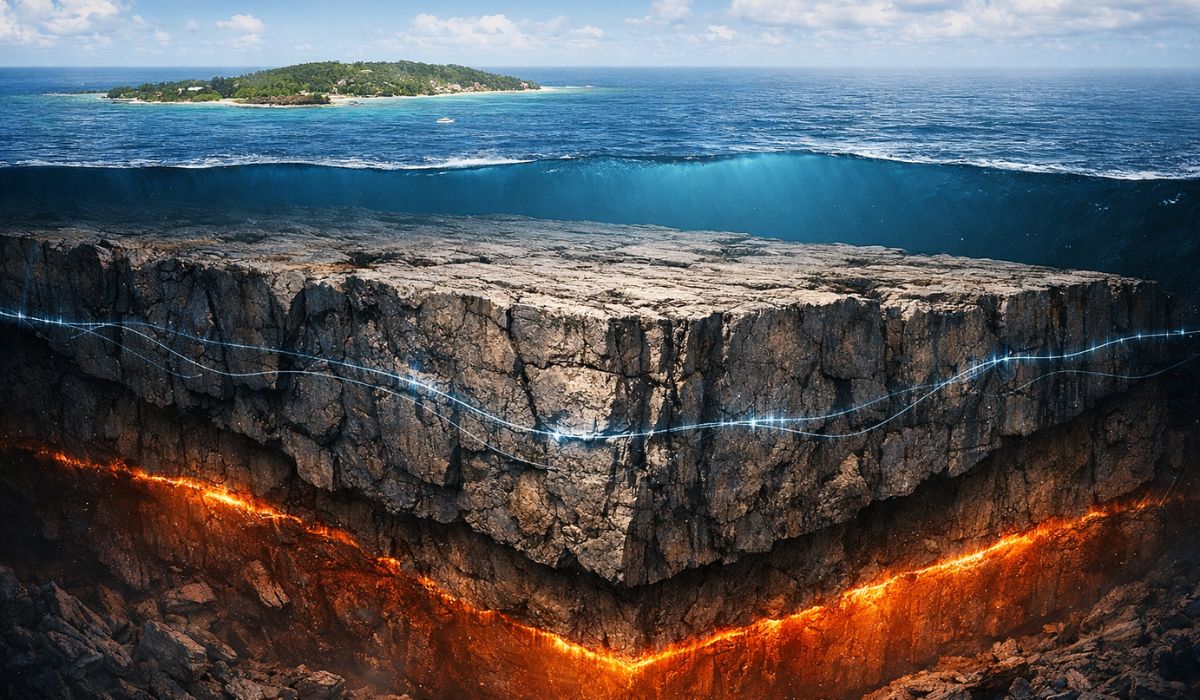
An unusual rock layer beneath Bermuda led researchers to revise hypotheses about the formation of the archipelago and the persistence of its submarine relief, placing the region at the center of a geological debate that spans millions of years.
A rock layer about 20 kilometers thick, identified beneath the oceanic crust of Bermuda, has been pointed out by researchers as a possible piece to explain an ancient geological problem: why the archipelago remains elevated relative to the Atlantic floor even without signs of active volcanism for about 31 million years.
The study indicates that this material, located between the crust and the mantle, may contribute to supporting the so-called oceanic swell of the region, an elevation of the seabed that still lacks a consensual explanation.
The rock layer beneath Bermuda intrigues geologists
In oceanic chains like Hawaii, the formation and maintenance of islands are often associated with mantle plumes, columns of hot material that rise from the Earth’s interior, deform the tectonic plate, and fuel volcanism.
-
For the first time in history, electrical discharges have been recorded in the atmosphere of another planet, and the discovery by Perseverance on Mars now forces NASA to completely rethink the safety of all equipment and habitats sent to the Martian surface.

-
Artemis II astronauts return from space and request Uncrustables after ten days for their first meal, and the Navy supplies the ship with an “abundant amount,” the manufacturer promises a lifetime supply.

-
Japanese mission uncovers the secret behind a 50-year astronomical mystery and reveals who was really emitting the X-rays from the star γ Cas.

-
(VIDEO) Three giant parachutes slowed the Orion capsule from 40,000 kilometers per hour to just 32 km/h, and NASA completed the most anticipated landing of the decade in the Pacific Ocean with the four Artemis II astronauts back on Earth after 10 days in space.

In the case of Bermuda, researchers claim that the observed scenario today is different.
There is no evidence of an active hot plume directly beneath the island, and yet, the submarine relief of the region remains elevated even after millions of years without known eruptive activity.
It was in this context that seismologists William D. Frazer from Carnegie Science and Jeffrey Park from Yale University analyzed records from a seismographic station installed in Bermuda.
To do this, they used waves generated by large earthquakes occurring in various parts of the world and tracked how these signals traverse the rocks at depth.
Sudden changes in the behavior of these waves allowed the authors to delineate underground layers down to about 50 kilometers below the island.
The analysis indicated the presence of a rock layer much thicker than described in similar oceanic contexts.
According to Frazer, the sequence normally expected beneath the seabed is the transition from the base of the oceanic crust directly to the mantle.
In Bermuda, however, seismic data suggest the existence of an additional layer beneath the crust, but still within the tectonic plate on which the archipelago is situated.
What the study indicates about the oceanic swell
The authors interpret this structure as a case of underplating, a term used to describe the accumulation of magma at the base of the crust, where it cools and solidifies.
According to the study, this material may have been injected during the final phase of volcanism in Bermuda, between about 30 and 35 million years ago.
As this rock would be less dense than some of the surrounding material, the researchers claim it may contribute to the buoyancy of the region.
In this scenario, the layer would help keep the ocean floor approximately 500 meters above the neighboring areas.
The work does not treat this hypothesis as a definitive explanation but as an interpretation compatible with the seismic data obtained.
The central point of the finding lies in the thickness of this rock layer.
In the summary of the article, the authors report that they identified a layer about 20 kilometers below the oceanic crust that, according to them, had not been described in this context before.
In geological terms, this suggests that Bermuda may represent an unusual case of preservation of magmatic material at the base of the crust.
The results were published on November 28, 2025 in the scientific journal Geophysical Research Letters.
The impact of the study focused on the scientific value of the discovery, especially because it offers a new line of investigation for an old theme in North Atlantic geology: the persistence of elevated relief around Bermuda, even after the end of known volcanism in the region.
Bermuda and the difference from other volcanic islands
The comparison with archipelagos like Hawaii helps to situate the uniqueness of the case.
In systems associated with hotspots, the tectonic plate moves over the heat source, volcanism shifts position over time, and the elevation of the ocean floor tends to decrease when magmatic feeding ceases to act at that point.
In Bermuda, this behavior does not appear in the same way.
Although the island has a volcanic origin, the data gathered so far indicate that its evolution does not easily fit into the classic model of an active hotspot sustaining the current topography.
For the authors, the permanence of the swell may be linked not to an ongoing thermal process, but to an ancient structure preserved at the base of the crust.
This interpretation does not eliminate other discussions about the Earth’s interior beneath the North Atlantic.
Still, it shifts part of the attention to what may have been retained there since the end of volcanic activity.
Instead of relying solely on a still-active deep source, the support of Bermuda’s relief may be related, according to the researchers, to a geological legacy left by past magmatic events.
Origin of the magma and the composition of Bermuda’s lavas
The discussion connects to previous research on the composition of Bermuda’s lavas.
Geologist Sarah Mazza, a professor of geosciences at Smith College and not directly involved in the seismic study, told Live Science that there is still remnant material from the period of volcanic activity beneath the island and that this residue may be helping to support the elevated relief area in the Atlantic.
Mazza’s group investigated the chemical composition of these lavas and found signs of an unusual origin.
According to the coverage of the research and the publication record in Geology, the rocks exhibit low silica content and characteristics consistent with a carbon-rich source from deep regions of the mantle.
The study on zinc isotopes was published on September 15, 2025.
According to this line of research, Bermuda’s geochemical signature differs from that observed in volcanic islands associated with hotspots in the Pacific and Indian Oceans.
For Mazza, this difference may be related to the tectonic history of the Atlantic.
Her interpretation is that part of the material that fed Bermuda’s volcanism may have been pushed to great depths when the supercontinent Pangea formed, between about 900 million and 300 million years ago.
This hypothesis does not replace the most recent seismic data but broadens the context of the problem.
Together, the studies suggest that Bermuda may record an unusual combination between the tectonic evolution of the Atlantic and deep mantle processes.
Therefore, the archipelago has been treated by researchers as a natural laboratory to understand how ancient materials can remain preserved beneath oceanic plates.
What the discovery may help clarify in geology
Even with the new seismic image, the authors emphasize that the exact origin of the layer beneath Bermuda is still not completely defined.
What the study presents at this moment is a structure compatible with the hypothesis that solidified magmatic material has remained at the base of the crust and has influenced the local topography for millions of years.
Now, the next step announced by Frazer is to compare Bermuda with other oceanic islands.
The idea is to check whether similar layers exist in other parts of the planet that have not yet been identified, or if the case of the archipelago truly deviates from the pattern observed so far.
For geology, this answer may be relevant not only to explain Bermuda but also to refine the understanding of how certain oceanic islands evolve long after the end of visible volcanism on the surface.
More than feeding speculative readings about the North Atlantic, the discovery places Bermuda back at the center of an objective scientific question: how can deep and ancient structures continue to shape the planet’s relief long after their formation?
This is the question that remains open while new analyses attempt to determine whether the layer identified beneath the archipelago is an isolated case or part of a broader process still little recognized.








Seja o primeiro a reagir!