





 Portuguese
  English
  Spanish
  8 min of reading
  0 comments



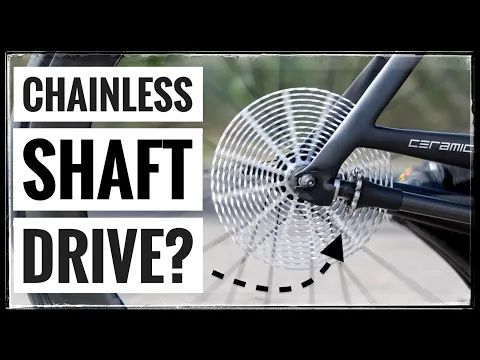
In Bicycles with Shaft Transmission, Bevel Gears Transfer the Pedal Power to the Rear Wheel Inside an Aluminum Case, Without an Exposed Chain. The Maintenance Promise Runs Into Efficiency Losses Close to 7%, a Penalty of 1 to 2 kg, Critical Alignment, High Tolerances, and Exclusive Parts.
Bicycles without chains seem like the perfect answer for those who dream of cycling without grease, without broken chains, and without parts exposed to dirt. On paper, the proposal is seductive: the power from the pedals goes to the rear wheel through a closed transmission shaft, with bevel gears working inside a case, away from dirt and impacts.
However, when I delved into what really happens with these bicycles, the list of downsides became too large to ignore. The shaft transmission offers a futuristic look and promises low maintenance, but it pays for this in efficiency, weight, mechanical complexity, the need for a stiffer frame, and reliance on proprietary components that lock any Plan B.
What Are Bicycles with Shaft Transmission Without Chain

Instead of a chain and a set of sprockets turning the rear wheel, bicycles with shaft transmission use two sets of bevel gears to transfer energy from the crankset to the rear hub via a shaft.
-
Something is happening around the Earth: Inside the huge explosion of fireballs in 2026

-
A hot air bubble coming from Argentina expands over Brazil, causing thermometers to exceed 38 degrees with a thermal sensation of 40 degrees in late March, affecting 6 states at once.

-
The radish leaf that almost everyone throws away has more polyphenols, flavonoids, and fiber than the consumed root, and a 2025 study showed that the leaf contains compounds that protect the intestine, combat inflammation, and may inhibit the growth of cancer cells.

-
A planet that seemed to defy the laws of physics has intrigued scientists for decades, until the James Webb revealed what is really affecting Saturn’s rotation.


Generally, the entire system is housed in a aluminum case that also serves as the right rear stay of the frame.
The idea is not new. These bicycles have been around for over 125 years, and even today, manufacturers continue to sell the concept with a straightforward promise: no exposed moving parts, no oily or broken chains, and less chance of failures caused by debris entering the transmission.
The problem is that the real world of bicycles comes with a cost that doesn’t show in the showroom.
Why Bicycles with Rear Derailleur Still Dominate
When talking about bicycles in everyday and sport use, the rear derailleur has gained a century of refinement. It is lightweight, efficient, cheap to manufacture, easy to adjust, and, most importantly, easy to maintain.
In practice, this turns into logistical advantages: replacement parts are easy to find, and it is common to find someone who knows how to adjust it in almost any city. And here lies a downside for bicycles with shaft transmission: the shaft cannot be paired with rear derailleurs.
For those who do cycle tourism and seek to cover long distances with low maintenance, there is an alternative within the bicycle world: gearbox systems with internal gear hubs, which can be combined with chains, belts, or shafts. It is in this type of comparison that the shaft transmission tries to compete, but it faces tough obstacles.
The Promise of Low Maintenance and Where It Really Helps
The appeal of chainless bikes is clear in two scenarios:
- Those who want a closed transmission, without constant exposure to dirt, oil, and debris.
- Those who ride in poor conditions and try to reduce the number of adjustments and problems in the system.
In these situations, the logic of a protected shaft inside a case seems flawless. However, what makes a bicycle “ride well” is not just surviving mud. It’s transforming effort into movement with minimal losses, and this is where the shaft transmission begins to slip.
Efficiency Losses in Bicycles with Shaft Transmission
The most well-known disadvantage of bicycles with shaft transmission is lower efficiency compared to chains and belts. The main reason is mechanical: there is a change in rotation direction twice, once at the crankset and once at the rear hub. This adds losses.
The most direct data from the material is a comparison from 1983, where Josef Keller put an unspecified shaft transmission against a single-speed chain and found a 7% difference in efficiency of the shaft, in pedaling powers between 50 and 200 watts.
In comparison, there are references for the efficiency of chains and belts under favorable conditions:
chain around 99% at 150 watts and belt reaching 98.6%.
Using this set, the reading becomes simple: a shaft transmission in the range of about 92% may seem acceptable, but in cycling, these points translate to lost time.
The very example provided is quite illustrative: a 70 kg cyclist with a 15 kg bicycle climbing a 5% incline for 10 km, something like an hour, would be four minutes behind on a bicycle with a shaft compared to a chain.
At the same time, not everything is black and white. Chains and belts also lose efficiency in mud and water. There are cited measurements where the chain drops to 94.4% in wet and muddy conditions and 92.8% in dry muddy conditions.
In this extreme scenario, a shaft in good condition could, in theory, be close to the efficiency of a chain in heavy mud, depending on how well the system is protected.
Still, for most bicycles and for most of the time, the higher efficiency of the chain and the overall lighter setup weigh more.
Extra Weight and Why It Matters More for Bicycles Than for Motorcycles
Another recurring cost in bicycles with shaft transmission is the weight penalty. The system requires robust components, and this usually adds 1 to 2 kg compared to a chain or belt transmission.
This extra weight is not a whim. It comes from a technical requirement: shaft transmissions undergo very high torques when the cyclist starts from rest, especially because they work with small radius bevel gears.
The text explains this with a direct mechanical comparison: the lever arm (moment) in a shaft transmission is approximately four to eight times shorter than that of a chain or belt sprocket.
Result: to deliver the same effect, the system must handle four to eight times more torque. This increases stress on bearings and bevel gears and can accelerate wear if not all components are precisely sized.
In motorcycles, shaft transmissions have a strong reputation because the engine compensates for weight and losses. In bicycles, it’s the opposite: the more the cyclist puts into the pedal, the more they want to see that effort turn into movement. That’s why 1 to 2 kg and some efficiency points make such a significant difference in the real world.
The Problem of Gear Alignment in the Frame
If there’s one point that few people imagine when looking at a chainless bicycle, it’s how much the system depends on perfect alignment.
To reduce wear and increase efficiency, there is an ideal distance for the fit of the bevel gears. However, bicycle frames flex under load. If the frame is not rigid enough for a shaft system, the fit of the gears loses precision.
A proposed solution is to use CV joints at both ends of the shaft, allowing the frame to flex without destroying the fit. But this comes at a cost: more friction, more weight, and more complexity.
Additionally, the shaft transmission must be built with very high tolerances to achieve the ideal fit, and the user must still be able to easily align the rear gears when installing the wheel.
Can it be solved? Yes, it’s a solvable problem. However, in bicycles, “solvable” often means “expensive,” “demanding,” and “difficult to standardize at scale.”
Proprietary Parts and the Trap of “No Alternatives”
Here lies the most decisive point to explain why these bicycles have never dominated: proprietary nature.
Shaft transmissions and the frames designed for them tend to be proprietary. This means that if you have a problem with the shaft or can’t find replacement parts, it’s not simple to convert the bicycle to a belt or chain.
In other words, the bicycle is stuck with the shaft. You either keep the system as it is, or you replace the entire bicycle. For a market accustomed to compatibility, upgrades, and local maintenance, this dependence is a huge brake.
Where Driven Enters and Why It Captures Attention
After understanding why traditional shaft transmission bicycles have not gained popularity, a newer and different attempt emerges: the transmission system from Driven Technologies.
The idea changes the mechanical path. Instead of classic bevel gears, it transfers power through a series of cartridge bearings interconnected with two circular sets of pinions.
What makes this attractive is the promise of not necessarily needing to be combined with an internal gear hub, which theoretically would allow high efficiency in all gears.
Driven claims 99% or more. As a reference, the material states that the best internal gear hub analyzed ranges from 92 to 97%, depending on the selected gear.
However, even within this proposal, the mechanical challenges remain significant.
The system has achieved up to 45 km/h in a velodrome, but turning this into a street product involves serious obstacles:
managing torque at low speeds, handling static load limits of small bearings, and ensuring the strength and longevity of the pinion sets, possibly requiring very advanced materials.
There is also another bottleneck: constructing a rear triangle rigid enough to maintain precise gear fitting, which contradicts the trend of reducing frame stiffness to improve comfort and “road feel.”
The company received one million dollars in external investment, and the CEO himself acknowledged via email that what exists thus far is still far from the final product, although there is confidence that engineering challenges can be resolved.
The Practical Verdict: Why the Brilliant Idea Has Not Conquered Bicycles

When I put side by side what chainless bicycles promise and what they require, the reason they have never “taken off” becomes quite clear:
- Lower efficiency due to changes in rotation and losses in the set, with an example of a 7% difference and a real effect on climb time.
- Extra weight of 1 to 2 kg, necessary to withstand high torque, especially from a standstill.
- Requirement for alignment and high tolerances, because the ideal fitting of the bevel gears does not tolerate frame flex outside the expected.
- Complexity and potential wear on bearings and gears if the system is not designed and built to the right level.
- Proprietary parts, which tie the bicycle to a closed ecosystem and reduce the scope for maintenance and adaptation.
Meanwhile, chains continue to be the best option for most bicycles because they combine efficiency, lightweight, and cost with derailleurs that are already extremely refined.
And for those seeking low maintenance, the comparison that makes the most sense within bicycles usually involves using gearboxes like Rohloff or Pinion with low-maintenance and long-lasting belts, maintaining a better balance between practicality and performance.
Would you own one of the chainless bicycles for the promise of nearly zero maintenance, even accepting more weight, proprietary parts, and potential efficiency loss?






-

-

-

11 pessoas reagiram a isso.