





 Portuguese
  English
  Spanish
  5 min of reading
  0 comments


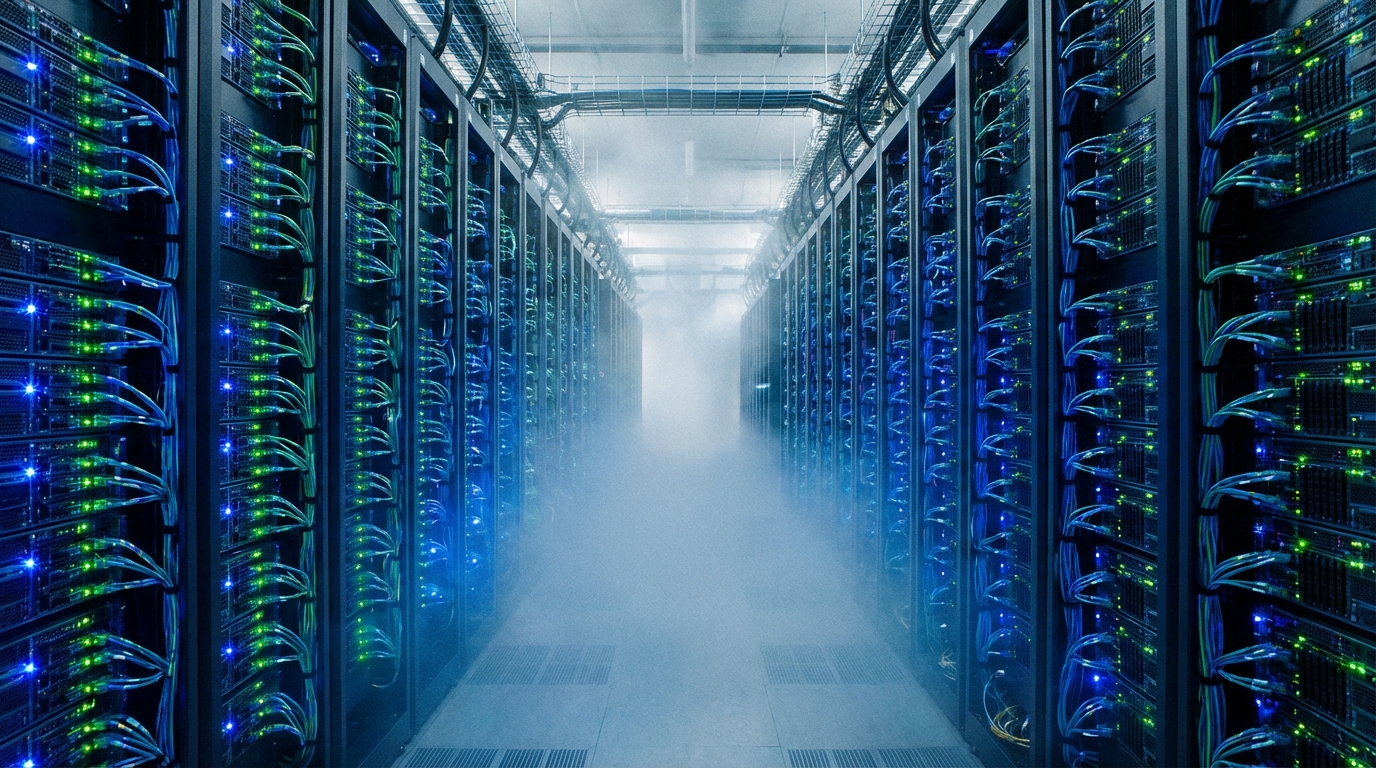
Technology giants plan US$ 635 billion in AI data centers, but energy and geopolitical crises threaten plans as Brazil positions itself with megacomplexes in Rio de Janeiro, Rio Grande do Sul, Paraná, and Minas Gerais, betting on natural gas as a firm source to ensure 24-hour operation in infrastructures that can consume the equivalent of 16 million homes.
Artificial intelligence is rewriting the maps of global energy consumption. Thus, AI data centers have become one of the most urgent debates in the global economy.
According to the International Energy Agency (IEA), data centers consumed 415 TWh of electricity in 2024 — about 1.5% of total global consumption. Therefore, this is equivalent to the annual consumption of entire countries.
The IEA report projects that this consumption could double by the end of 2026, surpassing 1,000 TWh — equivalent to Germany or Japan.
-
FPSO P-78 begins operations in the pre-salt of Búzios with 180,000 barrels/day, ROTA 3 pipeline, 13 smart wells, and CO₂ reinjection, while the field already produces 1 million barrels per day and generated R$ 81 billion in royalties in 2025.
-
The Moon has essential rare earth minerals for 99% of the electronics you use in your daily life and a future fuel that is almost nonexistent on Earth: now the race to explore the satellite has turned into a global competition among more than 70 countries.

-
Scientists reveal an impossible artifact for its time made with iron from space, and the discovery reignites a historical debate about the Bronze Age in China.

-
The humanoid robot G1 has gained a new digital brain that has transformed it into a true domestic worker: it learns by observing the environment, interprets objectives, and executes complete tasks without receiving step-by-step instructions.

Moreover, Gartner quantifies the acceleration. Global data center consumption is expected to jump from 448 TWh in 2025 to 980 TWh in 2030. AI servers are expected to increase from 21% to 44% of the total during this period.

AI data centers may consume the equivalent of 16 million homes in Brazil
Brazil ranks 12th in the global data center ranking and leads Latin America, with about 200 installed clusters. However, the country is about to make a gigantic qualitative leap.
To grasp the difference: a conventional 20 MW data center consumes the equivalent of 80,000 homes per day. The new AI megacomplexes operate at a radically larger scale.
Thus, the first four AI complexes in Brazil — planned for Rio de Janeiro (RJ), Eldorado do Sul (RS), Maringá (PR), and Uberlândia (MG) — are expected to consume together the equivalent of 16.4 million homes.
The largest of them is Rio AI City, in Jacarepaguá, with an initial capacity of 1,500 MW — equivalent to the daily consumption of 6 million homes — and a planned expansion to 3,200 MW.
In Rio Grande do Sul, Scala AI City in Eldorado do Sul will reach 1,800 MW by 2033. Therefore, it could reach 5,000 MW — all in a municipality with only 40,000 inhabitants.

Demand for AI data centers in Brazil is expected to jump 23 times by 2030
The National Electric System Operator (ONS) has already incorporated this impact into its planning. According to the PLAN 2026–2030, the additional demand from data centers is expected to jump from 89 MW average in 2025 to 2,157 MW average in 2030.
Furthermore, the projection from MIT Technology Review Brazil goes in the same direction. The electricity consumption of Brazilian data centers is expected to more than double by 2029, rising from 1.7% to 3.9% of national demand.
Consequently, this percentage will exceed the consumption of all public lighting in the country.
Big techs plan US$ 635 billion, but crisis threatens investments
Before the escalation of conflict in the Middle East, Microsoft, Amazon, Alphabet, and Meta planned to invest about US$ 635 billion in 2026 in data centers, chips, and AI infrastructure.
However, this plan now faces a serious obstacle. Melissa Otto, head of research at S&P Global Visible Alpha, warned that the crisis has raised serious concerns about energy costs.
The logic is simple: data centers are extremely energy-intensive infrastructures. When prices soar, the economic equation of AI investments deteriorates rapidly.
Additionally, Gartner warns that 40% of existing AI data centers will be limited by energy availability by 2027. Bob Johnson, vice president of Gartner, stated that the energy demand from AI “will exceed the capacity of providers to expand infrastructure quickly enough.”

Natural gas emerges as a solution for firm energy for AI data centers
Data centers require energy availability between 99.982% and 99.995% per year — less than five minutes of failure in twelve months. Therefore, this requirement is incompatible with the intermittent nature of sources like solar and wind.
Thus, natural gas positions itself as a strategic solution. Gas turbines, combined cycle engines, and microturbines can be installed alongside data centers, providing decentralized generation and redundancy.
Moreover, natural gas emits up to 50% less CO₂ than coal and fuel oil. It also ensures greater price stability compared to grid electricity.
A groundbreaking study by Energisa with the Pensar Energia institute revealed that the future of data centers in Brazil directly depends on the integration between renewable sources and firm energy from natural gas.
Thus, the Brazilian Northeast — with constant winds, high solar irradiation, and installed renewable capacity — could become a national digital hub. However, it needs dispatchable energy. Currently, more than 20% of renewable generation in the Northeast is wasted due to lack of regional demand.
Research from USP confirms the viability: natural gas cogeneration systems in data centers are economically viable and increase infrastructure availability.

Regulatory debate: REDATA may exclude natural gas
In September 2025, the government created REDATA (Special Tax Regime for Data Center Services), suspending federal taxes. The Chamber of Deputies approved PL 278/26 in February 2026.
However, the regime requires companies to use exclusively energy from clean or renewable sources. Therefore, entities like IBP, Abegás, FGV Energia, Firjan, and Fiergs launched a manifesto requesting the inclusion of natural gas.
The argument is straightforward: without a firm and stable source, Brazil risks losing competitiveness in attracting global data centers.
To understand how the oil and gas sector is already investing in automation and robotics, see the full report.
Brazil has 87% of its renewable matrix, but AI data centers require more
Brazil has 87% of its electric matrix composed of renewable sources — compared to a global average of 30%. Therefore, the country offers a combination of cost and carbon footprint that is hard to replicate.
The investment pipeline reflects this potential: it is estimated R$ 500 billion in data centers by 2030, aiming to quadruple capacity from 730 MW to 3.2 GW.
Still, the IEA points out that global water consumption by data centers is at 560 billion liters per year — and is expected to reach 1.2 trillion liters by 2030. A single data center can consume 1.9 million liters per day.
Thus, integration with biomethane further reinforces the outlook. The same infrastructure that operates with natural gas can progressively receive renewable volumes. Also, check how Petrobras invests US$ 180 million in underwater technology to keep this infrastructure operating.
While big techs compete for chips and processing capacity, the most strategic competition in the next five years may lie in contracts for firm energy supply — and those who dominate this energy in Brazil will be the natural gas companies.





Seja o primeiro a reagir!