





 Portuguese
  English
  Spanish
  5 min of reading
  0 comments


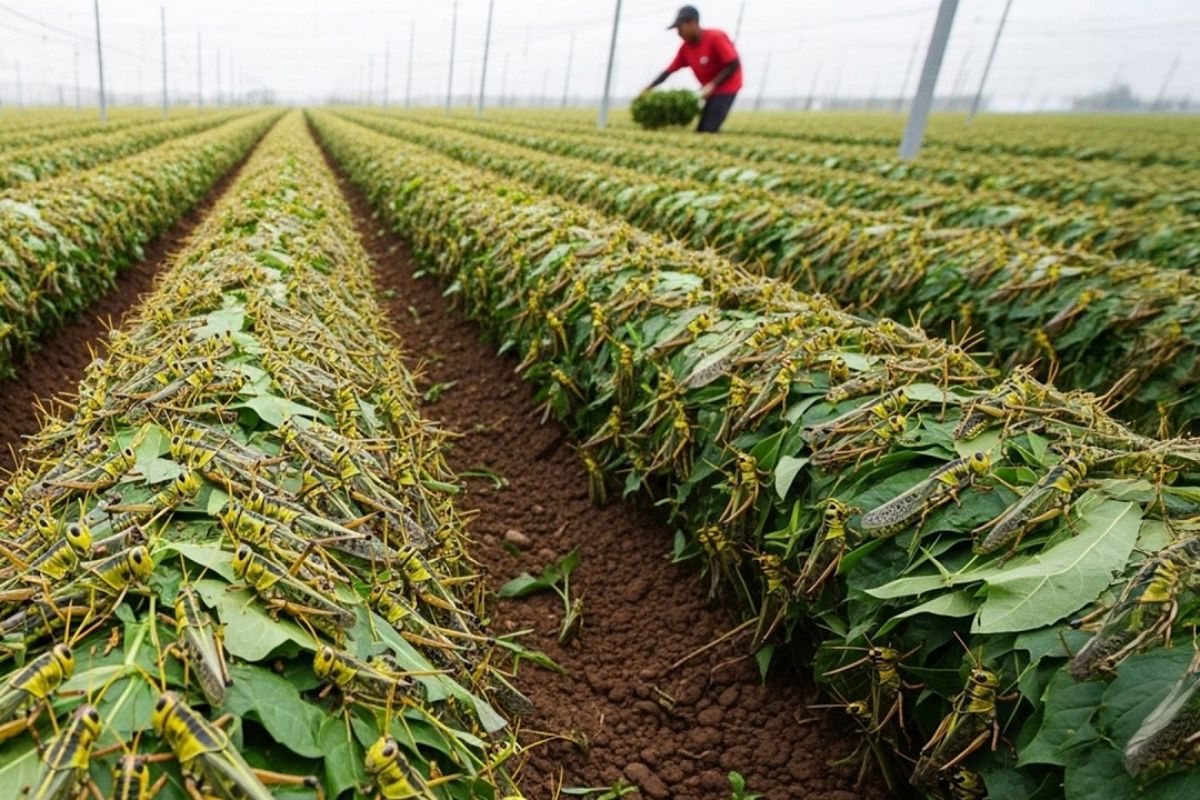
While Specialized Farms Multiply Grasshoppers Raised for Human Consumption, China Transforms Agricultural Pest into Industrial Asset, Exports Tons of Protein, Attracts Investors, and Tests Sustainable Production Models That Could Redefine Food Chains, Consumption Habits, and Nutritional Safety Policies Worldwide in the Coming Decades Across Different Continents
The image of billions of grasshoppers raised for human consumption still shocks a large part of the public, but it already drives a complex industrial chain inside and outside China. Instead of treating the insect merely as an agricultural pest, producers have come to see it as a valuable protein source, with a fast growth cycle, low production costs, and intensive technology use in controlled confinement.
In this process, the country organizes a system that goes from large-scale breeding to the annual export of thousands of tons of processed insects, positioning itself in a nascent global market. At the same time, the expansion of this alternative protein raises a sensitive debate: to what extent can the transformation of grasshoppers into industrialized food balance sustainability, health safety, and cultural acceptance in different markets.
How Grasshoppers Go from Pest to Industrial Raw Material

In nature, grasshoppers appear as an invasive species, with swarms capable of devastating entire crops.
-
Material present in millions of kitchens raises global alarm after causing severe lung disease and leading to multimillion-dollar lawsuits in the United States.

-
A person became a millionaire with just a 10-hour video of a lit fireplace on YouTube.

-
The Finnish armored vehicle Patria AMV 8×8 with eight wheels stands out with mine protection, advanced armor, modular design, and high mobility in military operations that redefine modern combat.

-
Workers manually excavate 6 million kilograms of ice to open a cave that allows observation of how a glacier is melting from the inside.


In Chinese farms, the logic is inverted: closed and monitored environments receive batches of insects in enclosures prepared for each stage of the life cycle.
The breeders are separated, and the breeding management is adjusted to ensure uniform growth, high development rates, and controlled mortality.
Instead of chemical combat in the field, the focus shifts to mastering the biological cycle to transform it into a stable productive process.
The Engineering Behind the Breeding Enclosures

As soon as they enter the enclosures, the grasshoppers are observed and allowed to mate naturally.
After about 30 to 35 days, the adults begin reproduction, and the females use the ovipositor to dig small holes in the substrate where they deposit the eggs.
The technical team controls temperature, humidity, and density per area, redistributing breeders and eggs among different modules.
The goal is to standardize the breeding conditions, reduce size variations between batches, and ensure predictability for the industry that buys grasshoppers raised for human consumption.
In a system designed to scale, each deviation in density or microclimate can mean a loss of yield at the final stage.
Intensive Feeding and Weight Gain in a Few Weeks

During the adult phase, the grasshoppers receive continuous and intensive feeding, especially before and after each molting phase.
The organism needs a large volume of nutrients to regenerate the exoskeleton and complete the development of wings, muscles, and other structures.
Thanks to the strong digestive capacity and accelerated growth rate, the animals progress from stage to stage in a few weeks, reaching commercial size still within a relatively short cycle.
For the industry, this means a quick inventory turnover and less capital immobilization per batch, one of the reasons why grasshoppers raised for human consumption have gained space on the sustainable protein agenda.
When is the Ideal Harvest Point for Grasshoppers
The harvest occurs when the grasshoppers reach the ideal state: bodies about 4 to 6 centimeters long, fully developed wings, and firm texture.
At this point, the balance between weight, processing yield, and sensory quality tends to be more favorable.
To increase efficiency, the capture is primarily done at night when the insects are less active and remain still on nets and walls of the enclosures.
This operational window reduces effort, risk of escape, and physical damage to the animals, important factors for maintaining quality standards in grasshoppers raised for human consumption that will be destined for direct consumption or industrial processing.
From Enclosure to Plate: How Grasshoppers Are Consumed
In China and several Southeast Asian countries, grasshoppers already appear on popular menus and in typical street preparations.
After harvesting and sanitizing, they are deep-fried, stir-fried with aromatic leaves, seasoned with local mixes, or roasted with salt.
The result is dishes that combine crunchiness, high protein content, and strong regional identity, integrating grasshoppers raised for human consumption into everyday cuisine.
In some markets, the insect is also dried and ground, serving as a base for protein flours used in snacks, pasta, or dietary supplements.
Why Grasshoppers Attract the Sustainable Protein Industry
Once seen exclusively as a threat to crops, grasshoppers have taken on a new role in the food value chain.
Their bodies are rich in protein and can be produced with a relatively simple breeding model, low input consumption, and little physical space, especially compared to traditional livestock farming.
Moreover, the industrial use of a species historically associated with pests helps reduce waste and paves the way for systems where the pressure on agricultural areas can be lessened.
For investors, the combination of low cost, automation potential, and increasing demand for alternatives to conventional animal protein explains why grasshoppers raised for human consumption appear as a strategic bet in climate and food-focused portfolios.
Cultural, Regulatory, and Sanitary Limits Still Under Discussion
Despite the potential, the expansion of this value chain faces significant barriers.
Cultural taboos, lack of familiarity with insect consumption, and doubts about health standards still limit acceptance in many markets.
Regulators discuss safety requirements, labeling, and traceability, while consumers assess whether the promise of sustainability compensates for the initial strangeness.
At the same time, experts warn of the need to closely monitor animal welfare in intensive systems, the sourcing of inputs used in feed, and the environmental impacts of large concentrations of grasshoppers raised for human consumption in certain regions.
Without clear answers to these points, the transition to insect protein on a global scale may face prolonged resistance.
What Is at Stake in the Future of Grasshoppers in Food
In practice, the advancement of this industry serves as a large laboratory for the future of sustainable food.
By transforming an agricultural pest into a high-value asset, China tests whether it is possible to combine productive efficiency, reduced environmental impact, and social acceptance around grasshoppers raised for human consumption.
If the model solidifies, it could influence everything from public policy design to how global food chains incorporate new protein sources.
The central question moves beyond just technical or economic considerations to involve collective choices about what we consider food, acceptable risk, and desirable innovation on the plate.
In your place, facing a plate of carefully processed insects, would you confront the experience and try grasshoppers raised for human consumption, or do you think this frontier of sustainable food is still far from your table?








-

-

2 pessoas reagiram a isso.