





 Portuguese
  English
  Spanish
  5 min of reading
  0 comments


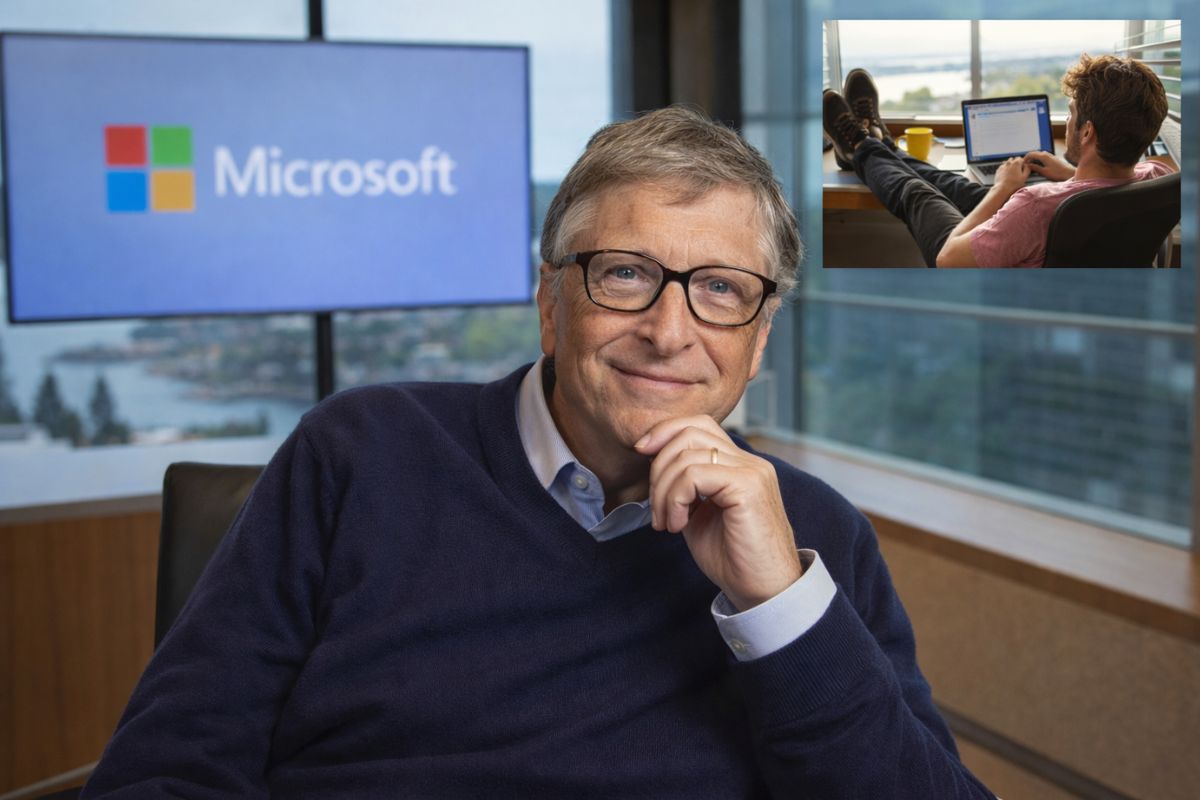
Bill Gates revealed that he chooses lazy people for difficult jobs because they find the easiest way to solve problems, a philosophy that seems to contradict everything we know about productivity, but is behind the efficiency culture that made Microsoft a global giant.
Most people grew up hearing that hard work is the key to success. But Bill Gates revealed a philosophy that goes in the opposite direction: he said he prefers to hire lazy people for difficult tasks because it is precisely they who find the easiest way to solve complex problems. The exact phrase is: “I choose a lazy person to do a difficult job. Because a lazy person will find an easy way to do it.” The statement may sound strange at first, but when placed in the right context, it reveals a way of thinking that is applied in business, technology, and everyday problem-solving.
What Bill Gates revealed with this phrase is not a praise of laziness in the literal sense. “Lazy,” in this context, does not mean someone who avoids responsibilities or refuses to work. It means someone who does not accept doing unnecessary work and naturally seeks more efficient ways to achieve the same result. When faced with a complicated task, this person tends to think differently, cutting out unnecessary steps from long processes and finding quicker and better solutions. It is a mindset that values efficiency over brute effort.
What Bill Gates revealed about the difference between working hard and working well

Bill Gates’ phrase revealed a fundamental distinction that many people confuse. Working hard and working well are not the same thing. It is possible to spend ten hours a day on a task and produce mediocre results because the method is inefficient.
-
Sitting on the sidewalk at the end of the afternoon: the simple habit that brought neighbors together, slowed down the routine, and reveals why social interaction was stronger before the digital age.

-
Daughter of a public servant, a young woman from MA turns her fight for the environment into a victory and secures a full scholarship at a university in the USA.

-
Psychology explains why the generation that grew up in the 60s and 70s became so tough but still struggles to ask for help even when they are drowning, and the cost of this is extremely high.

-
The lemon that grows alone in Brazilian backyards has powers you can’t even imagine: it lowers high blood pressure, prevents kidney stones, fights cholesterol, and even removes rust from any surface.

And it is possible to solve the same problem in two hours using a smarter approach. The person that Bill Gates calls “lazy” is the one who naturally seeks the second option.
In practice, what Bill Gates revealed is that the way a task is executed matters more than the time spent on it. In many work environments, employees who organize their activities well deliver results faster than colleagues who work without a clear plan.
Companies use automation and software to eliminate repetitive tasks precisely with this logic: less manual work does not mean less productivity. Often, it means more.
How the philosophy that Bill Gates revealed shaped Microsoft
What Bill Gates revealed did not remain just talk. Microsoft was built on the premise of simplifying complex processes so that anyone could use a computer. The early operating systems were difficult to operate, requiring technical commands that only specialists mastered.
Over time, the company invested in increasingly simple interfaces, transforming the personal computer into an accessible tool for hundreds of millions of people.
This evolution happened because Microsoft developers sought ways to reduce complexity, just like the “lazy” person that Bill Gates revealed he prefers to hire. Instead of writing extensive and complicated code, efficient programmers create shorter systems, with fewer lines and fewer chances of error.
Windows, Office, and practically all of the company’s products reflect this mindset: doing more with less user effort. The philosophy that seemed like a joke became the foundation of one of the most valuable companies on the planet.
Why the efficiency that Bill Gates revealed to value is so important today
The current world rewards speed and accuracy. Companies want to reduce costs, speed up deliveries, and produce more with fewer resources, and automation, artificial intelligence, and digital tools exist precisely for that.
The logic behind these technologies is the same that Bill Gates revealed in his phrase: finding the easiest way to achieve the desired result, without sacrificing quality.
The mindset that Bill Gates revealed applies from software development to everyday decisions. When someone uses a keyboard shortcut instead of clicking through three different menus, they are applying the same principle. When an engineer designs an industrial process with fewer steps, they are doing the same.
When a cook organizes the ingredients before starting the recipe to avoid wasting time looking for each one during preparation, the logic is identical. Efficiency is not laziness. It is intelligence applied to the use of time.
What happens when companies ignore what Bill Gates revealed
Organizations that value presence over results often pay a high price for that choice. Employees who spend hours in unproductive meetings, who repeat manual tasks that could be automated, or who follow bureaucratic processes without questioning them are working hard, but they are not necessarily producing proportionally to the effort.
The culture of “always being busy” can mask inefficiency with the appearance of dedication.
What Bill Gates revealed is that questioning the process is as valuable as executing it. The person who looks at a complex task and asks “is there a simpler way to do this?” is the same one who invents shortcuts, creates tools, and redesigns workflows.
They are not avoiding work. They are refusing unnecessary work. And in a market where time is a scarce resource, this refusal is exactly what differentiates growing companies from stagnant ones.
How to apply the philosophy that Bill Gates revealed in daily life
You don’t have to own Microsoft to use this principle. Before starting any task, asking if there is a simpler way to achieve the same result is the first step.
Using tools that automate repetitive tasks, organizing work by priority instead of by order of arrival, and eliminating steps that do not add value are practical applications of the mindset that Bill Gates revealed to work.
Bill Gates’ phrase revealed something that most people feel but rarely verbalize: effort without direction is waste. The goal should never be to work as much as possible, but to achieve the best possible result with the least waste of time and energy.
People who naturally understand this find shorter paths, more elegant solutions, and ways of working that seem simple but require a type of intelligence that no overtime can replace.
Do you agree with what Bill Gates revealed about hiring “lazy” people, or do you think that working hard is still more important than working smart? Have you ever met someone who solves everything the easiest way and delivers better results than others? Leave a comment. This debate about productivity divides opinions and always yields good stories.








Seja o primeiro a reagir!