





 Portuguese
  English
  Spanish
  4 min of reading
  0 comments


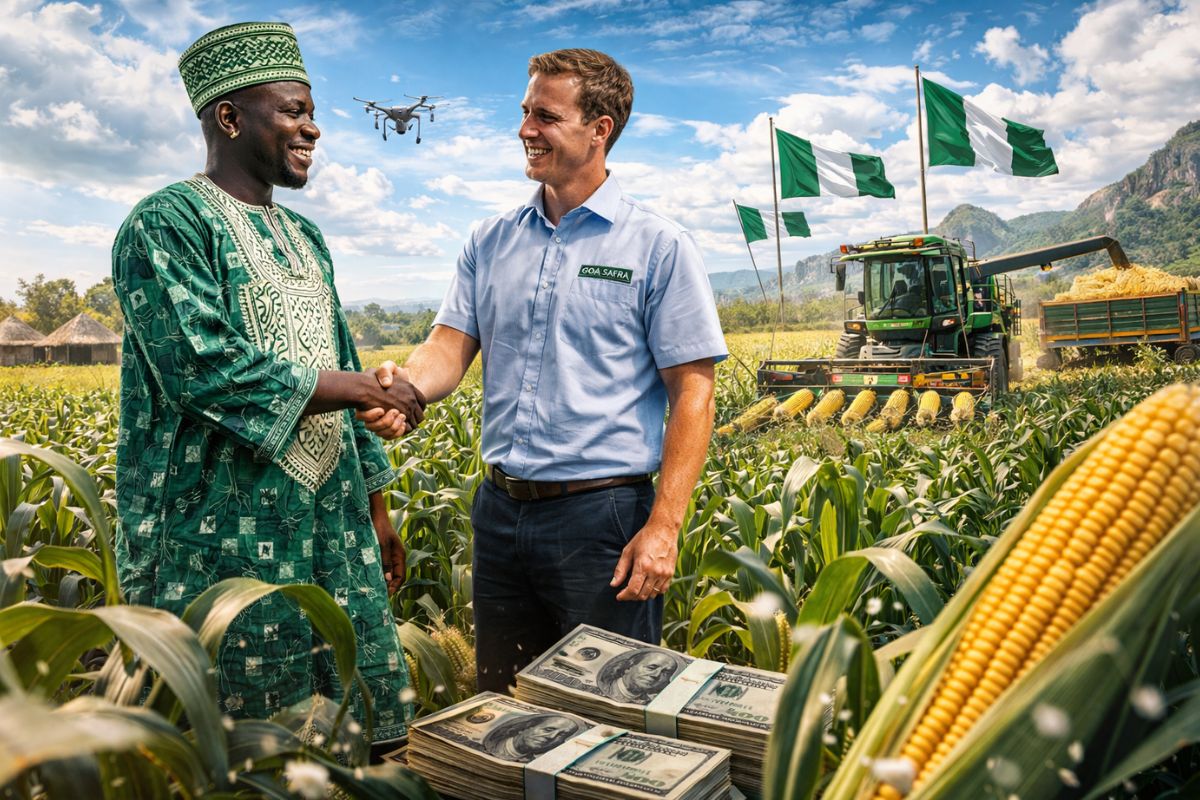
With credit pressuring agriculture in 2026, Boa Safra closes joint venture in Nigeria for corn seed production and aims to grow without capex or working capital.
Credit has become one of the biggest brakes on agriculture in 2026, but Boa Safra chose to respond with expansion and efficiency. The company announced a $10 million joint venture in Nigeria for corn seed production, in a move that combines internationalization with internal cost adjustments.
The strategy arises at a time of pressure in the sector, with agricultural commodities at low levels, smaller margins, and a strong credit restriction. Nevertheless, Boa Safra claims that the project in Africa was designed to advance without requiring heavy capex investment and without consuming working capital.
What the joint venture in Nigeria represents for Boa Safra
According to the company’s CEO, the investment is initial and occurs in partnership with a local company. The design of the agreement is straightforward: it is not a project to immobilize large resources, because Boa Safra mainly brings technical knowledge of seed production.
-
Russia and China already conduct 99% of their trade with each other without using the dollar, and BRICS is creating a digital tool on blockchain so that other countries in the bloc can do the same soon.

-
IBGE’s revision redraws the map of Santa Catarina and changes the borders of 18 municipalities, with Penha gaining a piece of Balneário Piçarras the size of an entire neighborhood without anyone noticing.

-
The Chinese chain that surpassed McDonald’s, Subway, and Starbucks in the number of stores worldwide arrives in Brazil this Saturday with ice cream priced at R$ 3 and a billion-dollar plan to open thousands of units by 2030.

-
Spain launches a 197 million plan to reduce dependence on Europe: 97% of magnesium comes from China; drones and AI will map lithium and neodymium in the Iberian Massif by 2030.

The company was already a leader in soybean seeds in Brazil and has been growing in corn seeds. In this context, Nigeria appears as an opportunity because it combines a large planted area with low productivity, something that opens space for technology and quality improvement.
Why Nigeria became the target and what is the size of the market
Nigeria plants about 6 million hectares of corn, while Brazil plants around 25 million hectares. Corn is described as the main local agricultural product, but the average productivity is low.
The contrast mentioned by the CEO is significant: a corn field in Brazil produces an average of 6 tons per hectare, while in Nigeria, production is around 2 tons per hectare, which represents about one-third.
The central explanation presented is the low quality of seeds, which limits the potential of the field even when there is available area.
The technology brought to Africa and the impact on productivity
Boa Safra’s bet is to bring a package of technology already widespread in Brazil, with an emphasis on hybrid corn, seen as a lever to increase productivity. The understanding is that when the seed changes, productivity can change along with it.
The CEO recalls that Brazil has already experienced a similar scenario, with lower productivity in the past and progress when higher quality seeds gained scale.
Nigeria, in this sense, would be an environment where the productivity leap can reduce food imports and strengthen the local chain, including effects on animal protein production.
How the company’s participation in the business looks

Boa Safra states that it enters with 20% of the business and has triggers that could lead to 40% in the future. The project is described as “end-to-end,” with involvement in industry, planting, seed multiplication, and sales, which reinforces the intention to not be just a technical consultancy.
For the company, it is the first entry into the African continent, which is cited as a region with a large population, potential to grow as a production hub, and at the same time, a strong dependence on food imports.
More expensive credit in Brazil changes the game in 2026
The backdrop of the announcement is the scenario of expensive and difficult credit in Brazilian agriculture. The CEO describes 2026 as a challenging year, with high interest rates, credit restrictions, and pressure on producers, adding high costs and global overproduction that leaves elevated stocks.
At the same time, he indicates an expectation of correction starting in 2027, with adjustments to these stocks. The message is that 2026 still requires efficiency and discipline, especially for companies linked to soy and corn, the two major products mentioned in the Brazilian trade balance.
Diesel, biofuels, and the cost that returns to the sector’s credit
In the final part, the conversation turns to government measures related to energy and transportation costs, a sensitive topic for an agriculture sector that depends on trucks. The view presented is that reducing taxes and improving competitiveness helps, but the sector would like additional actions.
Among the ideas mentioned is to increase the use of biofuels, such as raising the ethanol blend in gasoline and biodiesel in diesel.
The argument is that expanding biofuels can help balance costs, which has an indirect effect on the producer’s cash flow and on the dynamics of credit in a period of high interest rates.
Do you think that, with expensive credit, the best way out for agriculture in 2026 is to seek efficiency within Brazil or to accelerate expansion movements like Boa Safra’s in Nigeria?







Seja o primeiro a reagir!