





 Portuguese
  English
  Spanish
  6 min of reading
  1 comment


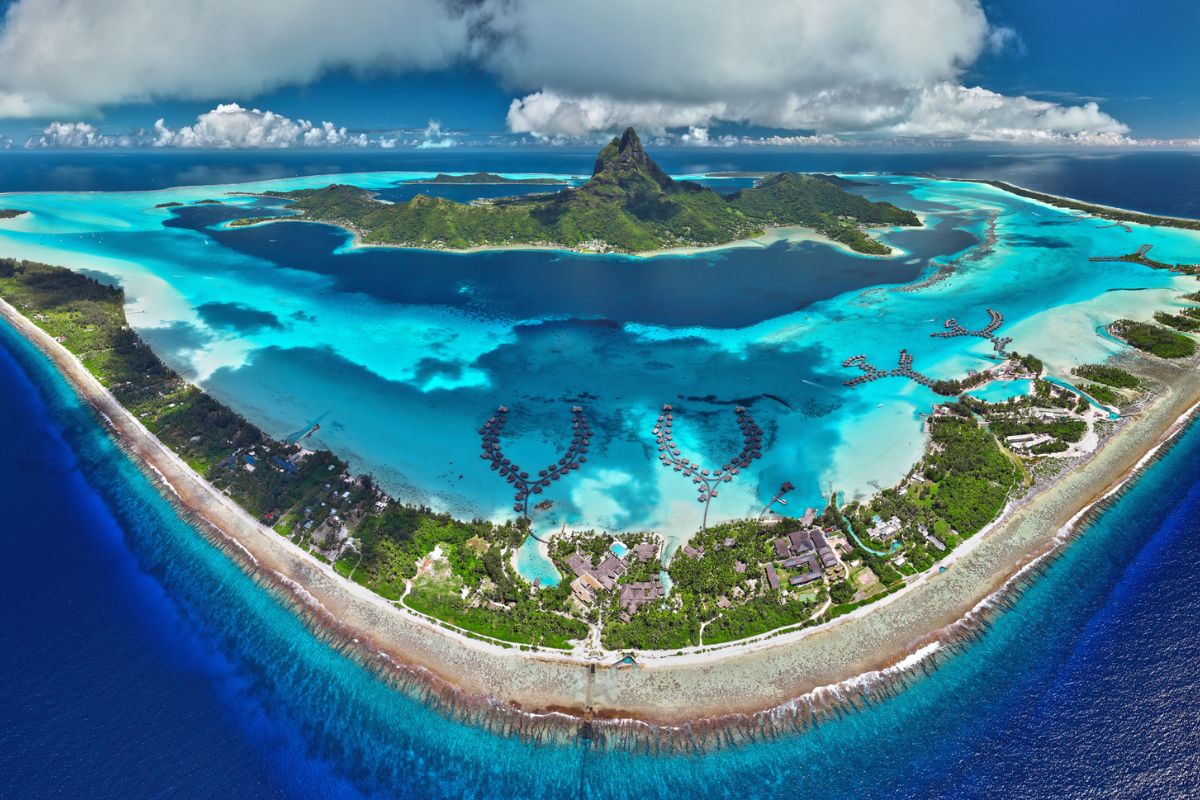


Bora Bora, in French Polynesia, occupies only 30 square kilometers, was born from an ancient volcano, relies on a weekly freighter, desalination, strict waste management, and a growing coral reef to sustain residents, resorts, and infrastructure on an island that continues to sink slowly in the South Pacific every day.
Bora Bora looks like a visual dream in the middle of the South Pacific, but the image of a turquoise lagoon and overwater bungalows hides a physical and human structure much more fragile than the scenery suggests. The island is the remnant of a volcano that emerged about 7 million years ago, occupies just 30 square kilometers, and today relies on a supply chain, sanitation, and transportation to maintain around 10,000 people living in an isolated spot of French Polynesia.
This contrast is what makes Bora Bora unique. Behind the paradise lies a transitioning geology and extreme logistics, with an airport separated by water, minimal agriculture, waste that needs to leave the island, and technical systems that prevent sewage and garbage from destroying the lagoon that sustains the local economy. The place looks simple from afar. Up close, it functions like a delicate mechanism.
The Volcano That Sinks While the Corals Rise
The beauty of Bora Bora comes from a geological process that is far from static.
-
Something is happening around the Earth: Inside the huge explosion of fireballs in 2026

-
A hot air bubble coming from Argentina expands over Brazil, causing thermometers to exceed 38 degrees with a thermal sensation of 40 degrees in late March, affecting 6 states at once.

-
The radish leaf that almost everyone throws away has more polyphenols, flavonoids, and fiber than the consumed root, and a 2025 study showed that the leaf contains compounds that protect the intestine, combat inflammation, and may inhibit the growth of cancer cells.

-
A planet that seemed to defy the laws of physics has intrigued scientists for decades, until the James Webb revealed what is really affecting Saturn’s rotation.

The island emerged when a large volcano pierced the Pacific plate and raised a mountain that, in the past, towered far above sea level.

Over time, however, the tectonic plate moved away from the hot spot that fed this volcano, the structure cooled, and began to give way under its own weight, in a process of subsidence.
At the same time, another force began to act in the opposite direction.
The corals began to grow around the island, rising in search of sunlight as the volcanic core slowly sank.
This race between sinking and growth gives rise to the lagoon, a shallow and protected basin between the old central massif and the coral barrier.
The turquoise water, so associated with the image of Bora Bora, is no miracle: it results from light reflected by the white coral sand on the shallow and clear bottom of the lagoon.
This stage is not permanent. If the process continues for geological time, the central peak will disappear, leaving only a ring of coral sand, an atoll.
Bora Bora is literally in an intermediate phase between mountain and void, which helps explain why its landscape seems so improbable.
What is now seen as a tourist paradise is also a rare moment of transformation in the Pacific.

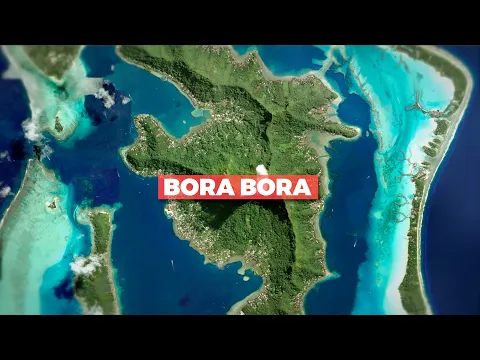
Mount Otomanu, which dominates the current landscape, is precisely the most visible remnant of this old volcano in decline.
The lagoon does not exist despite it, but because of it. And the coral barrier is not just a scenic frame: it is an active part of the mechanism that sustains the shape of the island and protects the shallow waters that have made Bora Bora a global reference for tropical geography.
A Logistics That Starts at the Airport and Ends on the Freighter
If geology explains the appearance, logistics explains the survival. In Bora Bora, the infrastructure is not concentrated in a single continuous strip of land.
Since the main island is carved by volcanic rock and has hardly any flat areas, much is spread across the lagoon.

The airport, for example, is located on a separate sand island, built over the outer reef on an old United States Navy runway constructed in 1943.
This means that arrival already imposes a basic rule: there is no direct land transition between the airport and the rest of life on the island.
Those disembarking need to travel by boat. This detail summarizes the local condition. In Bora Bora, transportation, supply, and service provision depend on water at all times.
The logistics sector is not invisible. It is present from the first moment someone touches the island.
The fragility becomes even more evident in everyday food and consumption. As agriculture is minimal, almost everything comes from outside, from fuel to fresh food.
The supply passes through a single break in the reef deep enough for cargo ships. This creates a clear bottleneck: the weekly freighter coming from Tahiti becomes the most important event on the island’s functional calendar.
When this ship is delayed due to storms or route problems, the effect appears quickly. Shelves empty, choices diminish, and the local stock shows how the visual abundance of Bora Bora depends on a rigid logistics system that is intolerant of failures.
The paradise is not self-sufficient; it is sustained by a narrow, maritime, and vulnerable chain, typical of a remote territory in the Pacific.
Waste, Water, and Sewage Cannot Escape to the Lagoon

The same fragility repeats itself in sanitation and environmental management. On a small island, waste does not disappear just because it leaves the field of vision.
In Bora Bora, this problem is even more sensitive because any toxic leak directly threatens the lagoon, the groundwater, and the island’s main economic base.
For this reason, the municipal system includes door-to-door collection, green waste composting, and technical burial centers designed to prevent contamination.
Part of the waste still needs to leave the island. Materials such as aluminum, glass, and even toxic waste, like batteries, are sent hundreds of kilometers back to Tahiti or even to New Zealand for recycling and treatment.
It is a costly, continuous, and invisible operation to those who only see the overwater bungalows, but essential to prevent the landscape from degrading from within.
Water also requires its own infrastructure. With few sources and limited wells, Bora Bora relies on desalination plants.
Sewage goes through specialized maritime vacuum systems to ensure that the water returned to the environment is completely clean before returning to the lagoon.
Nothing there works due to natural abundance; everything depends on permanent technical control.
This makes the island a kind of laboratory for island survival. The image of purity only remains because there is hidden engineering behind it.
The landscape is sold as spontaneous, but its preservation requires technical discipline. In Bora Bora, beauty does not eliminate plumbing. It depends on it.
The Tourist Paradise and the Real Life of Those Who Live There
Outside the resort circuit, around 10,000 residents primarily live around Vaitape, the island’s main village.
It is in this area that local life tries to balance Polynesian tradition, high costs, and dependence on international tourism.

A visitor can spend in one night the equivalent of what a resident earns in a week, and this difference summarizes the island’s economic tension.
The daily costs weigh heavily because almost everything travels a huge distance to get there.
Essential items travel about 15,000 kilometers from mainland France, pushing the cost of living to a level around 40% higher than in Europe.
Self-sufficiency, therefore, is not a romantic notion in Bora Bora; it is a practical necessity.
Many families maintain activities related to harvesting, handicrafts, and using local materials, while the island’s labor force supports the technical operation of the resorts scattered across the lagoon.
The result is a harsh coexistence between two worlds: that of the global luxury showcase and that of the routine of those who ensure that electricity, water, transport, and maintenance continue to function on the same piece of land.
Still, the cultural backbone has not disappeared. Every July, the island holds the Heiva festival, featuring stone lifting, javelin throwing, and traditional dances.
Before being an international destination, Bora Bora already had language, warrior memory, and community life of its own. Tourism did not create the island; it simply began to compete with it for the same physical and symbolic space.






Bora!