





 Portuguese
  English
  Spanish
  5 min of reading
  1 comment


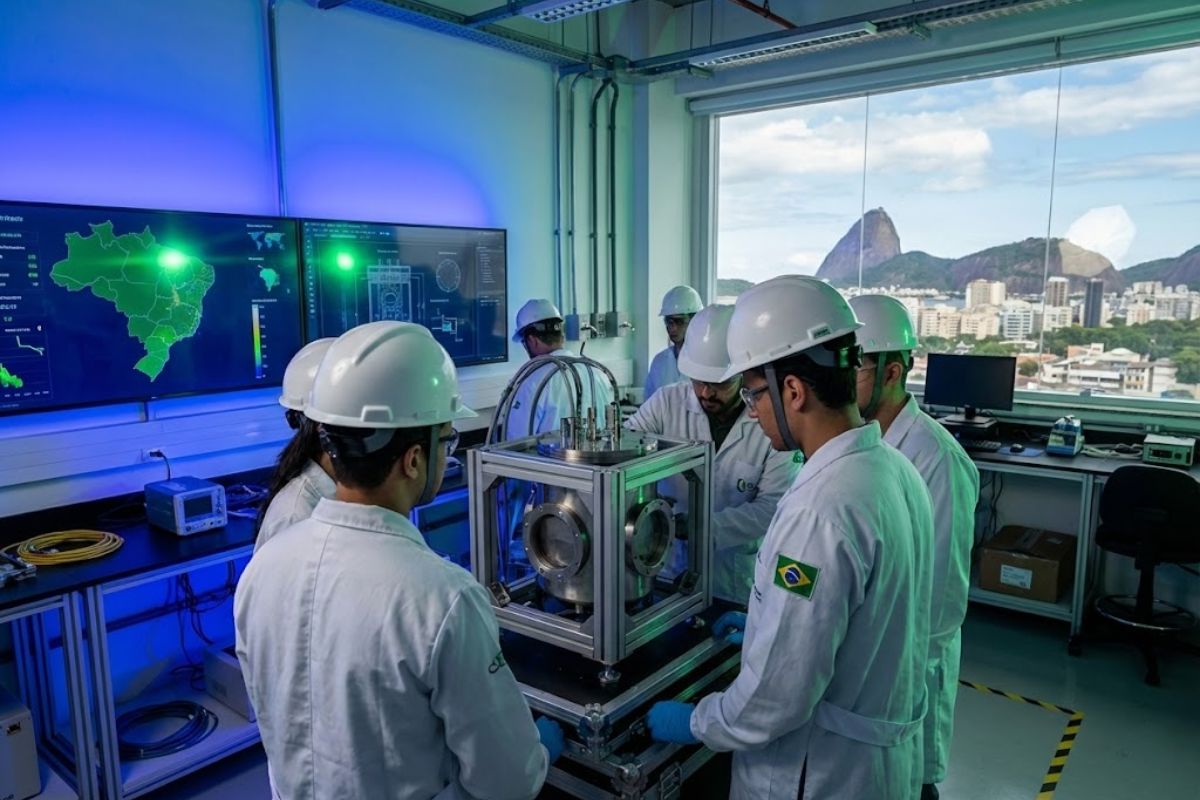


First Critical Unit of Nuclear Microreactors to Be Built at the Nuclear Engineering Institute in Rio, with an Investment of US$ 50 Million and 13 Partners to Test Technology That Could Supply Small Cities, Data Centers, and Isolated Communities Starting in 2033, Reinforcing Clean Energy, Decarbonization, and Electric Security for the Interior
On December 15, 2025, the federal government officially started the process to install, in Rio de Janeiro, the first critical unit of nuclear microreactors in Brazil. Days later, on December 19, 2025, the Ministry of Science, Technology, and Innovation detailed the project, which amounts to US$ 50 million in funding, brings together 13 institutional partners, and places the country among nations developing small modular reactors for low-emission electricity generation.
The plan is for the prototype on Brazilian soil to be ready for operation by 2033, after licensing from the National Commission of Nuclear Energy. The critical unit, installed at the Nuclear Engineering Institute in Rio, will operate at very low power, around 100 watts, sufficient to sustain the chain reaction in a controlled manner and test, in a real environment, solutions that in the future could power electricity grids of small towns and isolated systems in different regions of the country.
Pioneering Critical Unit in Rio de Janeiro

The first phase of the program will be the construction of the critical unit of nuclear microreactors at the Nuclear Engineering Institute, linked to the National Commission of Nuclear Energy (CNEN).
-
The Earth will plunge into a few minutes of darkness in broad daylight in August 2026, when a total solar eclipse transforms the sky into one of the most impressive astronomical phenomena in recent years.

-
How the terraforming of Mars can transform the planet: artificial aerosols can increase the temperature by up to 35°C in 15 years, creating conditions for liquid water.
-
Scientists drilled nearly 8,000 meters into the ocean floor above the fault that caused the 2011 tsunami in Japan and discovered that a layer of clay 130 million years old was responsible for making the wave much worse than any model had predicted.
-
Thousands of years after causing the largest eruption of the Holocene, one of the world’s largest supervolcanoes is rebuilding itself beneath the sea south of Japan, receiving new magma and alarming scientists with its transformation.


This type of installation is used for research, development, and qualification of technology, without yet operating at the level of commercial power.
The structure was designed to operate at very low power, on the scale of 100 W, just enough to maintain the chain nuclear reaction under control and validate safety, operational, and engineering parameters.
From the construction licensing, the official expectation is that the first microreactor will be ready to enter operation by 2033, paving the way for commercial models capable of generating electricity at a scale suitable for small towns and specific industrial units.
How Much Brazil Is Investing in Nuclear Microreactors
The project amounts to US$ 50 million in funding, of which US$ 30 million is provided by the MCTI through Finep, the Funding Agency for Studies and Projects.
The remainder comes from private partners, scientific institutions, universities, and international organizations like the International Atomic Energy Agency.
According to the Ministry, the initiative involves 13 institutional partners, in an arrangement that combines regulatory bodies, research centers, technology companies, and players from the existing nuclear chain in the country.
CNEN coordinates the venture, while the National Traffic Secretariat of the MCTI, Finep, and companies such as Terminus P&D in Energy act in the financial, technical and industrial structuring of the program.
What Brazilian Nuclear Microreactors Will Be Used For
Official documents project that the nuclear microreactors developed in the country will be used to provide electricity to small towns, data centers, offshore oil platforms, military bases and various industrial segments.
These include metallurgy, food industry, chemicals, textiles, and non-metallic mineral products.
The proposal is to offer compact, transportable, and long-lasting modules, capable of ensuring stable supply in places where the expansion of large transmission lines is expensive or unfeasible.
In these applications, the advantage of nuclear energy is its high energy density combined with virtually zero greenhouse gas emissions during operation, reinforcing the agenda of decarbonization and energy security.
Reach in Small Towns and Isolated Communities
According to a survey by the MCTI, around 68% of Brazilian municipalities have potential to receive energy from nuclear microreactors, especially towns with fewer than 20,000 inhabitants.
This represents a direct impact on approximately 30 million citizens who currently depend on fragile networks, isolated diesel systems, or intermittent supply.
Being compact, these reactors can be transported to hard-to-reach areas, such as riverside communities and locations in forested areas.
The logic is to gradually replace fossil fuel-powered generators with nuclear microreactors that have continuous operation and low refueling needs, reducing logistical costs and emissions associated with the constant transportation of diesel or derivatives.
Science, Energy Transition, and Technological Domination
For the Secretary of Science and Technology for Social Development of the MCTI, Inácio Arruda, the installation of the critical unit demonstrates that the country is willing to treat science as a driver of energy policy.
He emphasizes that the active participation of the National Council of Science and Technology reaffirms the bet on high-technological complexity solutions as part of the development strategy for the Brazilian electricity sector.
The director of the Nuclear Engineering Institute, Cristóvão Araripe, highlights that nuclear microreactors can help tackle 21st-century challenges such as decarbonization, energy transition, and sustainable development.
In his assessment, one of the main advantages of nuclear energy is electricity generation without the direct emission of gases that increase the greenhouse effect, reinforcing the role of technology in a global scenario of stricter climate goals.
National Industry and Fuel Cycle as a Differentiator
According to Adolfo Braid, executive director of Terminus P&D in Energy, Brazil has scientific and technological capacity to design, manufacture, and operate nuclear microreactors autonomously, leveraging the accumulated experience in power plants, uranium enrichment, and mastery of the fuel cycle.
He states that having an enterprise of this nature installed in the country means internalizing critical knowledge, which includes everything from project engineering to operating, maintaining, and disposing of fuel.
These factors are seen as essential for the program not to depend exclusively on foreign suppliers, allowing the technology to become a direct benefit for the Brazilian population through reliable energy in areas currently poorly served.
Next Steps Until 2033
The official timeline anticipates, for the coming years, the completion of licensing, the beginning of construction of the critical unit, and the phase of operational testing under CNEN supervision.
Following validation at low power, new stages should define the design of commercial nuclear microreactors, their typical powers, safety standards, business models, and ways of integrating into the energy matrix.
By 2033, the goal is to have at least one microreactor ready for operation in a real environment, paving the way for contracts with municipalities, companies, and strategic bases.
The speed of this expansion will depend on regulatory decisions, social perception of nuclear energy, and financing capacity for projects in remote areas.
Brazil thus enters a decisive testing phase to determine whether nuclear microreactors will be a central or merely complementary piece in the national energy transition.
Given this investment in research, the promise to serve small cities and isolated communities, and the debates on safety and waste, do you believe that nuclear microreactors should play a relevant role in the Brazilian electric matrix starting in 2033, or do you think the country should prioritize other sources of clean energy?








Acho que o país está no caminho,deve sim, investir na produção de microrreatores.Entendo que esta será a solução para as comunidades ribeirinhas e locais de difícil acesso e a partir daí esse tipo de energia se torna a principal fonte do país.